
Microsoft Patents an AI Service That Writes Its Own Coding Instructions
Getting an AI to write good code usually depends on giving it good instructions. Microsoft has filed a patent for a service that automates that step entirely, building tailored prompts from a company's own codebase before the AI ever sees the task.
What Microsoft's custom prompt builder actually does
Every time a software team asks an AI tool to review code, write a test, or fix a bug, someone has to phrase the request carefully or the AI gives a generic, unhelpful answer. That phrasing work is surprisingly time-consuming, and most teams do it over and over without any system behind it.
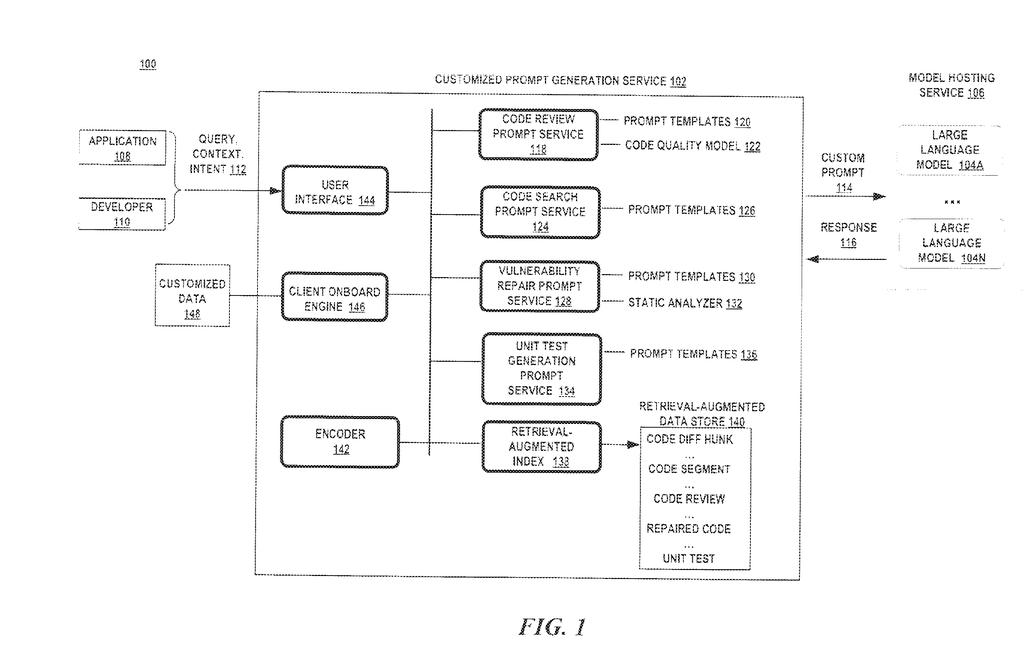
Microsoft's patent describes a service that handles that step automatically. When a developer triggers a coding task, the system pulls up a pre-built template for that specific task type, then fills it in with real examples from the company's own code history: past bug fixes, code reviews, unit tests, and so on. The finished prompt goes straight to the AI model.
The service also checks the AI's output, classifies what kind of result it produced, and uses that classification to pull related code artifacts from a stored database. Think of it as a prep cook who knows your kitchen, not a generic recipe card.
provide a service configured to generate a prompt for a model to perform a software engineering task; receive a request associated with the software engineering task; obtain a prompt template corresponding to the software engineering task; generate a prompt for the model based on the prompt template and data associated with the request; …
Translation: The system automatically builds custom instructions for an AI whenever a user asks it to write or fix code.
How the system picks templates and retrieves code examples
The system acts as a middleware layer between a development team and a large language model (an AI trained on text and code, like GPT-4 or similar). Rather than letting developers craft prompts ad hoc, the service manages a library of prompt templates, one for each supported software engineering task.
When a request comes in, the service:
- Identifies the task type (code review, bug repair, unit test generation, etc.)
- Fetches the matching template
- Populates it with relevant examples pulled from the client's own repository, including code diff hunks (the before-and-after of a code change), source segments, and past review comments
- Sends the assembled prompt to the AI model
After the model responds, the system doesn't just hand the output back. It classifies the output, deciding what category of software artifact was produced. That classification then drives a second lookup: retrieving candidate artifacts from a retrieval-augmented data store (a searchable database that the system queries based on semantic meaning, not just keywords) to support further modification, analysis, or generation.
The client data stays separate per organization, so the examples baked into each prompt reflect that company's coding style and history, not a generic training set.
The service stores the custom data of a client that includes code diff hunks, source code segments, code reviews, repaired code, and unit tests from a code base or repository of the client.
Translation: It learns from a company's existing code history, past bug fixes, and tests to understand their specific projects.
What this means for teams using AI coding assistants
For software teams using AI coding tools today, prompt quality is a constant bottleneck. A vague or generic prompt produces vague or generic code suggestions. This system moves prompt-crafting from an individual skill into a repeatable, organization-specific process, which could make AI coding tools noticeably more consistent across a team.
Microsoft's run of AI-assisted development filings points to a sustained push to embed these capabilities into tools like GitHub Copilot. If this approach ships, the difference for your team could be an AI assistant that already knows your codebase conventions without anyone having to explain them each time.
Microsoft's 58th filing in the Language AI patents we've tracked since May follows a combined reading and writing model and a prompt interpretation visualizer.
Building every request to the AI around a fixed script buys consistency but sacrifices the ability to handle unusual problems well. A template tuned for routine code review will handle a strange, one-off bug clumsily, and the system has no obvious way to recognize when it is out of its depth.
The more consequential cost comes from the feedback loop, where the AI's own answer triggers a follow-up action. That loop depends entirely on a classification step working reliably, and the document says little about how often that step gets it wrong. A misfire there compounds the mistake rather than catching it.
For large organizations where dozens of engineers might otherwise ask the AI the same questions in dozens of inconsistent ways, trading flexibility for discipline is probably the right call. Unpredictable answers at scale are worse than occasionally clumsy ones, and that trade reads as worth it.
There are more where this came from
We read every patent application Big Tech publishes and send you the ones worth knowing. Plain English, free, every week.
The drawings
11 drawing sheets from US 2026/0278303 A1 · click any drawing to enlarge


Want this weekly breakdown for a company we don't cover? Patentlyze Pro →