
Google Patents an AI System That Watches Your Network for Problems in Real Time
Google has filed a patent for a system that uses AI to automatically spot problems on a computer network, turning what is normally a slow, manual process into something that happens on its own, in the background.
What Google's AI network watchdog actually does
You're the IT manager at a mid-sized company and something is wrong on your network. Traffic is routing oddly, a server is behaving strangely, but nothing has crashed yet and no alarm has fired. Right now, catching that takes a human who knows exactly where to look.
Google's patent describes a system that does that watching automatically. It builds a kind of moving map of your network, tracking how devices and connections relate to each other over time. An AI model then reads that map and flags anything that looks out of place, pushing an alert to a dashboard so someone can investigate.
The goal is to catch network anomalies earlier and with less manual effort. Instead of waiting for something to break, the system is designed to notice when behavior starts drifting in a suspicious direction.
construct one or more temporal network graphs representative of the network; identify, using a graph neural network (GNN), one or more anomalies within the network based on the one or more temporal network graphs; and output the one or more anomalies to a frontend interface.
Translation: It builds maps of network activity over time, uses AI to spot unusual behavior, and displays the alerts on a screen.
How the graph neural network flags network anomalies
The system works in three stages.
- Build a temporal network graph: The system creates a mathematical map of the network that captures not just which devices are connected, but how those connections change over time. Think of it like a time-lapse diagram of your office's internal internet.
- Run a graph neural network (GNN): A GNN is a type of AI model designed specifically to analyze relationship data, meaning it can read a network map and understand patterns in how devices talk to each other. It then compares current behavior against learned baselines to spot anything unusual.
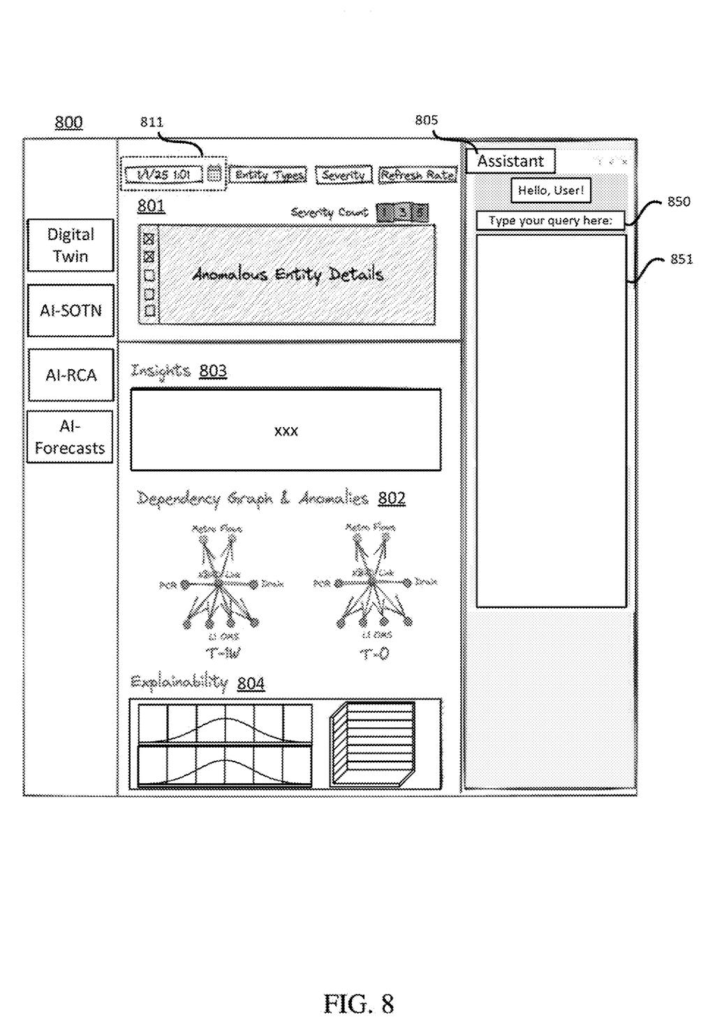
- Surface anomalies on a frontend interface: Whatever the AI flags gets pushed to a human-readable dashboard, so an engineer or IT administrator can review and act.
The patent's core claim is that representing the network as a time-aware graph, rather than a simple snapshot, gives the AI enough context to catch subtle, slow-moving problems that a point-in-time check would miss.
The technology is directed to systems, methods, and computer-readable mediums for identifying anomalies on a network. One or more temporal network graphs representative of the network may be constructed.
Translation: This patent covers software that maps out a network to catch unexpected problems as they happen.
What this means for IT teams and cloud reliability
For anyone running infrastructure at scale, whether that's a corporate IT department or a cloud provider, catching anomalies early is the difference between a five-minute fix and a hours-long outage. An automated system that watches continuously and surfaces problems before they escalate has obvious value for teams that can't afford eyes on every dashboard at all hours.
Google's interest in AI-driven network management fits naturally into its cloud and infrastructure business. If this kind of detection were baked into Google Cloud or enterprise networking products, it could make those platforms more appealing to customers who currently rely on expensive third-party monitoring tools.
Google has filed its 39th application we've tracked since May in our AI agents acting for you watchlist, building on work like running app tasks hands-free and pulling action items from meetings.
Google is patenting a system that watches a computer network the way a doctor reads an EKG, using AI to spot unusual patterns before they become real problems. Nothing here requires new physical equipment, just software trained to recognize when network behavior drifts from normal.
The shortest path to a real product is straightforward: build the training data, teach the AI what "normal" looks like, and pipe the alerts into an existing dashboard. All the underlying pieces already exist in Google's infrastructure.
The patent is written broadly by design, which means it claims the general idea rather than a finished tool. Whether this ever reaches users depends entirely on how well the AI actually performs on real networks, and no patent can tell us that.
There are more where this came from
We read every patent application Big Tech publishes and send you the ones worth knowing. Plain English, free, every week.
The drawings
13 drawing sheets from US 2026/0277728 A1 · click any drawing to enlarge


Want this weekly breakdown for a company we don't cover? Patentlyze Pro →