
Salesforce Files Patent to Let AI Take Over Robots a Human Already Taught
Salesforce's patent application takes the lesson a worker teaches a robot with a joystick and turns it into an AI agent that runs the robot from then on.
What Salesforce's robot-training patent does
Ever walked a new hire through a routine job, like checking a pressure gauge, and then had to stay close to make sure it got done right every time? Warehouse robots have a version of this problem. Someone drives the robot along its route with a tablet and a joystick, and the robot saves that lesson.
Salesforce's patent application describes what happens next. The saved lesson is uploaded to Salesforce's cloud software and broken into individual steps. An AI agent (a program that can decide on and carry out tasks by itself) is then created for that robot, built from those steps. The agent writes the instructions the robot needs and sends them back.
The robot also gets a record in the company's customer database, like any other piece of equipment, so other business tools can find it and send it work.
… an orchestration and planning service configured to instantiate and execute one or more agent instances associated with the remote robot management system, wherein executing one or more agent instances comprises determining one or more actions of the plurality of actions to generate command information for the remote robot management system to perform the one or more actions.
Translation: The system uses an AI planner to figure out what the robot should do next and sends it new commands.
How a joystick lesson becomes an AI agent
The filing starts with training records a facility already has. When someone guides a robot through a "mission" (say, driving to a gauge, snapping a photo, and returning to base), the robot stores it as a "walk" file, usually in JSON or XML (plain-text formats for organized data). Those files are uploaded to a database in Salesforce's cloud environment.
From there, the system works in steps:
- Extract: it reads the file and pulls out each trained operation.
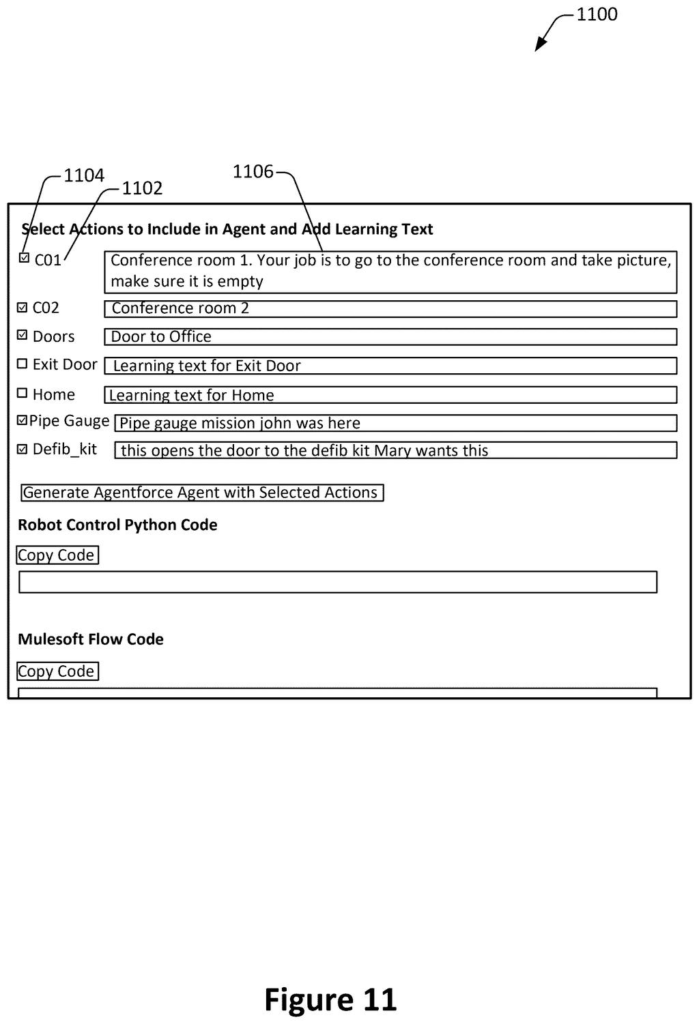
- Map: it matches each operation to an action an agent can take, using a stored mapping or text a person types in, which a language model helps interpret.
- Create: it sets up an agent for that robot and registers the robot as an asset record in the customer database.
- Command: the agent, guided by a generative language model (the same kind of AI behind chatbots), picks actions and writes code in the robot's own format, often Python, usually by filling in templates.
The agent also writes the connection details (endpoints, meaning addresses) so the robot can upload photos to the right place. Other business tools can plug in as well. In one example, a robot's temperature reading climbs too high, a workflow notices, and the agent sends the robot to a repair bay. A chat-style history lets a person watch what the agent did and step in.
Why warehouse robots may need less babysitting
If you run a warehouse, hotel or office building, the practical promise is fewer trips by a technician every time a robot needs a new job or a fix. The training a worker already did becomes the raw material, and software handles the code and the connections to your other business systems.
For Salesforce, the bigger idea is treating a robot as one more entry in its customer database. The description names Agentforce, Slack and Flow Builder, so the robot would plug into products the company already sells. For the rest of us, the effect would be indirect: the filing mentions cleaning and maintenance work in hotels and offices, so you might notice it as faster equipment checks or tidier hallways.
Salesforce's 25th filing we've tracked on our AI agents that act for you watchlist since May builds on one warning users about task timing and one teaching AI to hold conversations.
This filing sits close to a product, since it needs no new hardware. Everything described is software: a database, an AI model, templates, and code the agent sends to robots that already exist and already save their training in files.
The first thing that has to exist is cooperation from the robot side. The agent writes code in each robot's own format, and the description says that code reaches the robot automatically or with a person on site helping. Robots store training in their own native formats, so each one needs its own translation rules, and that is slow work.
The shortest route to a product is a connector for one popular robot type, with a person approving every command at first. The filing includes a chat history built for exactly this supervision. The open question is how much a business will trust an AI model to write commands for a machine moving around a workplace, and the document offers no test results to answer it.
Get our take in your Top Stories
Liked this breakdown? Add Patentlyze as a preferred source on Google, and our plain-English take shows up more often in your Top Stories the next time Salesforce patent news breaks.
There are more where this came from
We read every patent application Big Tech publishes and send you the ones worth knowing. Plain English, free, every week.
The drawings
25 drawing sheets from US 2026/0319488 A1 · click any drawing to enlarge


Show the other 17 sheets


Want this weekly breakdown for a company we don't cover? Patentlyze Pro →
Be the first to weigh in