
Google Files Patent for a Layer That Gives Text Chatbots Voice Capability
Thousands of text-based chatbots exist, but none of them can hold a real voice conversation. Google's latest patent describes a plug-in layer that changes that, without touching the chatbot itself.
What Google's voice wrapper actually does to a chatbot
Imagine you have a customer service chatbot that only knows how to read and write text. You'd like it to talk to customers out loud, but rebuilding it from scratch would take months. Google's patent describes a kind of "voice jacket" you can slip over an existing text chatbot, giving it ears and a mouth without changing anything under the hood.
The wrapper listens to what you say, turns your words into text, cleans them up if needed, feeds them to the chatbot, then takes the chatbot's written answer and reads it back to you. The chatbot itself never knows a voice conversation happened. It just sees text going in and sends text back out.
The system also has tricks to hide the delay between your question and the answer, so the conversation feels more natural rather than like you're waiting for a slow printer.
How the wrapper converts speech, routes, and cleans output
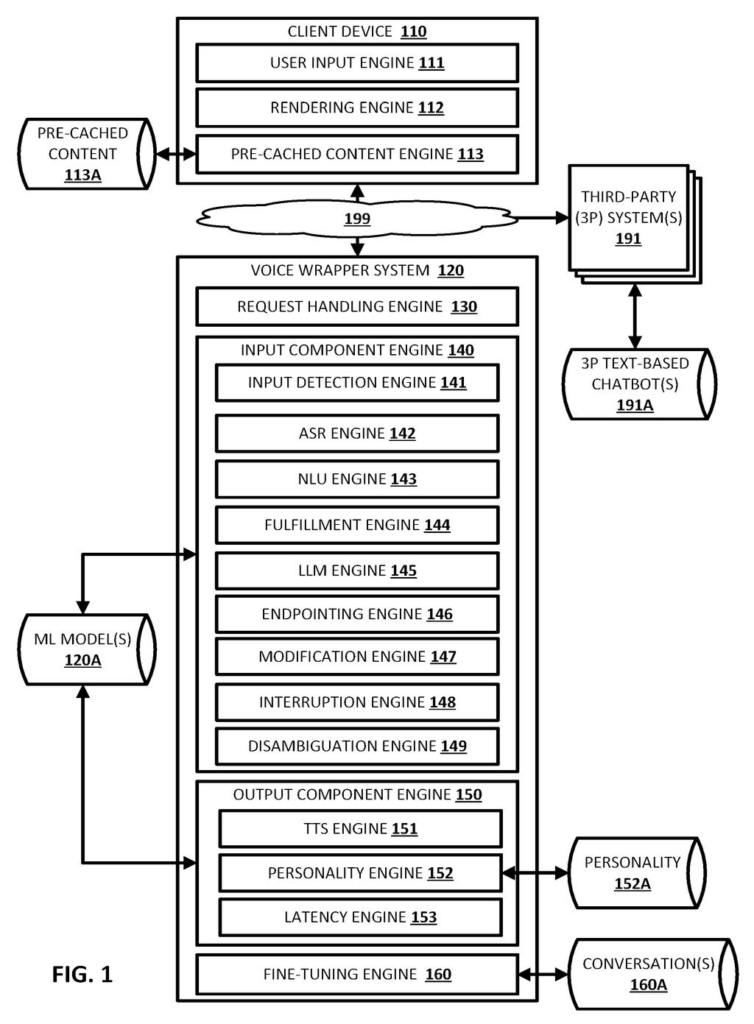
The patent describes a voice wrapper: a modular software layer that sits between a user's microphone and an existing, unmodified third-party text chatbot.
Here's what happens in a single turn of conversation:
- An automatic speech recognition (ASR) component converts the user's spoken words into text.
- A natural language understanding (NLU) component interprets that text to figure out what the user actually meant.
- A modification component can rewrite the transcribed text before sending it to the chatbot, for example stripping out filler words, reformatting questions, or expanding voice-only shorthand that a text chatbot might misread.
- The chatbot's text response is then converted back to speech by a text-to-speech (TTS) output component and played aloud on the user's device.
Critically, the wrapper can also decide to bypass the chatbot entirely for certain inputs, answering simple spoken questions itself without ever querying the third-party service. That shortcut is one of the main ways the system reduces perceived response delay (the gap between asking a question and hearing an answer).
The architecture is explicitly designed to be controlled by a first-party entity (Google, in this context) and applied to chatbots managed by third parties, meaning outside developers and companies.
What this means for third-party chatbots on Google platforms
For developers, this is a significant shortcut. Building a voice interface from scratch requires deep work on speech recognition, intent modeling, and audio output, all of which this wrapper handles as a drop-in service. If Google offers this through a platform like Google Assistant or Dialogflow, a company could make any existing chatbot voice-ready in a fraction of the usual time.
For you as a user, it means the chatbot on a retailer's website, a bank's app, or a healthcare portal could start answering your spoken questions without those companies rebuilding their software. The flip side is that Google would sit as an intermediary layer between you and the third-party chatbot, routing everything through its own infrastructure.
This is a real infrastructure bet, not a flashy consumer demo. Google is positioning itself as the voice-enablement layer for the broader chatbot ecosystem, which is a logical move given its speech recognition capabilities. Whether third-party companies are comfortable with Google sitting in the middle of their customer conversations is the more interesting question the patent doesn't answer.
There are more where this came from
We read every patent application Big Tech publishes and send you the ones worth knowing. Plain English, free, every week.
The drawings
7 drawing sheets from US 2026/0222373 A1 · click any drawing to enlarge


Want this weekly breakdown for a company we don't cover? Patentlyze Pro →
Be the first to weigh in