
Google Patents a Direction-Aware Touchpad That Only Powers the Sensors You're About to Touch
Most touchpads waste power keeping every sensor awake, even the ones your finger will never reach. Google's new patent describes a smarter approach: predict where a touch is going, then only power the sensors that are actually in the way.
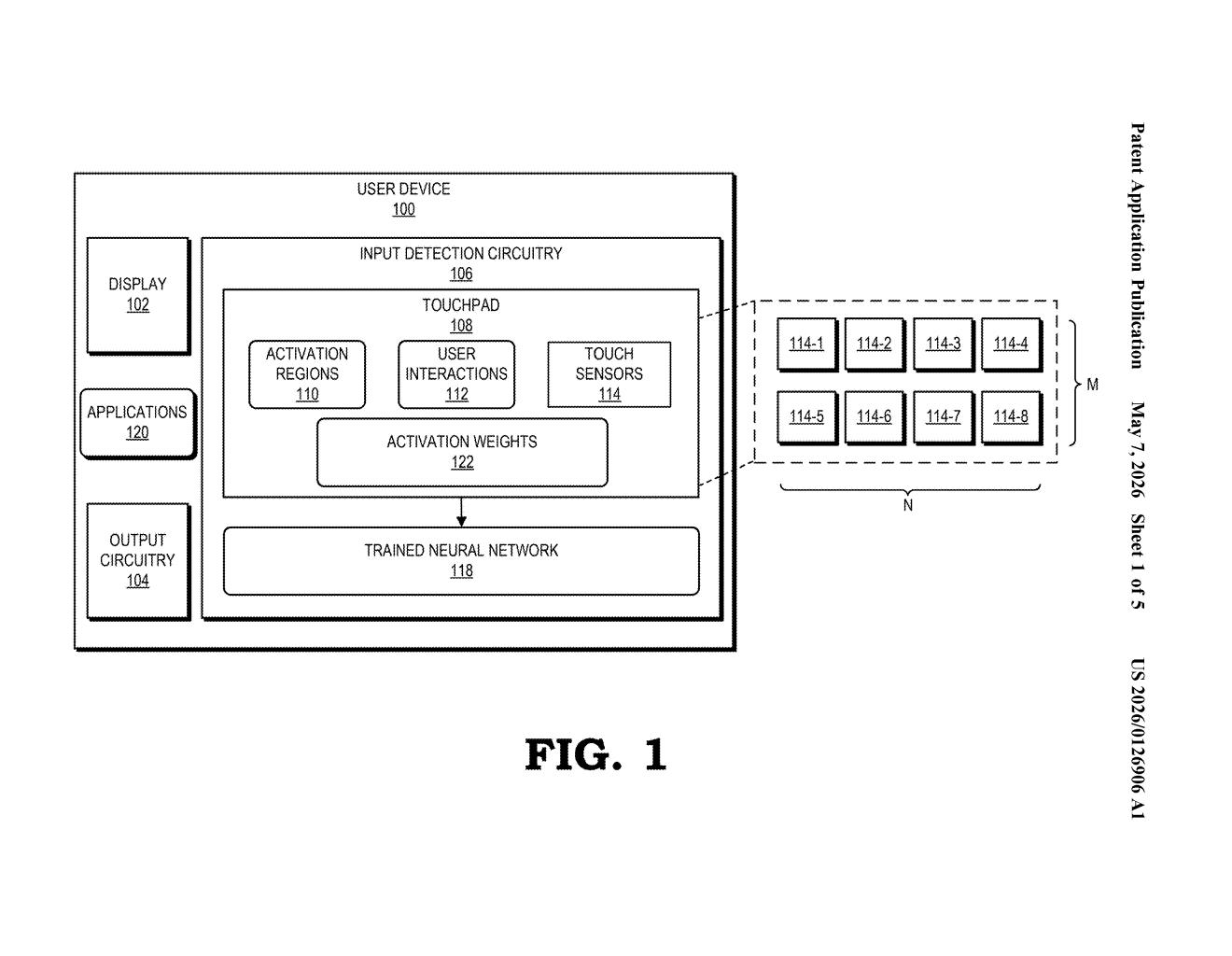
How Google's touchpad guesses where your finger is headed
Imagine dragging your finger across a touchpad — the sensors lighting up behind your finger are useless at that point, and the ones far ahead probably won't be touched either. But right now, most touchpads just keep all of them running all the time, burning battery whether they're needed or not.
Google's patent describes a system that watches where your finger lands and which direction it's moving, then divides the touchpad into zones. Sensors directly ahead get full power; sensors farther out get less; sensors in the opposite direction get very little or none at all.
The whole thing is tuned for extended reality (XR) devices — think AR glasses or VR controllers — where battery life is precious and even small efficiency wins add up fast. Instead of one big dumb grid of always-on sensors, you get a living, shifting map of probability that follows your hand.
How activation weights and regions slice up the touchpad grid
When a touch event lands on the touchpad, the system calculates both the location and the direction of travel of that interaction. It then draws a set of activation regions — essentially concentric or directional zones radiating outward from that point in the direction the finger is moving.
Each region is assigned an activation weight (a probability value). Regions closer to the current touch and aligned with the direction of movement get higher weights; regions farther away, or behind the finger, get progressively lower weights. Individual sensors within each region are then powered up or kept off based on their region's weight — a probabilistic decision rather than a binary on/off.
The output of whichever sensors do get powered feeds directly into XR application control signals — meaning the touchpad is specifically framed here as an input device for extended reality environments, where it might control cursor movement, object manipulation, or navigation inside a headset.
On first use (before any interaction has happened), every sensor defaults to a baseline probability so nothing is missed. After that first touch, the system shifts into its predictive mode and starts making smart power decisions in real time.
What smarter sensor power means for XR headsets and wearables
Battery life is the single biggest constraint on XR hardware right now. A touchpad that cuts power to sensors it doesn't expect to be used — and adjusts that prediction 60 times a second as your finger moves — could meaningfully extend session time on something like a standalone headset or an AR wristband without changing the battery at all.
This also hints at Google's XR input strategy: rather than relying solely on hand-tracking cameras or voice, a compact physical touchpad with smart power management could be a viable low-latency input surface. If you've been watching the race between Apple Vision Pro's eye/hand tracking and more tactile input approaches, this patent is a data point worth noting.
This is a genuinely clever piece of systems engineering — not a flashy AI feature, but the kind of tight power-optimization work that actually ships and makes a real difference in wearable products. The explicit XR framing in the claims is the most telling detail; Google isn't filing this for laptop trackpads, they're filing it for something strapped to your face or wrist.
There are more where this came from
We read every patent application Big Tech publishes and send you the ones worth knowing. Plain English, free, every week.
Want this weekly breakdown for a company we don't cover? Patentlyze Pro →