
Nvidia Patent Hides 360-Degree Camera Stitching Glitches Through Smart Spatial Masking
When a car's surround-view camera system reshuffles how it blends images together, the result can be a jarring visual pop on screen. Nvidia's new patent describes a way to hide that pop before the driver ever notices it.
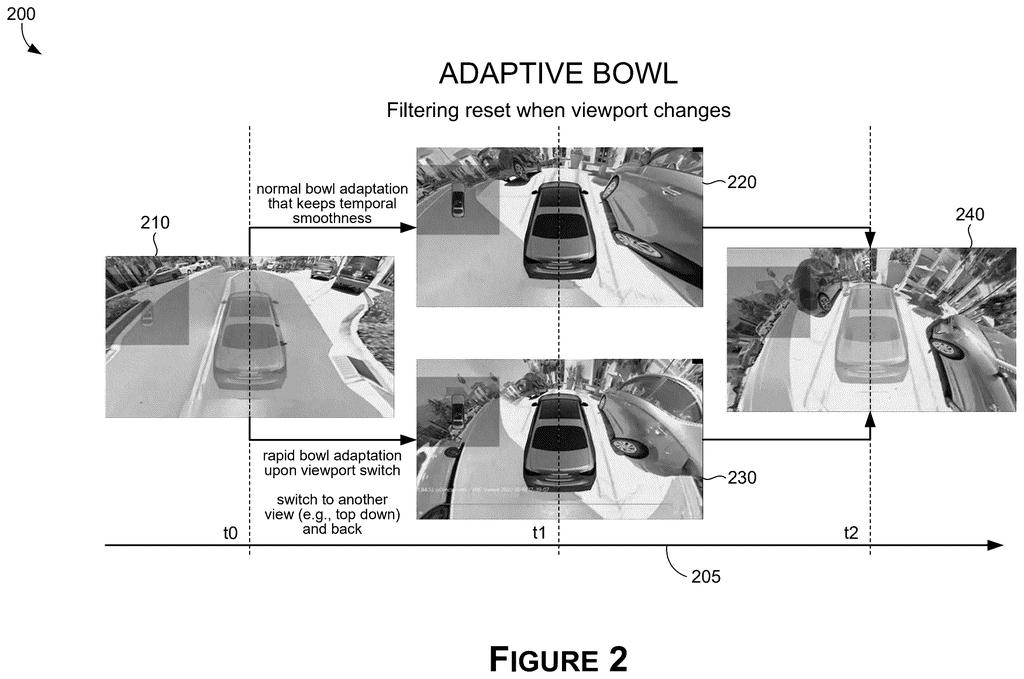
How Nvidia masks surround-view camera stitch jumps
Imagine the backup camera on a car, but expanded to show a full 360-degree bird's-eye view stitched together from four or more cameras. That stitching process has to decide where each camera's image ends and the next one begins. When a pedestrian or another car crosses one of those invisible boundary lines, the system sometimes has to shift the boundary, and that shift can look like a sudden visual jump on the display.
Nvidia's patent describes a way to hide those jumps. The system watches for moments when a big visual update is about to happen, and then deliberately switches your view to a slightly different camera angle at the exact same moment. The camera angle change acts as a distraction, masking the underlying stitch adjustment the same way a film editor cuts away before a special effect becomes obvious.
The system can even predict when a big adjustment is coming and prepare the cover-up in advance, choosing from a catalog of pre-approved camera angles for the current scene.
How the viewport switch times itself to the seam update
The patent centers on two things the surround-view system is constantly recalculating:
- Dynamic seam placement: The invisible boundary line where two camera feeds are blended together. It shifts based on where objects are detected around the car, so the seam avoids cutting through a person or a vehicle.
- 3D bowl model: A curved virtual surface (shaped like an upside-down bowl) onto which all camera images are projected to create the unified overhead view. Its shape changes based on measured distances to nearby objects.
When either of these changes by more than a set threshold, the patent's system triggers a viewport switch, swapping to a slightly different viewing angle stored in a "scene catalog." That camera angle change happens at the same instant as the seam or bowl update, so the viewer's eye is naturally drawn to the camera movement rather than to the underlying data shift.
The system can also work in two modes: predictive, where it anticipates a large change a few frames ahead and schedules the mask in advance, or reactive, where it detects a change between the current and previous frame and responds immediately. Either way, temporal filtering (the technique that normally smooths frame-to-frame changes over time) can be relaxed or turned off during the switch, allowing the correction to settle faster without visual smearing.
What this means for in-car surround-view displays
Surround-view displays are now common on trucks, SUVs, and increasingly on vehicles with driver-assist systems. The visual quality of these displays directly affects how much drivers trust and use them. A system that silently cleans up its own artifacts without flashing or stuttering on screen is a meaningful quality-of-life improvement for anyone who parks a large vehicle by camera.
For Nvidia specifically, this fits squarely into its DRIVE automotive computing platform, which powers surround-view processing on vehicles from several automakers. A patent like this suggests Nvidia is working on making that output look polished enough that drivers stop thinking of it as a tech demo and start relying on it.
This is a genuinely practical patent. It solves a real, visible annoyance in a product category that is already shipping in millions of cars. The masking approach is clever because it exploits how human vision works, using a deliberate camera cut to hide a computational seam, rather than trying to suppress the artifact computationally after the fact.
There are more where this came from
We read every patent application Big Tech publishes and send you the ones worth knowing. Plain English, free, every week.
The drawings
15 drawing sheets from US 2026/0212596 A1 · click any drawing to enlarge


Want this weekly breakdown for a company we don't cover? Patentlyze Pro →
Be the first to weigh in