
Google Patent Details AI That Responds Before You Finish Speaking
What if your voice assistant didn't wait for you to stop speaking before it started thinking? Google has filed a patent for exactly that: a system that begins generating a response while you're still mid-sentence.
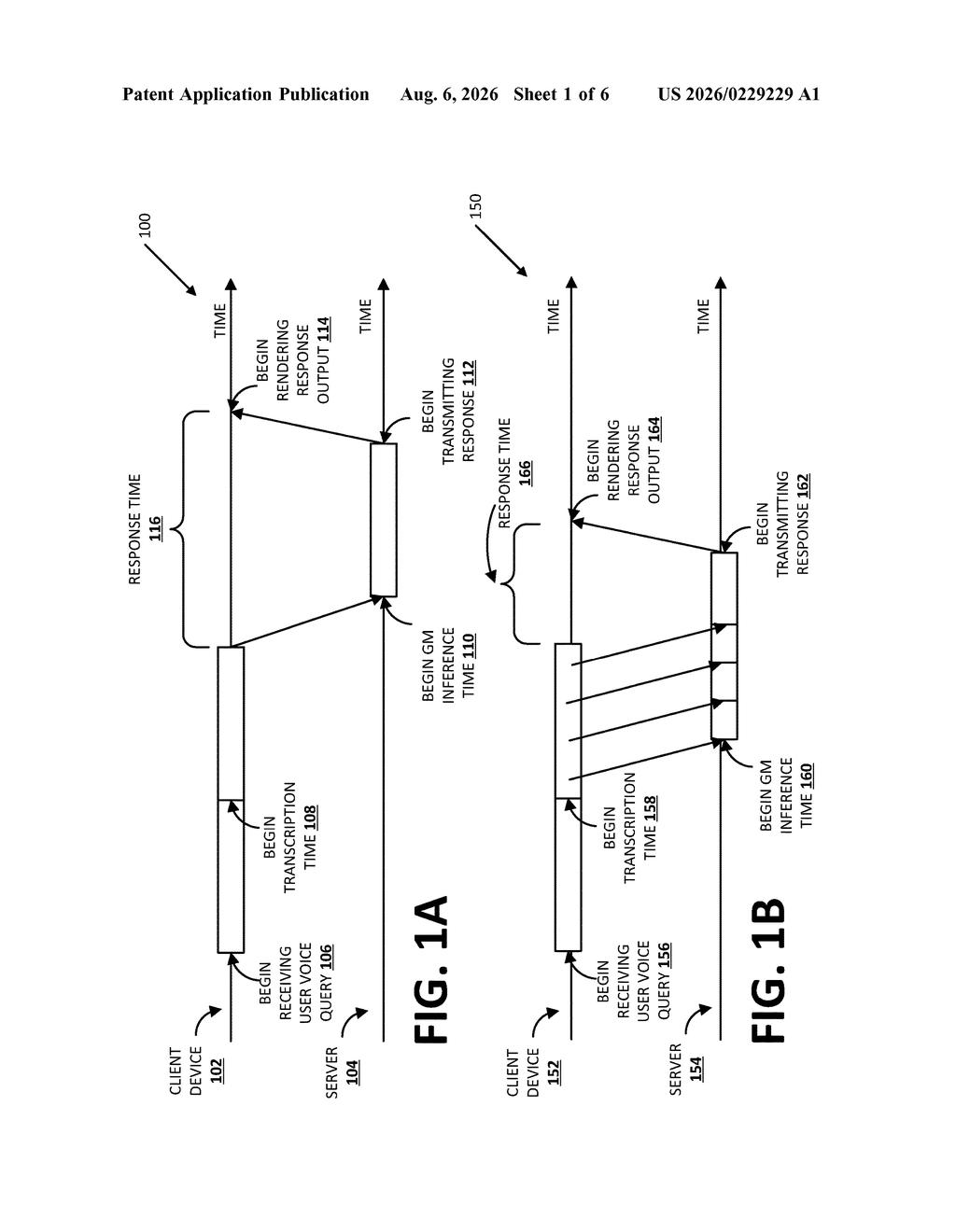
How Google's voice assistant jumps the gun (helpfully)
Imagine asking a friend a question and they start formulating their answer before you've even finished your sentence. That's essentially what Google is trying to teach its AI voice assistant to do.
Right now, when you ask your phone or smart speaker a question, it waits for you to stop talking, converts your speech to text, sends that text to a server, and only then starts working on a reply. Each of those steps adds delay. Google's patent describes a way to skip much of that waiting by sending pieces of your question to Google's servers as you speak, so the AI can start working on an answer in real time.
The result: by the time you say your last word, the system may already have part of its response ready to deliver. For voice assistants, where a two-second pause can feel like an eternity, that's a real improvement to everyday use.
… receiving, via the persistent bidirectional network connection, a sequence of instances of user query data representing a user voice query, wherein one or more instances of the sequence are received at the server computing system before the user voice query is completely captured at the remote client device …
Translation: The server starts getting your spoken words before you even finish talking.
How the server streams tokens before the query ends
The patent describes a pipeline with three key changes over conventional voice query handling:
- Streaming speech recognition: Instead of waiting for a complete audio recording, the client device (your phone, speaker, etc.) converts your spoken words into text tokens incrementally and sends them to Google's servers as they're generated.
- Persistent bidirectional connection: The client and server maintain an open two-way channel (think of it like a phone call that stays connected rather than sending individual text messages) so data can flow both directions continuously without setup overhead each time.
- Server-side streaming generation: Google's generative AI model on the server uses a technique called streaming multi-head attention (a way for AI to weigh earlier words against new ones as they arrive, rather than waiting for the full sentence) to produce response text incrementally. A buffer caches the incoming query tokens and previously computed context so the model doesn't have to restart from scratch with each new word fragment.
The server then transmits pieces of its response back to the device as they're produced, so the device can begin rendering the answer even before the AI has finished generating all of it. The patent frames the central goal as reducing end-to-end latency, meaning the total time from when you start speaking to when you hear or see a reply.
… the time between the user speaking the user query and the client device rendering the responsive output is reduced, thus decreasing latency in the system …
Translation: This method cuts down the awkward silence before your voice assistant replies.
What this means for voice assistants on your devices
Voice assistants have a perception problem: people find even modest delays frustrating, and that friction discourages use. If Google can shave a second or two off every query by overlapping speech recognition, network transmission, and AI generation, the experience starts to feel closer to talking to a person than talking to a machine. That's a meaningful difference for products like Google Assistant, Gemini, and smart speakers.
There's also a competitive angle. OpenAI demonstrated real-time conversational AI with GPT-4o, and Apple has been working on faster on-device inference. This patent signals Google is specifically focused on the server-side piece of the latency puzzle, suggesting the company sees cloud-connected voice interaction as a priority rather than betting entirely on on-device processing.
This is a solid, practical engineering patent rather than a flashy AI concept. Cutting voice assistant response time through overlapping pipeline stages is the kind of unglamorous work that actually makes products feel better. It's worth watching because latency is one of the few remaining reasons people still find voice assistants annoying.
There are more where this came from
We read every patent application Big Tech publishes and send you the ones worth knowing. Plain English, free, every week.
The drawings
6 drawing sheets from US 2026/0229229 A1 · click any drawing to enlarge


Want this weekly breakdown for a company we don't cover? Patentlyze Pro →
Be the first to weigh in