
Qualcomm Patent Defines Fixed Virtual Cells as 5G Satellite Registration Zones
Your phone already knows where you are via GPS. Qualcomm wants to use that location to connect you to a 5G network through a satellite, even when you're hundreds of miles from the nearest cell tower.
How Qualcomm's satellite 'virtual cells' would work for you
Imagine you're on a cargo ship in the middle of the Pacific Ocean, nowhere near a cell tower. Today, you either have no signal or rely on clunky satellite phone hardware. Qualcomm's patent describes a way for a regular 5G device to connect through a satellite by pretending the sky above you is divided into fixed, map-like zones called virtual cells.
Here's the clever part: your phone already knows its GPS coordinates. This system uses that position to figure out which virtual zone you're in, then signs you onto the appropriate mobile network, just as if you'd walked into a normal coverage area. The whole handshake happens through a satellite overhead, not a ground tower.
Because these virtual zones have defined borders, the system can also handle things like emergency calls and local alert messages based on your actual country or region. So even at sea or in a remote desert, a 5G phone could receive a national emergency alert or place an emergency call through the correct local network.
obtaining information that defines each of one or more virtual cells or virtual tracking areas or both as a respective fixed geographic area located within wireless coverage of the first satellite and associated with one or more public land mobile networks (PLMNs) …
Translation: The device receives details about fixed geographic zones covered by the satellite and tied to specific mobile networks.
How the UE determines its virtual cell from GPS position
The patent describes an architecture for connecting a phone (called a UE, or user equipment, in wireless engineering) to a 5G core network via satellite when no ground-based cell tower is within reach.
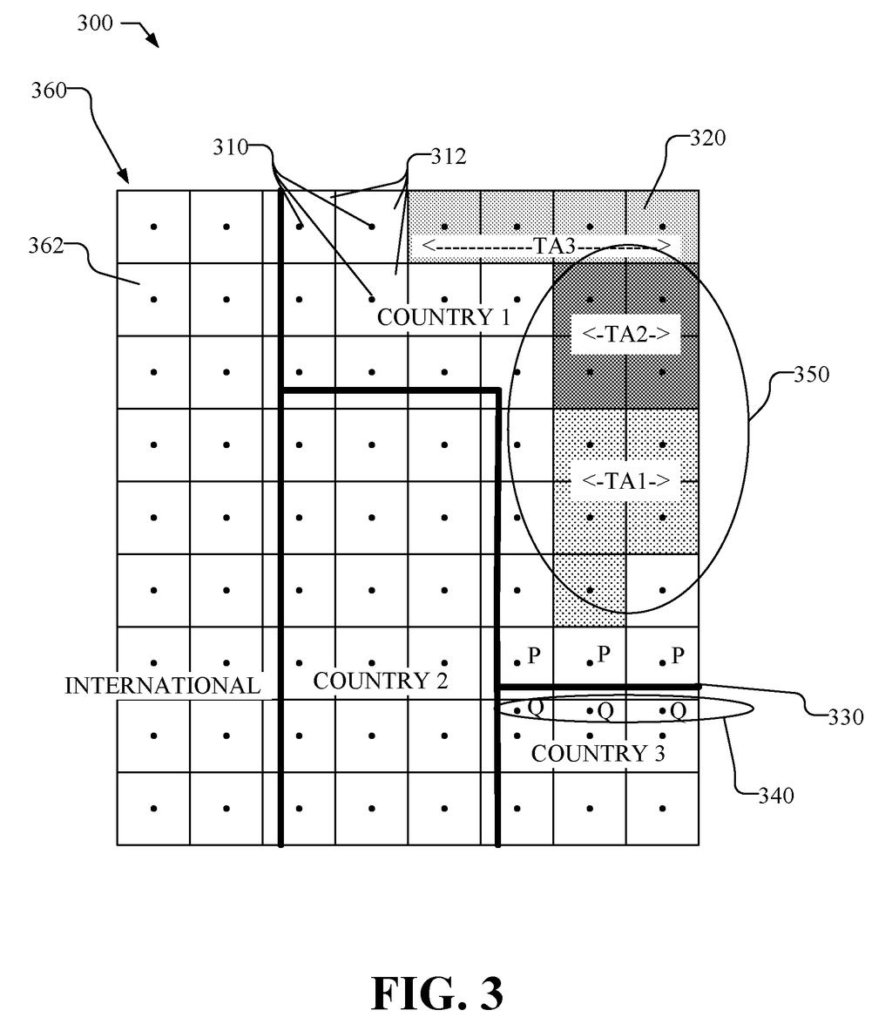
The key invention is the concept of virtual cells and virtual tracking areas. Instead of the cell boundaries that a physical tower creates with radio signals, these are purely geographic boxes drawn on a map. A satellite broadcasts a directory of these boxes, including which mobile network operators (called PLMNs, or Public Land Mobile Networks) are associated with each one.
The phone's steps are:
- Receive the satellite's broadcast listing all nearby virtual cell definitions
- Check its GPS position to figure out which virtual cell it is sitting inside
- Use that cell identity to register with the correct mobile network, routed back through a ground station connected to the satellite
Because the virtual zones follow real geographic and political boundaries, the system can support regulatory services (things carriers are legally required to provide), including emergency calls, lawful interception by authorities, and wireless emergency alerts, all matched to the correct country or jurisdiction based on where the phone physically is.
A coverage area, e.g., country, region, multiple countries, and international areas, are divided into fixed virtual cells having well defined geographic boundaries and fixed tracking areas.
Translation: Large regions like entire countries or international waters are split into fixed virtual boundaries for satellite tracking.
What this means for emergency calls and global 5G reach
Mobile networks are legally required to know roughly where a phone is, not just for billing, but for routing emergency calls to the right dispatch center and delivering government alerts in the right language to the right region. That requirement is easy to meet when towers are everywhere. Satellites covering thousands of miles of ocean or desert make it much harder, and that gap has historically meant true 5G service simply doesn't exist outside tower range.
If this approach is built into satellite systems, your existing 5G phone could potentially register with a real carrier network from a remote location without any special hardware. That also matters for aviation, maritime shipping, and disaster-response scenarios where connectivity is critical but towers are absent.
This is infrastructure-layer patent work, not a flashy consumer feature, but it matters because it tackles the one thing that keeps satellite connectivity from being a true 5G replacement rather than a niche add-on: regulatory compliance. Without a way to assign phones to defined geographic zones, carriers can't legally provide emergency services over satellite. Qualcomm is solving the plumbing problem that everyone else is dancing around.
There are more where this came from
We read every patent application Big Tech publishes and send you the ones worth knowing. Plain English, free, every week.
The drawings
11 drawing sheets from US 2026/0230171 A1 · click any drawing to enlarge


Want this weekly breakdown for a company we don't cover? Patentlyze Pro →
Be the first to weigh in