
Microsoft Patents a Circuit That Randomizes Encryption Math to Block Spy Attacks
Your device could be doing all the right encryption math and still leak your secrets, just by the pattern of power it draws. Microsoft's new patent tries to plug that gap.
What Microsoft's shuffled encryption circuit actually does
Imagine a safe with a perfect lock, but every time you spin the dial, the motion is so predictable that someone watching the power meter on the wall can guess your combination. That's roughly the problem Microsoft is trying to solve here.
Modern encryption relies on complex math operations that run inside chips. Even when those operations are done correctly, attackers can sometimes figure out secret information by watching how the chip behaves, such as how much power it uses or how long it takes, while the math runs. This is called a side-channel attack.
Microsoft's solution is to shuffle the order in which the numbers get fed into the math circuit, using a random number generator to change the sequence every time. If the pattern is never the same twice, an attacker watching from the outside can't build a useful picture of what's happening inside.
… a shuffle circuit coupled between the memory and the butterfly operator circuits, the shuffle circuit configured to change, based on the random number, an order in which the polynomial coefficients are provided to the butterfly operator circuits including which address of polynomial coefficients is provided to the butterfly operator circuits.
Translation: A shuffling component mixes up the data order using random numbers so spies cannot track the math.
How the random shuffle blocks side-channel snooping
The patent describes a hardware circuit designed to perform a mathematical operation called a Number Theoretic Transform (NTT), which is a core building block of several post-quantum cryptography (encryption schemes built to resist attacks from future quantum computers) algorithms.
The circuit has three main parts working together:
- Memory that stores the numbers (called polynomial coefficients) the transform needs to process.
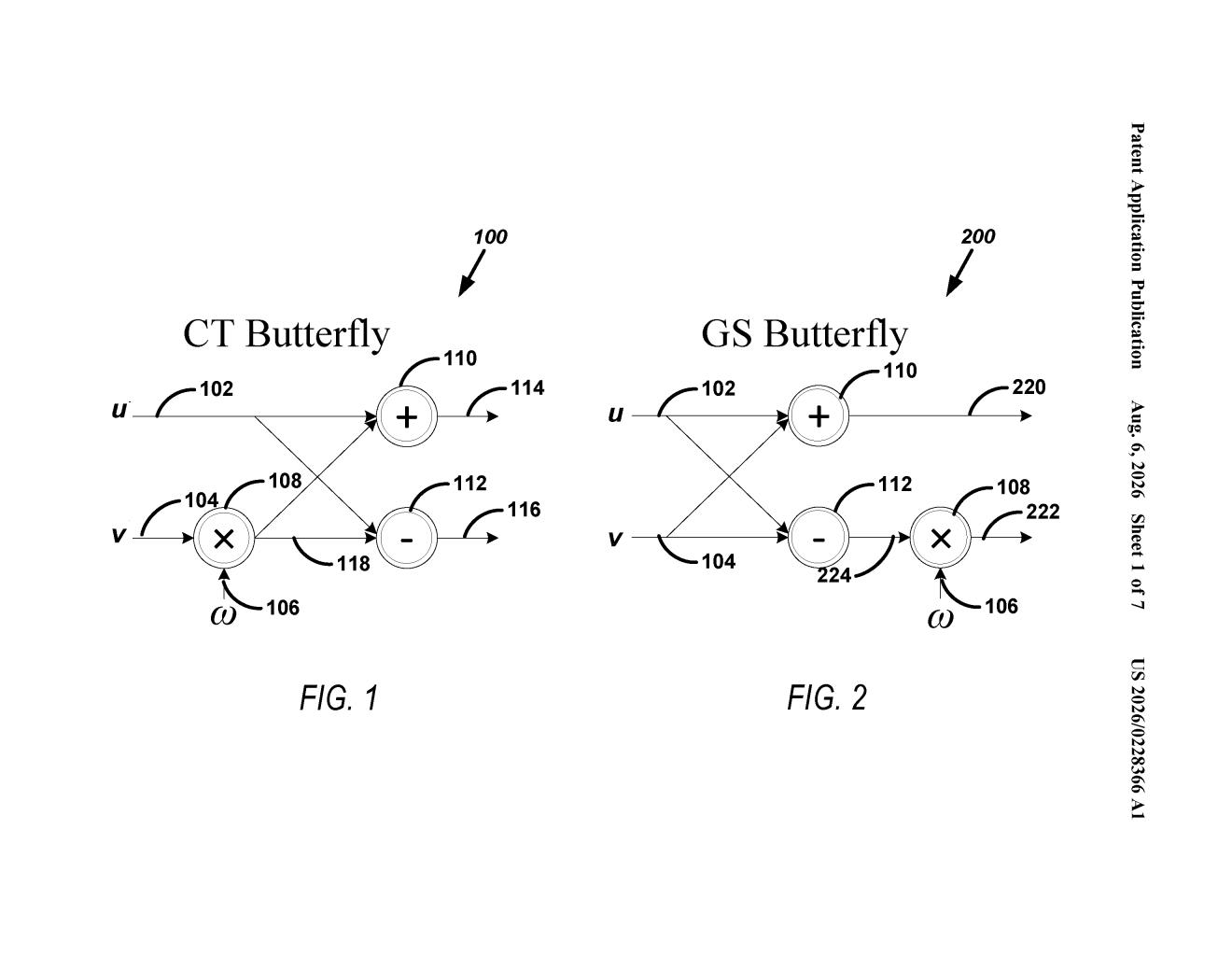
- Butterfly operator circuits, the actual computation units that repeatedly process pairs of numbers through many rounds until a final encrypted result emerges.
- A shuffle circuit connected between the memory and the computation units, which uses a random number generator to vary the order in which stored numbers are handed off to the processors.
The key insight is that because the shuffle is driven by a fresh random number each time, an outside observer monitoring power consumption or electromagnetic emissions (the classic side-channel attack vectors) sees a different pattern on every run. Without a consistent pattern to analyze, extracting the secret key becomes far harder. The patent also covers the inverse operation (INTT), which is the decryption side of the same math.
… a first subset of the butterfly operator circuits situated in series with each other and in parallel with a second subset of the butterfly operator circuits …
Translation: The chip uses a combination of sequential and simultaneous processing pathways to handle the equations.
What this means for post-quantum encryption hardware
Post-quantum cryptography is rapidly moving from research into real products and standards. The U.S. government finalized its first post-quantum encryption standards in 2024, and chip makers are already designing hardware to support them. NTT is central to the most widely adopted of those standards, so protecting NTT hardware from side-channel attacks is a practical engineering problem, not a theoretical one.
For you, this kind of protection matters most in devices that handle sensitive data at the hardware level: security chips in laptops, cloud server processors, and hardware security modules used in banking and government. If Microsoft ships this into its Azure hardware or Surface security subsystems, it would mean your encrypted data is harder to extract even if an attacker has physical access to the chip.
This is a genuinely useful piece of cryptographic engineering, not headline-grabbing AI work, but the timing is sharp. With NIST's post-quantum standards now final and hardware implementations ramping up, side-channel resistance for NTT circuits is a real and active problem. Microsoft filing this now suggests the company is doing serious silicon-level work on post-quantum security, not just updating software libraries.
There are more where this came from
We read every patent application Big Tech publishes and send you the ones worth knowing. Plain English, free, every week.
The drawings
7 drawing sheets from US 2026/0228366 A1 · click any drawing to enlarge


Want this weekly breakdown for a company we don't cover? Patentlyze Pro →
Be the first to weigh in