
Microsoft Patents an AI System That Reads Big Documents in Sections to Build Better Navigation
AI models can only read so much text at once, which is a real problem when your document is 500 pages long. Microsoft's new patent describes a way to feed those giant documents to an AI in overlapping chunks, so nothing gets lost in the gaps.
How Microsoft's AI breaks down huge documents for search
Ever tried to search a 200-page report and gotten results that make no sense out of context? That happens because most search tools look at words in isolation, with no understanding of what came before or after on the page.
Microsoft's approach works like a reading assistant who goes through a long document a few pages at a time, always keeping the previous page in view so context doesn't get cut off. The AI reads a small group of pages, writes a description of each one based on what it sees (including charts, images, and surrounding text), then slides forward and repeats, overlapping with the pages it just described.
Those descriptions get compiled into an index, basically a rich table of contents that captures what's actually on each page, not just which keywords appear. When you search later, the tool has real context to work with, not just word counts.
… prompting the generative AI model to generate a description of each page in the particular page window based on any included visual content and contextual information including each other page in the particular page window …
Translation: The system asks an AI to describe every page using both pictures and surrounding text context.
How the sliding window feeds pages to the AI model
AI language models have a hard ceiling on how much text they can process at once, often called a context window (the maximum chunk of text the model can "hold in mind" at one time). For a typical corporate report, legal contract, or technical manual, that ceiling gets hit fast.
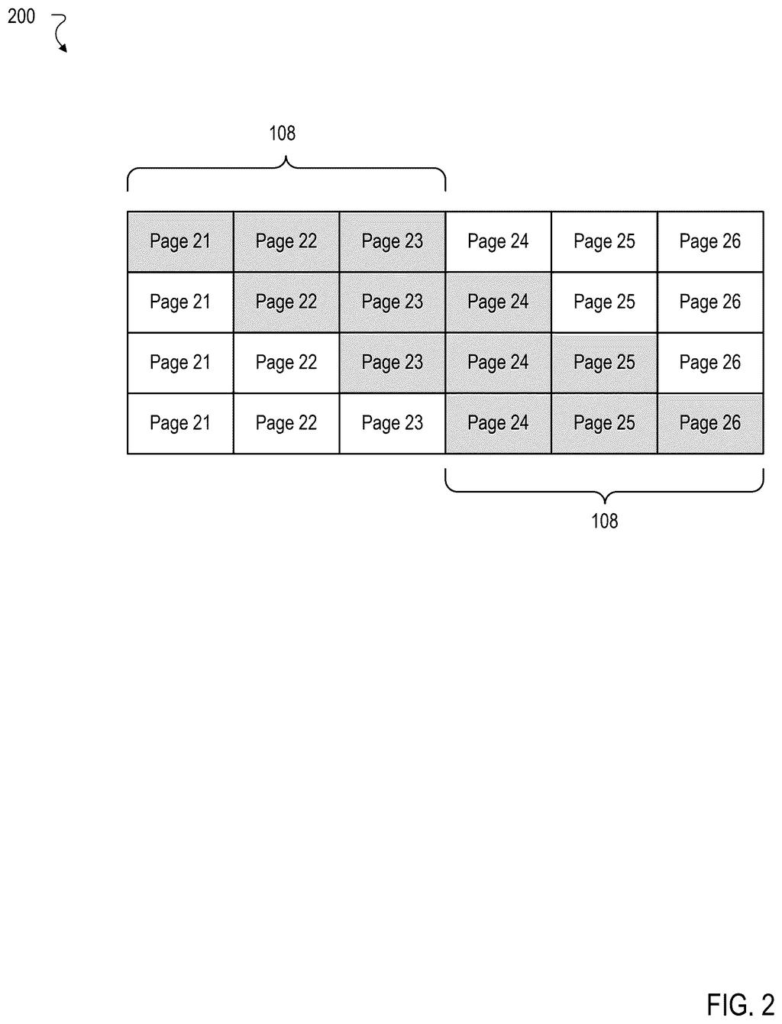
The patent describes a sliding window indexing method that works around this limit. The system divides a document into overlapping groups of pages called page windows. Each window is small enough to fit inside the AI model's context limit, but the windows overlap, so the boundary pages of one window also appear in the next window. That overlap preserves narrative continuity.
For each window, the system sends those pages to a generative AI model (one capable of reading text and interpreting images) with a prompt asking it to describe each page, taking into account the visual content on that page and the surrounding pages as context. The AI writes out a description of what each page covers.
- The window slides forward through the document, repeating this for every page group.
- All the AI-generated descriptions are collected into index data for the whole document.
- That index then powers search, allowing queries to match against rich, context-aware descriptions rather than raw keyword counts.
… generating index data for the document based on the output from the generative AI model for each page window of the plurality of page windows …
Translation: It creates a search index for the whole file using the AI responses from each section.
What this means for searching long reports and contracts
For anyone who regularly hunts through long documents, this is the difference between a search that finds the right page and one that finds a page containing the right word. A contract clause buried in page 340 of a legal filing doesn't always use the exact phrase you'd type into a search box, but a good description of that page might match your query perfectly.
Enterprises deal with enormous volumes of documents where fast, accurate search is a real operational cost. Microsoft's track record in enterprise search and AI patents suggests this is part of a broader push to make tools like SharePoint and Copilot genuinely useful on the sprawling, messy document libraries real companies actually maintain, not just tidy demo datasets.
Microsoft's 60th Language AI filing we've tracked since May follows one on self-rewriting prompts and one on self-written coding rules.
The problem here is real and underappreciated. Most document search tools were built for keyword retrieval, and they fail badly on long, complex files like annual reports, technical specifications, or multi-party contracts. When an AI model can't fit the whole document in memory, it has to make trade-offs, and those trade-offs usually mean losing context at page boundaries.
The sliding window approach is a well-established technique in natural language processing, and this patent applies it specifically to the indexing step rather than to query-time retrieval. That's a practical engineering choice: build the rich context into the index once, then serve fast searches from it later. The overlap between windows is the key detail, because it's what prevents a page from being described in isolation just because it happened to sit at the edge of a processing chunk.
Whether this becomes a patent of lasting importance depends entirely on whether richer AI-generated indexes actually improve search precision in practice. The concept is sound, but it's an incremental improvement to a well-known technique, not a departure from established thinking.
There are more where this came from
We read every patent application Big Tech publishes and send you the ones worth knowing. Plain English, free, every week.
The drawings
11 drawing sheets from US 2026/0277943 A1 · click any drawing to enlarge


Want this weekly breakdown for a company we don't cover? Patentlyze Pro →