
Zoox Patents a System That Scores How Politely a Self-Driving Car Changes Lanes
Merging into traffic is one of the trickier things a human driver does by instinct. Zoox is filing patents on how to teach its robotaxis to do it politely, by assigning a numerical score to how much a lane change would inconvenience the car already behind you.
What Zoox's lane-change scoring actually does for riders
Imagine you're cruising in the right lane of a highway and you want to move left. You'd naturally glance in your mirror, judge how far back the other car is, and decide whether you have room. A Zoox robotaxi needs to make that same call, thousands of times a day, without any instinct to lean on.
This patent describes a system that gives each possible lane-change path a "cost" score before the car commits to it. The higher the cost, the more the move would cut off or inconvenience another driver already in that lane. The car picks the lowest-cost path, which ideally means the most considerate one.
The key detail is that the system pays close attention to vehicles behind the robotaxi in the target lane, since those are the cars that would have to brake or swerve if the merge went badly. By weighing their position and speed, the car can decide whether to go now, wait, or skip the lane change entirely.
… determining a score representing a position of the object relative to a vehicle; determining, based at least in part on the score and the metric, a cost associated with a portion of the candidate trajectory that is associated with the driving lane; and controlling the vehicle based at least in part on the cost.
Translation: The car calculates how rude a lane change would be and adjusts its driving to be more polite.
How the system calculates a right-of-way cost before merging
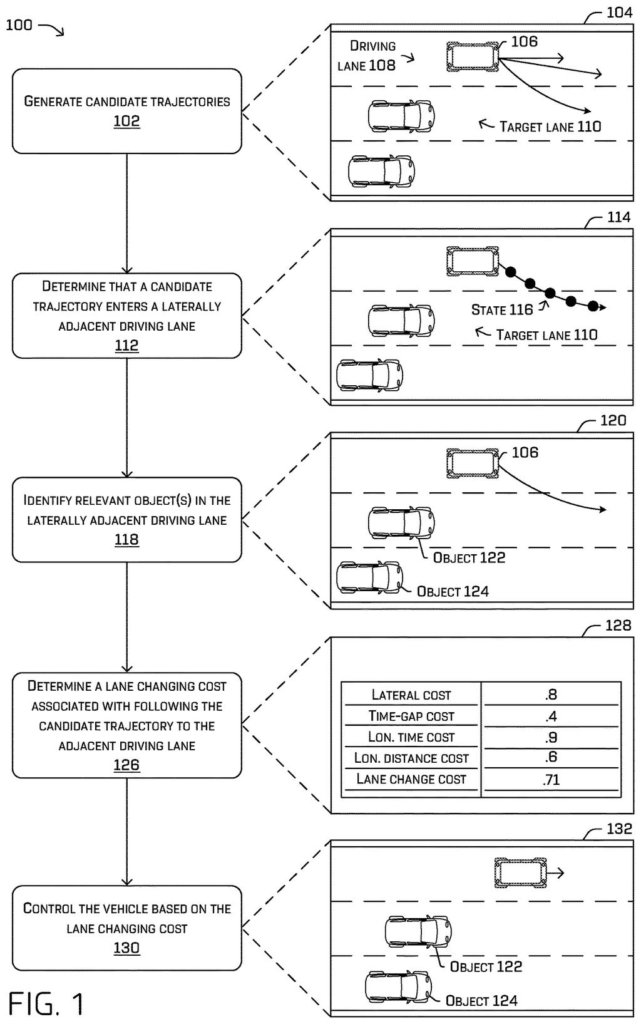
The system generates a set of candidate trajectories (think of these as a menu of possible paths the car could take over the next few seconds). Some of those paths involve changing lanes; others stay put.
For any lane-change option, the system runs two calculations:
- A position score that measures where the other vehicle sits relative to the robotaxi. If the car in the target lane is behind you, that's the dangerous case, it's the one most likely to need to brake.
- A rule-compliance metric that estimates how well that other driver is already obeying traffic rules (speed, following distance, etc.). A well-behaved car leaves more predictable gaps; an aggressive one may close distance fast.
Those two numbers are combined into a single lane change cost attached to that candidate trajectory. The planning system then compares costs across all options and picks the trajectory with the best overall value, including whatever penalty the lane change carries.
Critically, claim 1 is written broadly: it covers any system that detects an object, scores its position relative to the vehicle, measures a road-rule metric, and uses both numbers to price a trajectory. The underlying math is not locked to one formula, which gives the patent wide coverage over the general concept.
… to evaluate the degree to which the candidate trajectory respects the right-of-way of the object(s) located in the target lane.
Translation: The system checks whether a planned merge cuts off other drivers or gives them proper space.
What this means for self-driving car behavior on real roads
Lane changes cause a disproportionate share of highway accidents, and one of the recurring criticisms of early robotaxis was that they were either too timid (refusing to merge at all) or too abrupt (cutting off other drivers). A formal cost-based framework gives engineers a tunable way to dial in how assertive or deferential the car should be, without rewriting low-level code every time.
For passengers, the practical effect should be merges that feel less jarring and fewer situations where the car freezes at a merge point. Zoox's steady investment in autonomous-vehicle planning suggests the company sees this kind of fine-grained behavioral control as a core differentiator for its purpose-built robotaxi fleet.
That makes this Amazon's 24th filing we've tracked since May in our self-driving sensing race watch, joining earlier Zoox work on matching driving to plain-English and remote hand-gesture steering.
Claim 1 is broad. It covers the general idea of combining a position score with a rule-compliance metric to price a lane-change trajectory, without specifying a particular algorithm, sensor type, or vehicle architecture. That breadth is a double-edged thing: it would be harder to design around, but it also means the claim faces a tougher road through the patent office, since examiners will look hard for prior art in autonomous-vehicle planning research.
What the claim does NOT cover is almost as telling as what it does. It says nothing about pedestrians, cyclists, or oncoming traffic, only objects in the target lane that are longitudinally behind the vehicle. That narrow scenario focus may actually strengthen the claim's novelty argument, since it is targeting a specific sub-problem rather than sweeping up all of autonomous driving.
If granted as written, this would give Zoox (and by extension Amazon) a potentially wide toll gate over any system that prices lane changes using both positional and rule-compliance data. Whether that holds up depends entirely on what a prior-art search turns up from academic robotics and competing AV filings.
There are more where this came from
We read every patent application Big Tech publishes and send you the ones worth knowing. Plain English, free, every week.
The drawings
6 drawing sheets from US 2026/0264687 A1 · click any drawing to enlarge


Want this weekly breakdown for a company we don't cover? Patentlyze Pro →