
Adobe Patents a System That Trains AI to Answer Plain-English Database Questions
Writing a database query today requires knowing a specialized language called SQL. Adobe is filing patents on a system that trains AI to handle that translation for you, including when the database itself changes shape.
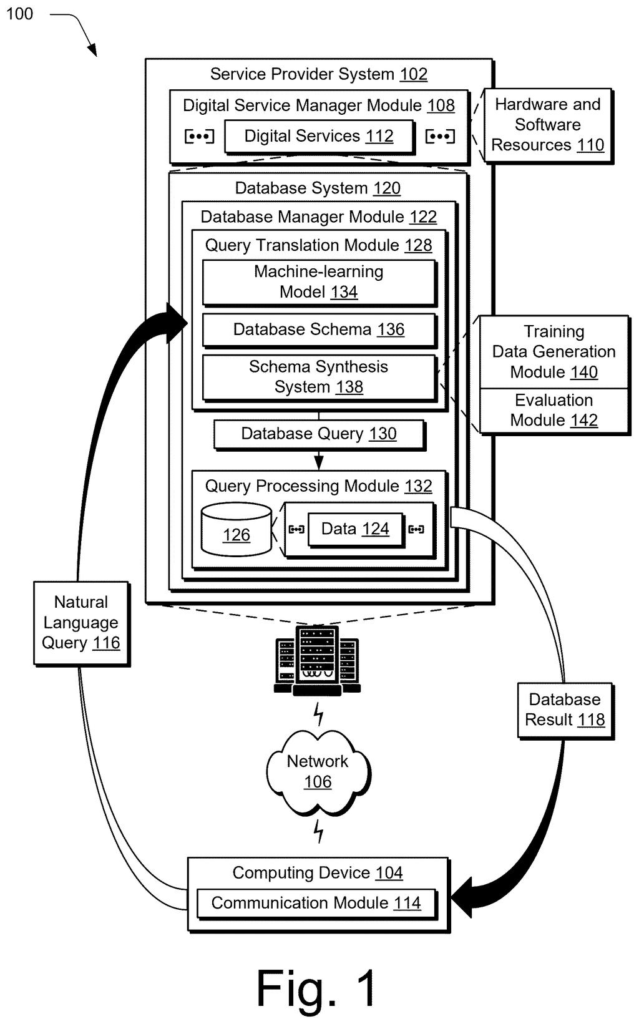
What Adobe's plain-English database query AI actually does
Most corporate databases are locked behind a query language called SQL. If you want to find something in a database and you don't know SQL, you're stuck asking someone who does.
Adobe's patent describes a system for training an AI to act as that translator. You type a question in plain English, the AI converts it into the technical query the database needs, and you get your answer. The tricky part this patent focuses on is keeping that AI working correctly even when the database gets reorganized, columns get renamed, or tables get moved around.
To handle those database changes, the system automatically generates new training examples every time the structure shifts. It also tests itself against those changes and picks the best new examples to study next. The idea is an AI that stays useful even as the data behind it keeps evolving.
… training, by the processing device, a machine-learning model to translate a natural language query to a database query using training data that includes the plurality of natural language queries and the plurality of plurality of database query variations; …
Translation: The system teaches AI how to turn everyday human questions into proper database commands.
How Adobe's system generates training data for query translation
The patent covers a pipeline with three main stages.
Training data generation: The system starts with an existing database structure (called a schema, essentially the blueprint of how the data is organized), a set of plain-English questions, and their matching SQL queries. When the schema changes, say a column is renamed or a new table is added, the system automatically rewrites all those SQL queries to reflect the new structure. This gives the AI a fresh set of correct examples to learn from without humans writing them by hand.
Model training: Those examples are fed into a machine-learning model, which learns to map a question like "how many customers bought something last month" to the correct SQL string. The patent emphasizes handling multiple types of schema evolution: additions, deletions, renames, and structural reorganizations.
Evaluation and selection: An evaluation module tests the trained model against the schema changes using performance metrics (basically scoring how often the AI produces a working query). Based on those scores, the system selects which additional training examples to feed the model next, creating a feedback loop that focuses extra practice on the changes the AI is struggling with.
A database system is configurable to address a variety of evolution types to a database schema in support of machine-learning model training through use of a training data generation module.
Translation: The software prepares the AI to handle databases that change and grow over time.
What this means for people who work with data but not SQL
For anyone who works with data but doesn't speak SQL, a reliable natural-language query tool would remove a real daily friction point. Today, most business-intelligence tools offer some version of this, but they break when the underlying database is restructured, which happens constantly in any growing company.
Adobe's approach addresses that fragility directly. By automating both the generation of new training data and the evaluation cycle, Adobe's growing interest in enterprise data tools the system could theoretically stay accurate through ongoing database changes without a team of engineers manually retraining the model each time. For Adobe's enterprise software customers, that kind of durability matters more than the headline feature.
That makes this Adobe's 25th filing we've tracked in Language AI since May, a group that includes recoloring designs by text prompt and live edit suggestions.
Adobe's patent covers a training system, not a finished tool. Before any regular person could type a question and get a clean answer from a company database, someone would still need to build the actual question-and-answer interface, then connect this training pipeline to a live database product.
The specific problem it targets is real friction: whenever a company's data team renames or reorganizes its tables, natural-language query tools tend to break silently. This filing describes a way to automatically update the training process when that happens, so the underlying model stays accurate without requiring constant manual repair.
On a shipping timeline, this sits at least two engineering phases from a product a business user would ever see. It could power a future Adobe analytics feature, or it could remain an internal research method. Either outcome is plausible from what the document actually shows.
There are more where this came from
We read every patent application Big Tech publishes and send you the ones worth knowing. Plain English, free, every week.
The drawings
10 drawing sheets from US 2026/0267853 A1 · click any drawing to enlarge


Want this weekly breakdown for a company we don't cover? Patentlyze Pro →