
Sony Patents a Way to Match Typed Words to Character Animations Automatically
Type a phrase, get an animation. Sony has filed a patent for a system that compares the meaning of typed text against a library of pre-labeled motions and picks the best match, potentially cutting hours of manual animation searching down to seconds.
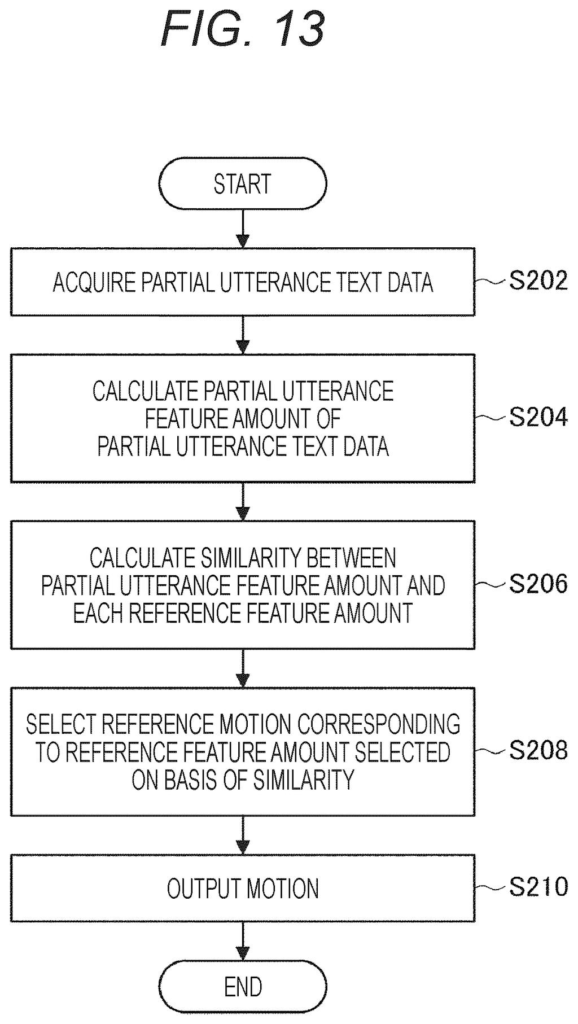
How Sony wants to turn a typed phrase into a character move
You're building a cutscene for a game and you need a character to look "surprised but defensive." Right now, that probably means digging through hundreds of motion-capture clips, previewing each one, and hoping you find something close enough.
Sony's patent describes a system that reads the text phrase you type and compares its meaning against phrases already attached to a library of animations. The system finds the animations whose descriptions are most similar to yours and surfaces them as matches, skipping the manual browsing entirely.
The idea is straightforward: instead of you hunting through a catalogue, the system does the comparing for you based on how close the words' meanings are to each other. That could save real time in any workflow where humans are assigning motion to characters.
an acquisition unit that acquires a first feature amount calculated from first text data indicating an input first phrase; and a motion selection unit that selects, on a basis of a similarity between the first feature amount and a second feature amount that is a feature amount calculated from second text data indicating a second phrase associated with motion …
Translation: It reads the words you typed and looks for similar phrases that already have animations attached to them.
How the feature-matching system finds the right animation
The patent centers on a two-part process called feature-amount matching (a way of turning words into numbers that capture their meaning, then comparing those numbers).
First, an acquisition unit takes your typed phrase and converts it into a numerical representation called a feature amount. Think of it as distilling "surprised but defensive" into a set of coordinates on a map of meaning.
Second, a motion selection unit compares your coordinates against a pre-built library. Each motion in the library already has its own coordinates, calculated from a descriptive phrase someone attached to it earlier. The system measures the distance between your phrase's coordinates and each stored motion's coordinates, then returns the closest matches.
- Input: a text phrase typed by the user
- Processing: convert both the input phrase and stored motion labels into numerical feature amounts
- Output: one or more animations ranked by how well their labels match the input phrase
The patent does not specify a particular embedding model or neural architecture, leaving the door open for various natural-language-processing approaches under the hood.
… at least one kind of motion from motion associated with each of a plurality of the second feature amounts as motion corresponding to the first feature amount.
Translation: It picks the best matching character animation to go with your typed text.
What this means for animators and virtual production tools
For animators, game developers, and virtual production crews, searching motion libraries is a daily grind. A tool that accepts plain-language queries and returns relevant clips directly changes how that time gets spent. You describe what you want and the system narrows the field; you still choose, but from a much shorter list.
Sony's steady investment in animation and virtual production tools suggests this is part of a broader push to automate the slower parts of content creation. Whether this surfaces in a future version of Sony's production software or inside a game development tool, the practical payoff is the same: less time browsing, more time making decisions that actually require human judgment.
That makes this Sony's 446th filing in our Sony coverage since May, adding to work like teaching AI 3D game layouts and learning object angles before streaming.
The core idea here is useful without being complicated. Matching typed descriptions to stored animations by comparing their numerical representations is a well-understood approach in natural-language processing, and applying it to motion libraries is a logical step, not a surprise.
What matters from a reader standpoint is the time saved at the most tedious part of the job. Animation browsing is one of those tasks that sounds minor but compounds badly across a project. A system that trims that friction in a professional tool would be noticed by anyone who spends hours a week hunting for the right clip.
The patent is narrow in scope and light on implementation specifics, which is typical for a filing at this stage. Whether Sony turns this into a shipping feature or files it away depends entirely on decisions this document cannot tell us.
There are more where this came from
We read every patent application Big Tech publishes and send you the ones worth knowing. Plain English, free, every week.
The drawings
17 drawing sheets from US 2026/0268568 A1 · click any drawing to enlarge


Want this weekly breakdown for a company we don't cover? Patentlyze Pro →