
Sony Patents a Way to Control Sound Directly From a Motion-Sensing Camera
Sony has filed a patent for a system that uses a special kind of motion-sensing camera to generate or control sound in real time, potentially letting a performer control audio simply by moving their hands or body.
What Sony's motion-to-sound camera system actually does
Imagine you're on a stage and instead of pressing a button or turning a knob, you just wave your hand and the music responds instantly. That's the rough idea behind this Sony patent, which pairs a particular type of camera with a sound-generation system.
The camera at the center of it is called an Event-based Vision Sensor (EVS). Unlike a regular camera that captures full frames many times per second, an EVS only registers the exact pixels that change at the exact moment they change. The result is that it detects motion with almost no delay, far faster than a conventional camera.
Sony's patent ties that ultra-fast motion detection directly to audio output. The device can use what the sensor sees to create new sounds or adjust sounds that are already playing. Think of it as a hands-free instrument that watches you instead of waiting for you to touch it.
How event-based vision data triggers and shapes audio output
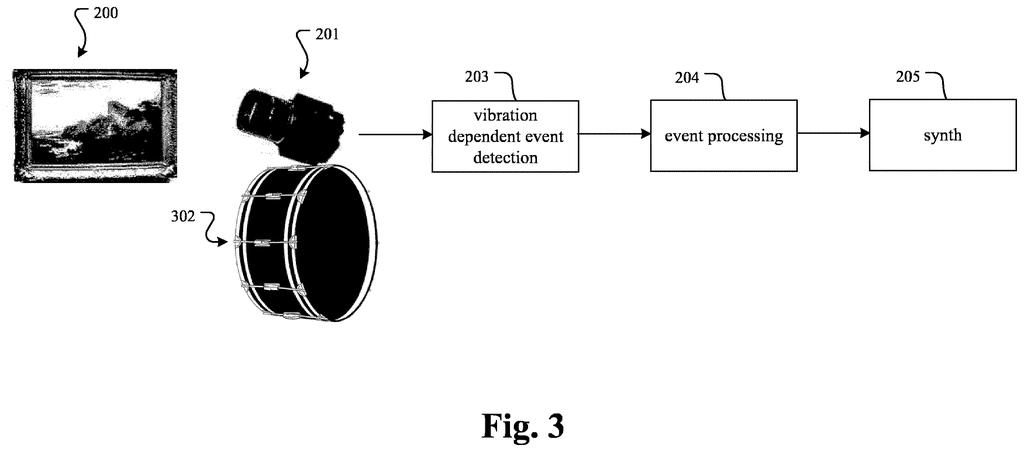
The core claim is an electronic device whose circuitry does two things: generate Event-based Vision Sensor (EVS) data, and use that data to generate or control sound.
An EVS (sometimes called a dynamic vision sensor or neuromorphic camera) works differently from a standard video camera. Instead of capturing complete images at a fixed frame rate, it fires individual pixel-level signals only when brightness at that pixel changes. This means it can track motion with microsecond-level precision and very low power consumption, because it ignores everything that isn't moving.
The patent connects that sensor output to an audio engine. Depending on how the circuitry interprets the incoming motion data, it could:
- Trigger a sound to start or stop
- Alter pitch, volume, or timing of a sound in progress
- Map different movement patterns to different audio parameters
The independent claim is deliberately broad, covering any electronic device that combines these two functions. The inventors, Piergiorgio Sartor and Giorgio Fabbro, are based within Sony's research organization, and the USPC classification 84/602 places this squarely in the field of electronic musical instruments, which is a useful anchor for understanding the intended application.
What this means for live performance and interactive audio gear
For musicians and audio engineers, the appeal is speed and expressiveness. Current gesture-controlled instruments typically rely on standard cameras or depth sensors, both of which introduce enough delay that fine musical timing suffers. An EVS-based system could, in principle, feel as immediate as a physical key or string, because the sensor is reacting to individual photon-level changes rather than waiting to assemble a full frame.
The consumer implications reach beyond professional stages. Sony already makes headphones, speakers, cameras, and PlayStation hardware, any of which could theoretically fold in gesture-to-audio control. Sensor-driven audio is one of the more active areas covered by new Big Tech patents, and Sony's EVS approach is a relatively focused bet on a sensor technology the company has invested in for years through its image-sensor division.
Sony's 355th filing among the patents we've tracked in our Sony coverage since May joins earlier work on a noise-cutting camera chip and a director-style copier.
A tiny delay between a musician's movement and the sound that follows is not a small problem. It is the difference between an instrument that responds and one that cannot be played at all.
Normal cameras make this worse. They wait until a full picture is collected before sending any information, and that built-in wait cannot be fixed by faster computers alone. Sony's approach ties the sound directly to a sensor that reports changes in light the instant they occur, not in batches. That matches a problem about timing with a tool built around timing, and that is exactly the right fix.
Get our take in your Top Stories
Liked this breakdown? Add Patentlyze as a preferred source on Google, and our plain-English take shows up more often in your Top Stories the next time Sony patent news breaks.
There are more where this came from
We read every patent application Big Tech publishes and send you the ones worth knowing. Plain English, free, every week.
The drawings
10 drawing sheets from US 2026/0245534 A1 · click any drawing to enlarge


Want this weekly breakdown for a company we don't cover? Patentlyze Pro →
Be the first to weigh in