
Adobe Patents a Way to Build 3D Models From a Set of Photos
Adobe has filed a patent for a system that takes multiple photos of an object or scene and stitches them together into a full 3D model you can explore from any angle. The interesting part is the architectural trade-off baked in: it pairs two very different AI building blocks to handle what neither does well alone.
What Adobe's multi-photo 3D reconstruction actually does
Ever tried to recreate a real-world space in 3D using photos you already have? Right now that's either painfully slow, requires expensive equipment, or produces muddy, incomplete results.
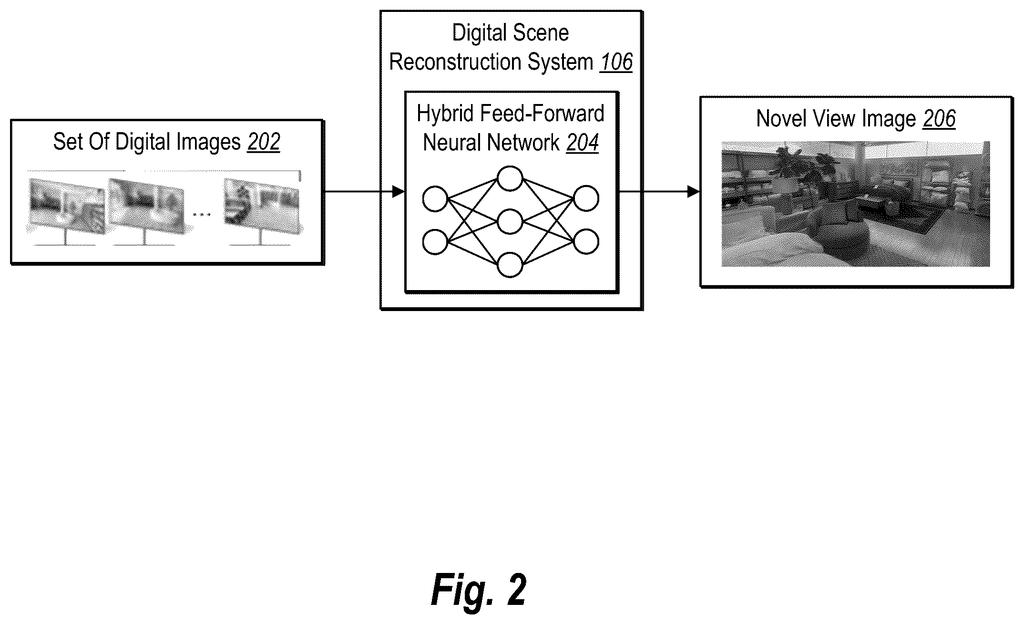
Adobe's patent describes a system that feeds a collection of regular photos into a neural network, telling it where each photo was taken from, and gets back a full 3D representation of the scene. That 3D model can then generate new images of the scene from angles that were never photographed. Want to see the back of that sculpture you only shot from the front? The system fills it in.
The payoff for designers and photographers is a faster path from a photo set to a usable 3D asset, without needing a 3D scanner or hand-crafted modeling work. Adobe is trying to make that pipeline fit inside the kind of AI tools it already sells.
… generating, utilizing a set of parallel state space blocks in a hybrid feed-forward neural network, a set of modified token sequences from the initial set of token sequences by mixing token information in the initial set of token sequences; …
Translation: The system uses a special neural network to mix up and process data from the images.
How the hybrid network mixes image data into a 3D structure
The system takes a set of digital photos and, for each one, records metadata about the camera's position and angle (called camera pose parameters). Each photo is broken into small chunks of data called tokens, which are the basic units an AI processes, similar to how words are tokens in a language model.
Those tokens pass through two different types of AI layers, combined into a single hybrid feed-forward neural network:
- Parallel state space blocks: these layers run across all images simultaneously, mixing together pixel information from different viewpoints. State space models are efficient at handling long sequences of data without the memory overhead of processing everything at once.
- Transformer block: a standard AI attention layer that refines the combined data into a cleaner, more structured output. Transformers are good at finding relationships across the whole dataset, but expensive to run at very long sequence lengths.
The output of both layers feeds into a 3D Gaussian reconstruction, a method that represents a scene as a cloud of small, overlapping 3D blobs, each carrying color and opacity information. That blob-cloud can then render photorealistic images of the scene from new, never-before-seen camera angles.
The disclosed systems generate a three-dimensional Gaussian reconstruction of the three-dimensional scene for synthesizing digital images depicting the three-dimensional scene with novel views from the set of output token sequences.
Translation: The software builds a 3D model that can render the scene from brand new camera angles.
What this means for 3D content creation in Adobe tools
For anyone who creates 3D content, the tedious part has always been the gap between having photos and having a usable 3D model. Photogrammetry tools exist, but they're slow and often fail on reflective or thin surfaces. A system that's faster and more reliable at that conversion step would matter a lot inside tools like Adobe Substance or Adobe's Firefly family.
The 3D Gaussian format it outputs is also notable because it has become a preferred target for real-time rendering. A 3D Gaussian scene can be viewed interactively in a browser or composited into video, which makes it more practical than older mesh-based formats for content production workflows.
This is the 14th Adobe filing in our AI simulation coverage we've tracked since May, following earlier work like building 3D scenes from text and filling holes in 3D models.
The design choice here is deliberate and worth naming: Adobe is pairing state space blocks (efficient at long sequences, weaker at global context) with a transformer block (strong at global context, expensive at scale). That hybrid is the bet. The state space layers keep memory costs manageable when you're ingesting many photos at once, and the transformer cleans up the output. But you're accepting a ceiling: the transformer step still gets costly as the photo count grows, and the state space layers can miss fine-grained detail that a full transformer would catch.
Whether that trade is worth it depends entirely on how many photos the system needs to produce a clean result. If it takes 50 images of a coffee cup to reconstruct it reliably, this is a research curiosity. If it works well on a dozen phone photos, it's a real tool.
several Adobe filings on 3D reconstruction this year suggest the company is taking this seriously as a pipeline for creative professionals, not just a lab demo. But the patent doesn't give performance numbers, so the honest read is: the architecture is sensible, the goal is practical, and the proof will be in what ships.
There are more where this came from
We read every patent application Big Tech publishes and send you the ones worth knowing. Plain English, free, every week.
The drawings
11 drawing sheets from US 2026/0278933 A1 · click any drawing to enlarge


Want this weekly breakdown for a company we don't cover? Patentlyze Pro →