
Nvidia Patents a System That Tests and Fixes Its Own Autonomous Machine Simulations
Before a self-driving car or robot ever touches the real world, it has to pass a lot of virtual tests. Nvidia's new patent describes a system that doesn't just run those tests, it hunts down the gaps and fills them automatically.
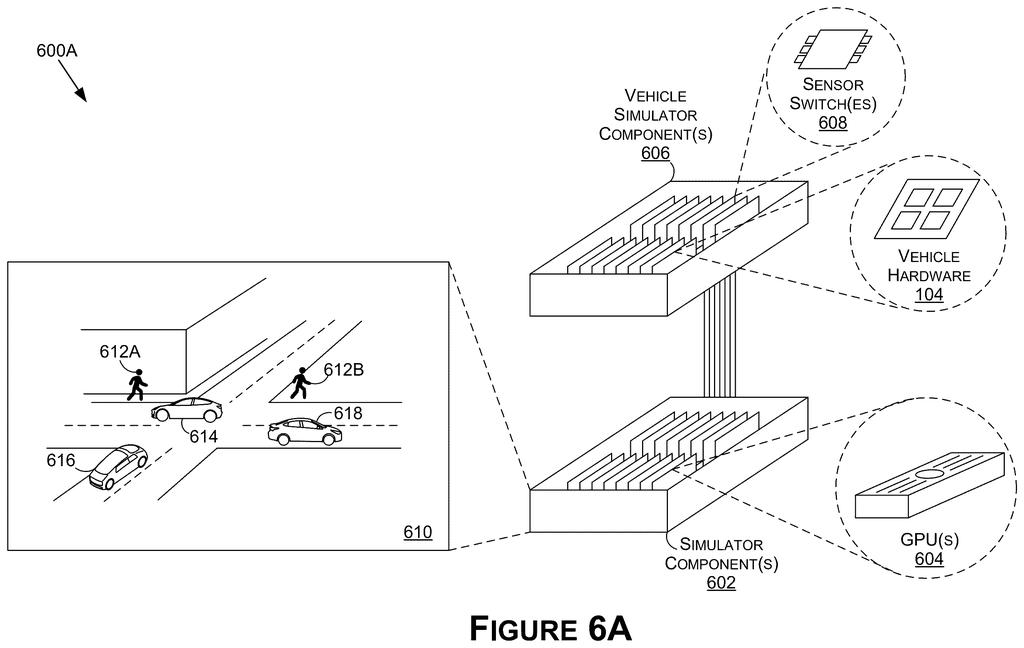
How Nvidia stress-tests self-driving AI before it hits the road
Imagine you're in charge of making sure a self-driving car handles every possible weird situation on the road: a kid chasing a ball, a truck cutting across three lanes, a traffic light flickering on and off. You'd need thousands of test scenarios, and you'd need to make sure none were missed.
Nvidia's patent describes a system that takes a plain description of a situation you care about, say "a pedestrian stepping into the road," and automatically builds a range of virtual versions of that situation to test an autonomous machine against. If the machine doesn't perform well, or if certain situations weren't covered, the system generates more variations and tests again.
The goal is a complete, automated loop: write what you want to test, let the system build it, run it, check the results, and keep going until every meaningful variation has been covered and the machine has proven it can handle them.
… feed the results back to the system to generate additional instances and/or variations where the coverage or accuracy is below a desired level.
Translation: The software automatically creates new tests when it spots weak spots in the vehicle's driving skills.
How the system turns test descriptions into virtual scenarios
The patent describes an end-to-end framework for testing autonomous or semi-autonomous machines, like self-driving cars or robots, inside virtual environments.
The core idea is a two-step translation process. An engineer writes a declarative description (a plain statement of a behavior or situation, like "a vehicle merges without signaling"). The system then converts that into a procedural description, a set of concrete instructions for generating one or many simulated instances of that scenario. Think of it like the difference between writing a recipe title versus writing out every step of a recipe.
The system then deploys observers and evaluators, automated monitoring tools that watch the machine's performance during each simulated scenario and score how well it did. It also tracks coverage, meaning which variations of a situation have been tested and which haven't.
- If coverage is low, the system generates more scenario variations.
- If machine performance is below a target threshold, it triggers additional testing cycles.
- The feedback loop continues until both accuracy and coverage meet the required standards.
The whole process is meant to run with minimal manual intervention, creating a self-correcting testing pipeline.
What this means for self-driving and robot safety testing
Testing autonomous vehicles and robots is one of the hardest problems in the field because the real world contains an almost unlimited number of situations. A human team can only write so many test cases by hand, and it's easy to miss the edge cases that cause accidents.
This patent describes a way to automate that process so the machine itself tells you where the gaps are and then fills them. Nvidia's steady investment in simulation and autonomous-system testing reflects how central this problem is to making AI-powered machines safe enough to actually deploy. For anyone waiting on self-driving cars or capable robots to become real products, better automated testing infrastructure is one of the less visible but most important pieces of the puzzle.
That makes this Nvidia's 56th filing we've tracked since May in our self-driving sensing race watchlist, building on cameras sharing what they see and calibrating sensors by detection.
The patent describes a software system, no new chips or sensors required, which puts it unusually close to something a company could actually ship. The main ingredients, simulation engines, automated testing, and coverage tracking, are tools Nvidia already builds with. What this patent formalizes is the automated feedback loop connecting them, so that gaps in testing get flagged and filled without engineers manually designing each new scenario.
If Nvidia folds this into a platform for developers building self-driving or robotics software, the practical payoff is real: teams spend less time writing test cases by hand and more time catching problems the system surfaces on its own.
That makes this less a moonshot and more a finishing move, turning existing internal machinery into a repeatable, scalable process that could meaningfully reduce the time it takes to validate an autonomous system before it meets the real world.
There are more where this came from
We read every patent application Big Tech publishes and send you the ones worth knowing. Plain English, free, every week.
The drawings
22 drawing sheets from US 2026/0268047 A1 · click any drawing to enlarge


Want this weekly breakdown for a company we don't cover? Patentlyze Pro →