
Sony Patents a Finer Way to Remove the Blocky Edges in Compressed Video
Every time you watch a compressed video, invisible filters smooth out the blocky artifacts left by compression. Sony's new patent adds a layer of precision to that process by using different filter strengths depending on where exactly a block boundary sits inside the video frame.
What Sony's color-boundary filter patent actually does
Imagine you're watching a high-quality streaming video and, in a fast-moving scene, you notice faint rectangular grid lines flickering across the image. Those artifacts come from how video is compressed: the picture is chopped into small blocks, and the edges of those blocks can leave visible seams. Deblocking filters are the software fix, smoothing those edges back out.
Sony's patent focuses on the color information in a video, separate from the brightness. It describes a system that applies different filter strengths at different types of block boundaries. The key distinction is between boundaries that sit inside a large encoding unit (called a CTU, or Coding Tree Unit) and boundaries that sit at the edge of one. The idea is that one-size-fits-all smoothing can over-blur some edges while under-smoothing others.
By using a precisely tuned filter at CTU boundaries, the system aims to preserve more accurate color detail while still eliminating the blocky look that compressed video often produces.
… apply, in a case where a second color-difference filter having a higher filter strength than a first color-difference filter is applied to a pixel of a color-difference component neighboring across a block boundary within a decoded image, a third color-difference filter to a pixel of a color-difference component neighboring across a block boundary of a CTU …
Translation: It applies a special third filter at specific boundary lines when stronger filters are already in use.
How Sony's filter swaps strength at CTU boundaries
Video compression works by dividing a frame into blocks of pixels and encoding each block separately. The largest of these blocks in modern video standards (like HEVC or VVC) are called Coding Tree Units (CTUs). Each CTU can then be subdivided into smaller blocks.
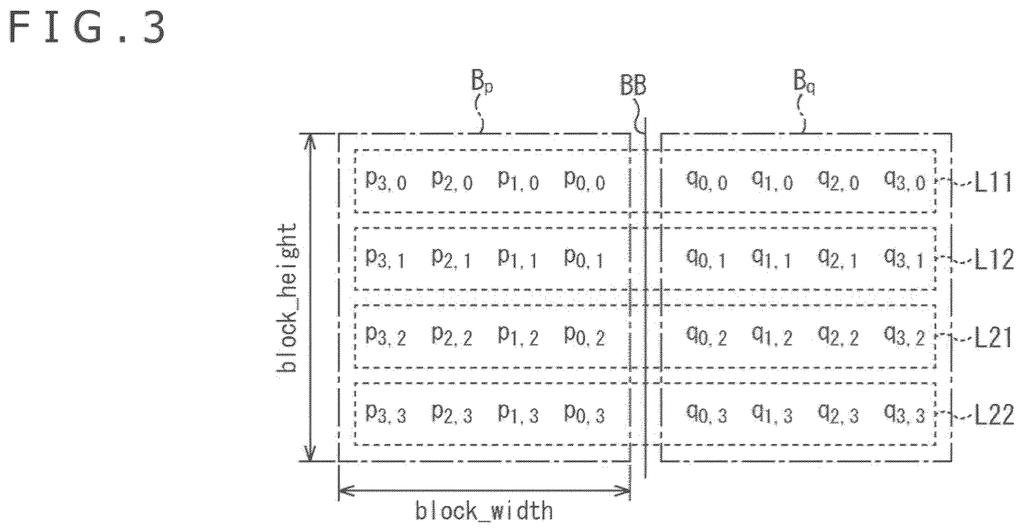
When the video is decoded on your device, a deblocking filter is applied to smooth out the visible seams between blocks. The challenge is that not all block boundaries are equal: a boundary between two small blocks inside a CTU may need a different amount of smoothing than the boundary at the outer edge of a CTU itself.
Sony's patent addresses the color-difference component specifically. In video encoding, color and brightness are stored separately; the color channels (the "color-difference" channels) can behave differently under compression than the brightness channel. The invention describes a third color-difference filter that is applied specifically at CTU-level boundaries, with a design distinct from the filter applied at inner block boundaries.
The result is a two-tier filtering approach:
- One filter strength handles block boundaries that fall inside a CTU.
- A differently designed filter handles boundaries that fall at the edge of a CTU.
This gives the decoder finer control over how aggressively it smooths color information at different scales of the block structure.
A reduced second luminance filter has a reduced filter characteristic with respect to a second luminance filter that has a higher filter strength than a first luminance filter, or a reduced first luminance filter having a reduced filter characteristic with respect to the first luminance filter is applied …
Translation: The system uses toned-down versions of brightness filters to smooth out the colors properly.
What this means for video quality in streaming and cameras
For everyday viewers, the difference shows up as subtly cleaner color in compressed video, particularly around areas with fine detail or sharp edges. Streaming services, broadcast encoders, and camera manufacturers all use deblocking filters as a standard part of their video pipelines, so even a narrow improvement in filter precision can affect a large number of devices and services.
For Sony specifically, this kind of work connects directly to its camera and television hardware businesses, where image quality at the decoding stage is a competitive point. A more precise color deblocking approach could find its way into Sony's cameras, televisions, or professional video equipment, though the patent itself covers the technique broadly rather than any specific product.
That makes this Sony's ninth filing in the Wearable patents we cover since June, a run that includes a controller passing signals to accessories and surfaces that change hardness on demand.
Claim 1 covers a specific filtering decision: when smoothing the rough edges that appear between large blocks in a decoded video image, the filter applied at the outermost boundary of each block must be meaningfully different from the filter applied at boundaries inside it. That is a narrow technical condition, not a sweeping claim over video sharpening in general.
In practice, narrowness has real consequences. Anyone implementing exactly this pattern, a differentiated filter calibrated specifically to that outer boundary, would need Sony's permission. Anyone achieving similar image quality through a different design choice would not.
For a viewer watching streaming video, this patent sits invisibly behind the smoothness of compressed footage. Small differences in how block edges are handled accumulate into visible improvements in picture quality, and this filing stakes out one precise method for making that happen.
There are more where this came from
We read every patent application Big Tech publishes and send you the ones worth knowing. Plain English, free, every week.
The drawings
21 drawing sheets from US 2026/0281462 A1 · click any drawing to enlarge


Want this weekly breakdown for a company we don't cover? Patentlyze Pro →
Be the first to weigh in