
Google Patents a Way to Interrupt Its AI Assistant Without a Wake Word
Google is filing a patent on letting you cut off its AI assistant mid-sentence without saying 'Hey Google' first. It sounds like a small thing, but it gets at one of the most annoying parts of talking to a voice assistant.
What Google's mid-answer interruption actually does
Ever asked a smart speaker something and immediately realized you asked the wrong question? Right now, you'd have to sit through the whole answer, then say 'Hey Google' again before you could correct yourself.
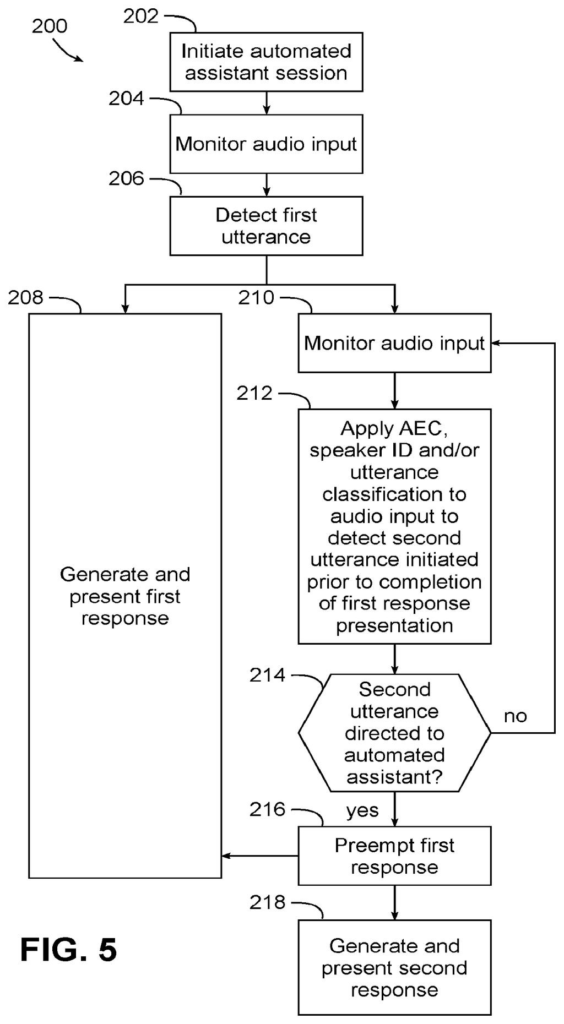
Google's new patent filing describes a system that listens for you to speak up during the assistant's answer and decides, on the fly, whether you're talking to the assistant or just talking to someone else in the room. If it thinks you're addressing it, it stops what it's saying and starts answering your new question instead. No wake word needed.
The filing also covers a related tweak: the assistant waits a smarter amount of time before deciding a conversation is over, based on whether it just finished speaking or cut off early. Both changes are aimed at making voice conversations feel less like filling out a form and more like talking to a person.
… receiving second data associated with a second, hot-word free utterance captured by the microphone during playback of the first, spoken audio response for the first utterance; …
Translation: The system listens for you to speak again while it is still talking, without requiring you to say a wake word.
How the assistant catches your cut-in without 'Hey Google'
The patent describes a two-part system built around utterance classification (software that judges whether a snippet of audio is a command aimed at the assistant or background noise and side-chat).
Here's how the flow works:
- You ask the assistant something, and it starts playing a spoken response.
- While the response is playing, the microphone keeps listening.
- If you speak, the system runs a classification check on your audio to decide whether you're talking to the assistant.
- If the confidence is high enough, the assistant immediately cuts off its current answer and starts handling your new request instead.
The key engineering detail is that no hot word (like "Hey Google" or "OK Google") is required for that interruption. Normally, voice assistants ignore everything that doesn't start with a wake word. Here, the wake word is replaced by a probability judgment: does the audio pattern suggest a directed question?
The second part of the patent covers dynamic session timeout. After a conversation, assistants typically wait a fixed number of seconds before deciding you're done. This system adjusts that window based on whether the assistant finished its answer or got cut off, making the conversation feel less abruptly ended.
The presentation of an automated assistant response may be selectively pre-empted in response to a hot-word free utterance that is received during the presentation and that is determined to be likely directed to the automated assistant.
Translation: Google's system can cut off its own answer if it realizes you are trying to interrupt it with a new command.
What this means for how voice assistants feel to use
For everyday use, this matters more than it sounds. Wake words are one of the biggest friction points in voice interfaces. Having to say "Hey Google" to redirect a response you already know is wrong feels clunky, especially on shared devices like smart speakers in a kitchen or living room.
The harder problem this filing acknowledges is the false-positive risk: what happens when the assistant mistakes a side conversation for a command and cuts off a perfectly good answer? the pattern in Google's voice-assistant filings suggests the company is trying to solve that through classification confidence thresholds rather than hardware changes, which matters because this is a software-only approach. It could ship as an update to existing Nest speakers or Pixel phones without new microphone arrays or chips.
Google's 42nd filing in voice and speech AI we've tracked since May follows asking users to fix its errors and reading spoken codes aloud.
From a shipping standpoint, everything described here is a software change. The assistant listens while it speaks, judges whether an interruption is meant for it, and responds accordingly, with no new microphone or hardware required.
The calibration is the real work. A system that cuts itself off too eagerly feels intrusive, and one that hesitates too long feels identical to what already exists, so the gap between this filing and a product update is mostly engineering time spent on tuning, not on any fundamental research problem.
The session-timeout piece, where the assistant waits longer when a conversation still feels active instead of cutting off at a fixed clock interval, may be the smoother of the two changes, because most people would simply notice that the assistant stopped feeling impatient.
There are more where this came from
We read every patent application Big Tech publishes and send you the ones worth knowing. Plain English, free, every week.
The drawings
7 drawing sheets from US 2026/0279344 A1 · click any drawing to enlarge


Want this weekly breakdown for a company we don't cover? Patentlyze Pro →