
Apple Patents a Headset That Slides Its Screens to Match Your Eyes
Apple has filed a patent for a head-mounted display that physically moves its two screens apart or together to match the distance between your eyes, then uses forward-facing cameras to show you the real world on those same screens.
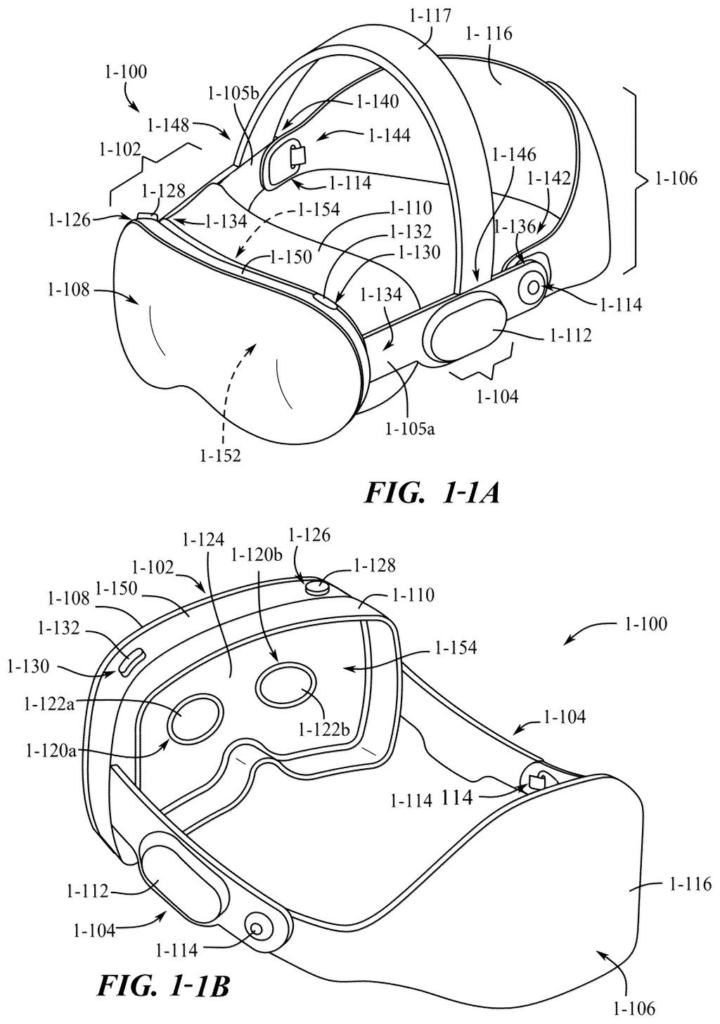
What Apple's eye-spacing display adjustment actually does
You're wearing a headset and everything looks slightly off, like watching a 3D movie with glasses that don't quite fit. That feeling often comes down to one thing: the screens aren't lined up with your eyes.
Apple's patent describes a headset with two displays that can slide in different directions so they land exactly where your eyes are. Everyone's eyes are spaced a little differently, and this adjustment mechanism accounts for that automatically based on your interpupillary distance (the gap between your pupils). The front of the headset is a curved transparent cover, and cameras behind that cover capture what's in front of you and feed it directly to the displays so you see the world around you in real time.
The result is a device that tries to feel less like a screen strapped to your face and more like a window. Whether you're blending virtual content with the real world or just using it as a see-through display, the system is designed to match what you see to how your eyes actually work.
… an adjustment mechanism coupled to the first display and the second display, the adjustment mechanism configured to move the first display in a first linear direction and the second display in a second linear direction non-parallel to the first direction based on an interpupillary distance of the user …
Translation: Mechanical parts shift the screens along different paths to match how far apart your eyes are.
How the displays move and cameras feed the view-through
The core of this patent is a rearward-facing display assembly, two screens that face toward your eyes rather than outward. Those screens are mounted to an adjustment mechanism that can move each one independently, in different directions, so both screens end up centered on each eye regardless of how far apart your eyes are.
The front of the headset is a curved, transparent cover that sits against the contour of your face. Behind it are forward-facing cameras, positioned on either side of a nasal bridge (the part that sits over your nose). Those cameras capture what's in front of you and pipe that footage straight to the displays in what Apple calls mixed reality video pass-through (essentially a live camera feed of the real world layered with or alongside virtual content).
The system uses two cameras and two displays in a stereo arrangement:
- The left camera feeds the left display to give your left eye its view
- The right camera feeds the right display to give your right eye its view
- The nasal bridge sits between the two cameras, mimicking where your nose would naturally split your field of view
A controller ties all of this together, taking the camera feeds and sending the right image to the right screen while also managing any virtual content layered on top. The transparent front cover means the cameras have a clear optical path without needing to look through opaque materials.
… configured to cause mixed reality video pass-through from the first forward facing camera to the first rearward facing display including a first image and from the second forward facing camera to the second rearward facing display including a second image …
Translation: External cameras stream live video of the real world directly onto the inner screens for your eyes.
What this means for fit and comfort in AR headsets
For anyone who has put on a VR or AR headset and had to squint or felt immediate eye strain, this patent is aimed directly at that problem. Getting the screen distance right for your specific anatomy is one of the harder comfort challenges in headset design, and doing it automatically, with a mechanical mechanism rather than manual dials, is a meaningful step toward a device that works for more people out of the box.
The pass-through camera approach also tells you something about how Apple sees the purpose of this device. Rather than fully blocking out the real world, the transparent front cover and camera system are designed to keep you connected to your surroundings. Apple's run of mixed-reality display filings That design philosophy shows up across Apple's run of mixed-reality display filings, where the balance between virtual and real seems to be a central concern.
Apple's 45th filing we've tracked on our AR glasses watchlist since May builds on earlier applications like devices speaking about what they see and guiding photo shoot paths.
The interpupillary distance adjustment is the part worth paying attention to here. Most headsets either fix the screen position or ask you to adjust it manually with a dial, which most people skip. A mechanism that moves two screens in different directions independently, rather than just sliding them symmetrically, is a more honest attempt to handle the fact that eyes are not always perfectly symmetric.
The camera pass-through design is also notable because it relies on a transparent front cover rather than opaque housing. That's a hardware commitment to see-through use, not just a software feature bolted onto a closed shell.
That said, a lot of this is engineering groundwork. Whether the actual adjustment mechanism is precise enough to make a real difference in daily comfort, or whether the camera pass-through introduces any lag or distortion, are questions the patent can't answer. The filing describes the architecture; shipping the experience is a different challenge.
There are more where this came from
We read every patent application Big Tech publishes and send you the ones worth knowing. Plain English, free, every week.
The drawings
592 drawing sheets from US 2026/0279233 A1 · click any drawing to enlarge


Want this weekly breakdown for a company we don't cover? Patentlyze Pro →