
Google Patents an AI That Pulls Real Action Items Out of Meeting Transcripts
Every meeting ends with vague promises that disappear into the ether. Google is patenting a system that reads a meeting transcript, figures out what was actually committed to, and hands you a clean, assigned list of tasks before anyone has left the call.
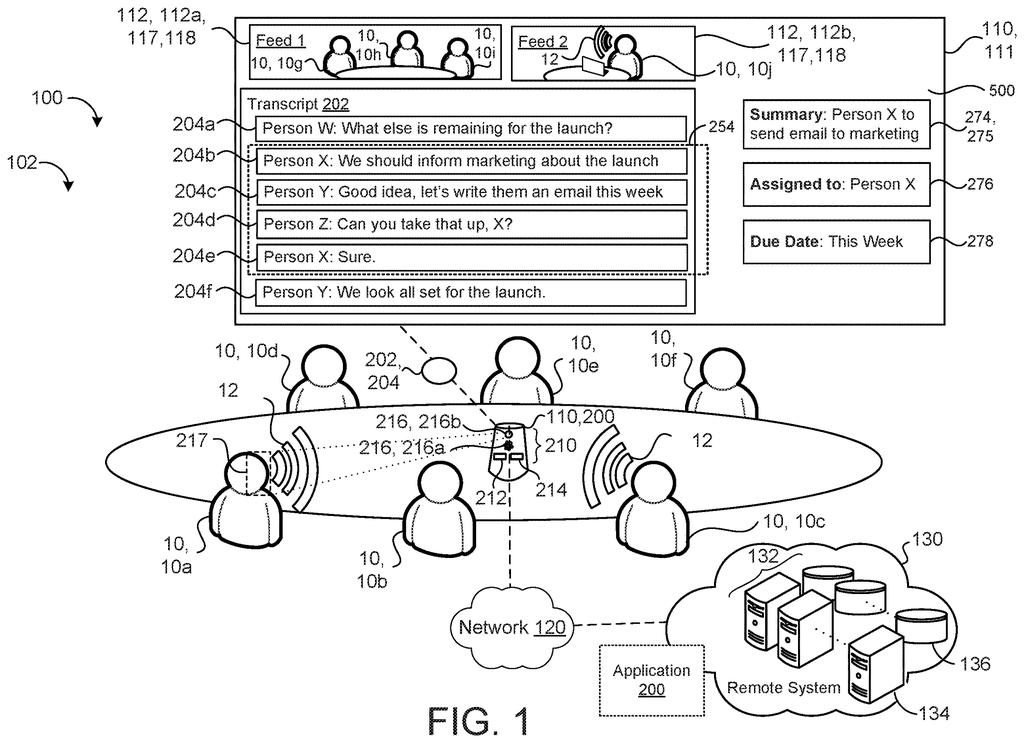
How Google's AI turns meeting talk into assigned to-dos
Imagine you just sat through a one-hour team call. Multiple people volunteered to handle things, some tasks came up twice under different names, and now the 'next steps' chat message is a jumble of bullet points that nobody owns.
Google's patent describes a two-step AI process that fixes that. First, it scans the meeting transcript and pulls out every moment where someone committed to doing something. Then a second AI groups the overlapping commitments into one clean task, writes a plain summary of it, and attaches a name and a due date. If the summary is wrong, you can tell it so, and the AI learns from your correction.
The result is a living task list that builds itself during the meeting, rather than something a note-taker tries to reconstruct afterward. Each item is presented on screen with who is responsible and when it is due.
clustering a subset of the plurality of extractive action items into a coherent group associated with a same respective task; and generating, using a text generation model, a summary of the abstractive action item that concisely describes the same respective task …
Translation: The AI groups related to-do items together and writes a clear summary for the combined task.
How the two-model pipeline clusters and rewrites tasks
The system works in two distinct stages.
Stage one: extraction. A first machine learning model reads the full transcript of a multi-party meeting and flags every extractive action item (a direct quote or close paraphrase from the conversation where a commitment was made). This gives the system a raw list of raw promises, often redundant, because real meetings circle back on the same topics repeatedly.
Stage two: abstraction and clustering. A second model, called an abstractive action item identification model, groups those raw extractions by which task they actually refer to. Once a cluster is formed, a text generation model (think of it as a focused summarizer) writes a single, concise sentence describing the task. This is the abstractive step: instead of quoting the meeting, it paraphrases it into something actionable.
The system then collects two extra pieces of information: who is responsible and when the task is due. All of that gets shown together in one UI card.
Finally, users can flag any summary as inaccurate. That feedback is fed back into the text generation model through fine-tuning (a process where the model adjusts its internal settings based on real-world corrections), so the system gets more accurate over time.
… extracting, from the transcript, a plurality of extractive action items each associated with a task expected to be completed within a timeframe to begin after the multi-party communication session ends.
Translation: It scans the conversation to find specific assignments that people need to finish later.
What this means for Google Meet and Workspace users
If Google ships this inside Google Meet or Workspace, it could replace the post-meeting email that everyone dreads writing. Right now, that email requires someone to remember what was said, decide what counts as a commitment, and guess at ownership. An AI that handles all three steps automatically, and learns when it gets it wrong, is a practical time-saver for anyone who sits through a lot of calls.
The self-improvement loop is the detail worth watching. Most AI summaries are static: they produce output and move on. A system that asks whether its summary was right and adjusts accordingly could become meaningfully more accurate the longer a team uses it, making it more useful for recurring project meetings than for one-off calls.
Google's 37th filing we've tracked since May in our AI agents that act for you watchlist follows the self-improving voice assistant and the email code fetcher.
Google's patent describes software that listens to a meeting, finds every moment someone agreed to do something, and rewrites those scattered moments into a clean to-do list. No new hardware is required, just a live transcript, which most video calls already produce.
That makes the path to a real product unusually short. The heavy lifting is connecting two software tools: one that spots raw commitments in conversation, and one that groups and rewrites them into readable summaries.
The real barrier is trust. Meeting talk is full of half-finished thoughts and promises people immediately walk back, so a single wrong task assigned to the wrong person can turn users off the whole feature. The patent builds in a correction loop where users flag bad summaries, but that only helps if people bother to correct it rather than simply ignore what the system got wrong.
There are more where this came from
We read every patent application Big Tech publishes and send you the ones worth knowing. Plain English, free, every week.
The drawings
7 drawing sheets from US 2026/0278496 A1 · click any drawing to enlarge


Want this weekly breakdown for a company we don't cover? Patentlyze Pro →