
Adobe Patents a Way to Build Graphic Designs by Talking Through Them
Adobe is patenting a system that lets you describe a design out loud, get back several variations, critique them by talking some more, and keep iterating until you land on something you like, all without touching a menu.
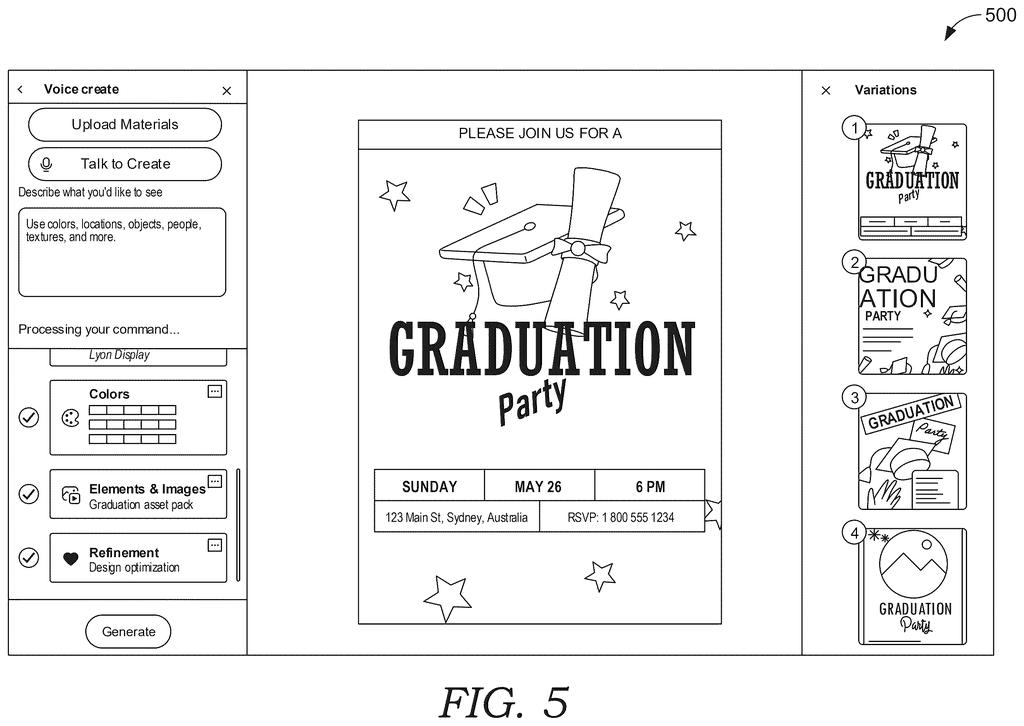
How Adobe's voice-to-design loop actually works
Ever tried to explain exactly what you want a logo to look like and watched a designer nod while producing something totally different? Adobe's new patent is aimed at that gap between what you picture and what ends up on screen.
The idea is straightforward: you speak a description of a design you want, the system figures out which design tools match what you said, runs those tools automatically, and shows you several versions. You then say what you'd change, "make the font bigger," "shift that to the left," "try a warmer color", and the system updates the options again. The back-and-forth continues until you pick a final result.
This isn't a single-shot AI image generator. It's more like a conversation with a design app, where your voice replaces the toolbar. Adobe's patent covers the engine that translates your words into the specific tool operations that a design application would normally require you to trigger manually.
generating, by a design variation generation engine, design variations from speech based on: determining from the speech, by a design command detection engine that uses natural language processing to detect parameters of design commands, detected parameters of detected design commands mapped to corresponding design tools …
Translation: The software listens to your voice and uses language processing to turn your spoken instructions into specific design actions.
How speech gets mapped to specific design tools
At the center of the system is what Adobe calls a design command detection engine, a natural language processing layer that listens to your speech and figures out not just what you want, but which specific design tool inside the application corresponds to your request. If you say "make it bolder," the engine maps that to the font-weight tool. If you say "add more breathing room around the text," it maps to padding or margin controls.
Once those parameters are detected, a separate design variation generation engine applies them and produces multiple design options at once rather than a single output. The idea is to give you choices, not a single answer.
The system is explicitly iterative. After you review the first round of variations, you speak again with corrections or new requests. The engine then picks up which specific variation you're reacting to, detects the change you want, and applies only that adjustment across the option set. This loop repeats until you select a final design.
The patent covers:
- Detecting structured design parameters from freeform spoken input
- Mapping those parameters to named tools inside a design application
- Generating parallel design variations rather than a linear single output
- Carrying changes forward through multiple spoken revision rounds
After the user reviews the new design variations, the design process iteratively continues until the user selects a final design.
Translation: You can keep talking to the computer to refine your project until you are happy with the final result.
What this means for designers who hate clicking
For anyone who has spent twenty minutes hunting through Photoshop or Illustrator panels to find one slider, the appeal here is obvious. A voice layer that understands "make the headline feel heavier" and actually moves the right dial could meaningfully speed up early-stage design work. The iterative framing also matters: most voice-controlled creative tools treat each command as a fresh start, but this system is designed to carry context forward from round to round, which is much closer to how real design conversations work.
The bigger question is whether Adobe folds this into Express, Firefly, or one of its full desktop apps, the patent doesn't say. Either way, the design-by-conversation approach is a clear direction across the industry, and the latest Big Tech patents in the creative software space consistently point toward voice and natural language as the next battleground for tools like these.
The tradeoff here is real and worth naming: a system that maps spoken words to specific tool operations is only as good as its translation layer. When the language is ambiguous, and design language almost always is, the engine has to guess, and a wrong guess generates several wrong variations at once, multiplying the friction instead of reducing it. Adobe is betting that enough context from the full utterance, plus the iterative correction loop, will cover those failure cases. That bet is reasonable for simple layout and typography adjustments, but it gets shaky fast for complex multi-element compositions where a single misread instruction can cascade across every variation. The patent is worth taking seriously as a framework for voice-assisted editing; the hard work is in the model quality that Adobe hasn't disclosed here.
There are more where this came from
We read every patent application Big Tech publishes and send you the ones worth knowing. Plain English, free, every week.
The drawings
10 drawing sheets from US 2026/0236222 A1 · click any drawing to enlarge


Want this weekly breakdown for a company we don't cover? Patentlyze Pro →
Be the first to weigh in