
Samsung Patents Earbuds That Work Out What You're Doing From Sound and Movement
Samsung's earbuds would listen to the room and feel how you're moving, then guess whether you're reading, working, walking or exercising. Each guess comes with its own kind of nudge, from a sitting reminder to a lost-phone warning.
What Samsung's earbud scene-detection setup does
Ever had a fitness gadget buzz you to stand up while you were already pacing around the kitchen? That kind of mistake happens when a device relies on a single clue about what you're doing.
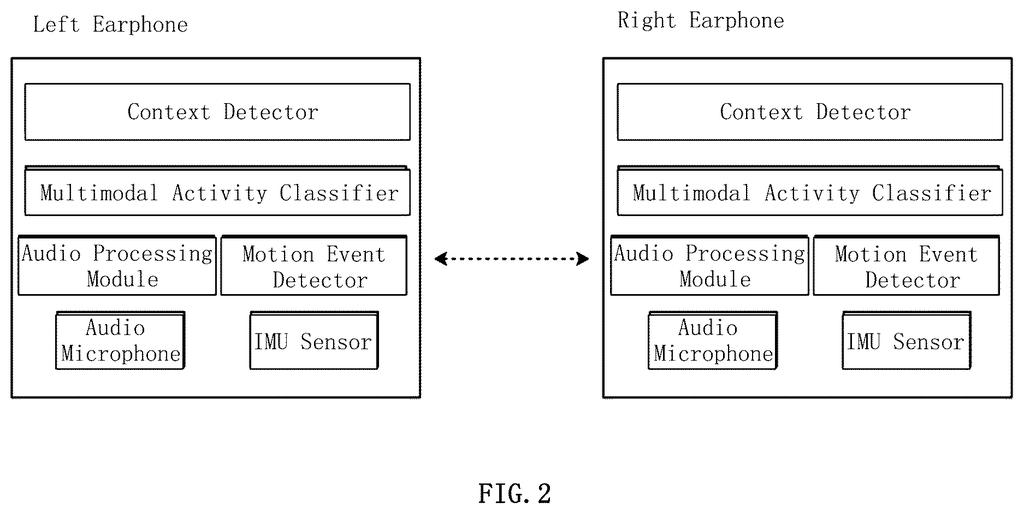
Samsung's patent application tries to fix that by giving earbuds two clues at once. The microphones pick up how loud and noisy your surroundings are, while a motion sensor tracks how much you're moving. The earbuds rate each on a simple low, medium, high scale, then match the pair to a scene such as reading, office work, moving or sports.
Once the earbuds think they know your situation, they only watch for the things that matter there. Sitting still and quiet for a long time might get you a long-sitting reminder. Walking while your phone is far behind might trigger a phone-loss warning.
… determining a target scene in which a user is currently located based on the determined audio level, the determined motion level and a preset correspondence …
Translation: The earbuds figure out your current situation by combining sounds around you with your physical movement.
How the earbuds turn sound and motion into a scene
The claims cover a method for earphones that collects two kinds of raw data: outside sound and user motion inertial data (readings from a motion sensor, called an IMU, that measures acceleration in three directions). The earbuds convert each into a level. Sound is rated by loudness and noise, and motion is rated by how large the acceleration readings add up to be.
The levels are then checked against a preset correspondence, which is essentially a lookup table. In the description's example, each of audio and motion has three levels (L0, L1, L2), and the table maps combinations to scenes: reading, office working, moving, sports and others.
Once a scene is picked, the earbuds measure scene-specific values and act when one crosses a threshold. The description gives examples:
- Reading: a long-sitting reminder
- Office: a conversation alert, or lowering your music so you can hear a coworker
- Moving: a warning if the earbuds and phone drift far apart
- Sports: an intense-exercise health notice
The filing also describes engineering extras. Sampling speeds up when motion changes quickly, such as going from a walk to a run (about 5 Hz versus 50 Hz in one example). With two earbuds, readings from the left and right can be averaged, or one can be dropped if its readings are erratic. One earbud can act as the main processor and hand off to the other if it is removed or low on battery. Your phone can also collect the data for the earbuds.
This may reduce the phenomenon of misjudgment to a greater extent, further ensure that the users are provided with services that can satisfy the actual needs of the users …
Translation: Using both sound and motion helps avoid false alarms so the device actually helps you when needed.
Why Samsung wants earbuds that read the room
If this worked well, your earbuds would stop acting like a plain speaker with a few sensors and start acting like an assistant that knows your situation. You'd get fewer pointless alerts, because a reminder that fits a desk and one that fits a run are different things. The filing's own stated goal is cutting down on wrong guesses.
It also shows where earbuds are heading: more sensing, more background monitoring, and more decisions made on the device itself. The description mentions a lightweight random forest model (a simple decision-tree approach) to keep things small enough for tiny hardware. Whether these features show up in a Samsung product is unknown, and the filing names none.
Samsung's new application is the 20th we've tracked since June in our body-reading wearables watchlist, which already includes filings like one on post-medication health tracking and one on wear detection.
The problem here is real but small. Anyone who has been told to stand up mid-walk, or had a wellness alert fire at a pointless moment, knows how annoying a wrong guess feels. Adding a second clue to the first is a sensible answer, and it matches the size of the annoyance.
The scene list is also very short: reading, office work, moving, sports and "others." Real days are messier than five boxes, so the practical gain depends on how well the earbuds handle the gray areas.
On its own, this is a modest, sensible filing. It becomes interesting only if the alerts it triggers are useful enough that you'd want your earbuds speaking up in the first place.
Get our take in your Top Stories
Liked this breakdown? Add Patentlyze as a preferred source on Google, and our plain-English take shows up more often in your Top Stories the next time Samsung patent news breaks.
There are more where this came from
We read every patent application Big Tech publishes and send you the ones worth knowing. Plain English, free, every week.
The drawings
10 drawing sheets from US 2026/0313282 A1 · click any drawing to enlarge


Want this weekly breakdown for a company we don't cover? Patentlyze Pro →
Be the first to weigh in