
Nvidia Files Patent for Sharper Game Shadows Without the Extra Computing Work
Nvidia has filed a patent for a way to spend extra graphics effort only on the spots in a scene where shadows tend to look rough, such as the shadow of a bicycle wheel or a patch of grass.
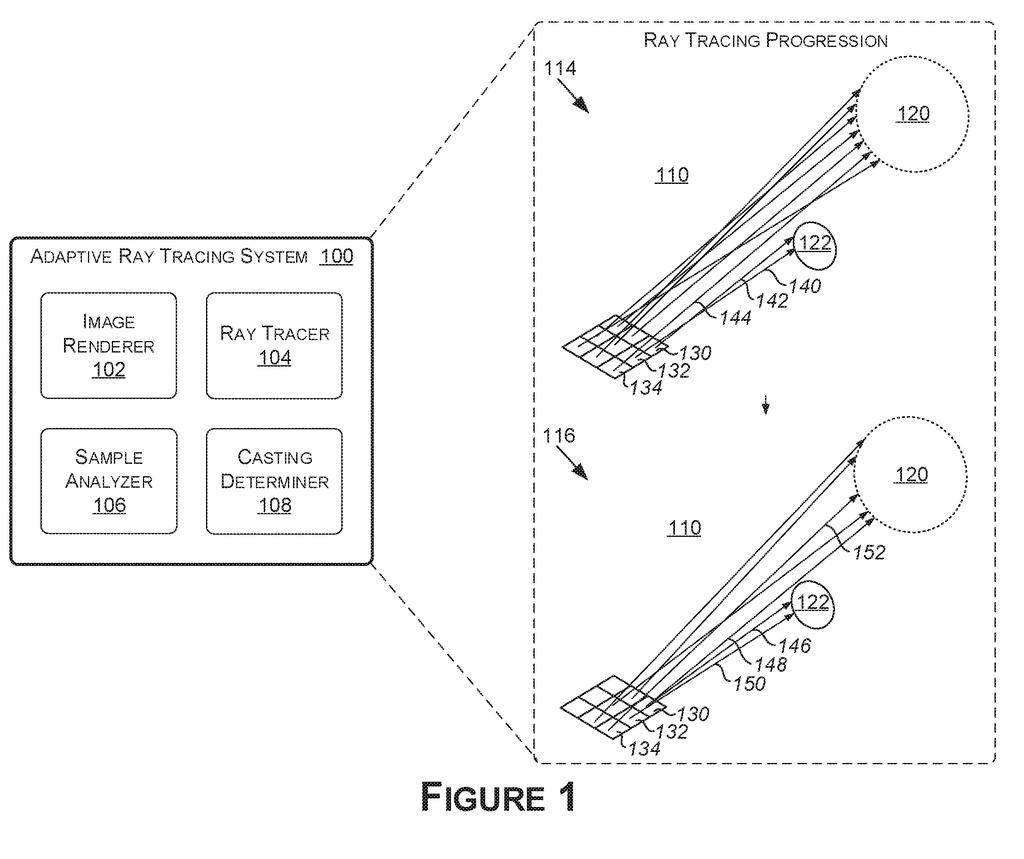
What Nvidia's adaptive shadow patent actually does
Today, a video game draws realistic shadows by firing a virtual ray of light from each point on the screen and checking whether something blocks it. Fire only one ray per point, which keeps the game running fast, and the soft edges of shadows come out noisy. The trouble is worst around thin, detailed things like bicycle spokes, leaves, and blades of grass.
Nvidia's patent stops treating every point the same. The computer takes a first quick pass, then checks the neighbors around each spot. Where an object sits close by and the results look mixed, it fires an extra ray or two just there.
Everywhere else, the shortcut stays. The filing says this cuts the total number of rays needed for good-looking shadows, which saves computing power and rendering time.
determining, based at least on one or more first samples corresponding to a first set of one or more rays cast from one or more locations in a virtual environment, that one or more distances between the one or more locations and one or more objects are within one or more proximity thresholds …
Translation: The system checks if objects are close enough to require extra detail.
How the renderer decides where to add rays
The patent describes a rendering method that samples shadows in two stages. In the first pass, the computer casts one ray (a line traced from a point in the scene toward a light) for each point. It records whether the light was reached and how far the ray traveled before hitting something. That second number is the hit distance.
Next, it looks at each point's neighbors, usually a small grid around it such as 3-by-3. The filing says the grid size can change with screen resolution, from 2-by-2 at high resolutions to 5-by-5 at low ones. The first independent claim covers the core step: if the distances show an object within a set threshold, the system casts a second set of rays from that point. That is where fine detail and jagged shadow edges tend to appear.
The filing's examples add some detail:
- Neighbors that are a mix of lit and shadowed suggest a soft shadow edge, which earns one extra ray.
- Short hit distances suggest a shadow-casting object nearby, which can earn another.
- Fully lit or fully dark areas get no extra rays.
The claims also cover scaling the number of extra rays with the distance values. Samples from both passes are combined into one result for each point, and a GPU (graphics chip) can run the checks in parallel.
An additional ray(s) may be used for locations that tend to be associated with visual artifacts in rendered images.
Translation: Extra processing rays are sent only to trouble spots prone to graphic flaws.
Why cleaner shadows matter for game graphics
If you play games or use 3D software with realistic lighting, the practical payoff is cleaner shadows without a heavy price in speed. Shadows with ragged or flickering edges are one of the visible rough spots in ray-traced graphics. Fixing them by adding rays everywhere would eat the performance that people buy powerful graphics cards to get.
The patent's answer is to spend rays only where the picture needs them. The filing says this lowers the overall ray count needed for high-quality shadows. It also notes the same approach could apply to other effects, such as reflections. Nothing here names a product, so treat it as a look at how Nvidia thinks about the trade-off between image quality and speed.
Nvidia's 43rd filing we've tracked since July, following a check on adding frames and sharpening only blurry spots, adds another piece to our GPU rendering race watchlist.
The problem here is real but modest. Rough shadow edges around fine details like leaves and fences are easy to spot once you notice them, and fixing them the brute-force way means paying for extra work across the entire screen. That cost is what makes the problem matter to anyone building a game that has to hold a smooth frame rate.
The approach is sized to match. It checks the neighbors, adds rays only where the clues point to trouble, and leaves everything else alone. A fix this targeted fits a problem this contained.
Expect better-looking shadows rather than a new kind of graphics. It reads as a sensible piece of engineering with a clear payoff, and nobody will mistake it for a big leap.
Get our take in your Top Stories
Liked this breakdown? Add Patentlyze as a preferred source on Google, and our plain-English take shows up more often in your Top Stories the next time Nvidia patent news breaks.
There are more where this came from
We read every patent application Big Tech publishes and send you the ones worth knowing. Plain English, free, every week.
The drawings
10 drawing sheets from US 2026/0350911 A1 · click any drawing to enlarge


Show the other 2 sheets


Want this weekly breakdown for a company we don't cover? Patentlyze Pro →
Be the first to weigh in