
Nvidia Files Patent for AI Video Built From Frames That Share Their Static
Nvidia's filing gives every frame of an AI-made video a family resemblance: each frame's starting static is built from the static of the frame before it.
What Nvidia's linked-static video idea does
Ever wondered how an AI turns a phrase like "dog riding a bike" into a moving video? Today's image generators start with a screen of random static and gradually clean it up into a picture that matches your words. A video is just a stack of pictures, so you need a lot of them.
Nvidia's patent application changes where each frame starts. Instead of giving every frame its own fresh static, it builds the static for each frame from the frame before, plus a small dose of new randomness. Neighboring frames start out related, like a row of photos shot a moment apart.
The AI then cleans up all those related frames, guided by your text. That text can describe which objects appear, where they sit and what style they have. The cleaned-up frames become the finished video.
generate a series of correlated noised images, wherein one or more of the correlated noised images contain noise based, at least in part, on noise within one or more earlier images in the series of correlated noised images; …
Translation: The system creates a chain of grainy starter pictures where each new frame borrows its random noise from the ones before it.
How each frame's static gets built from the last
The claims cover a processor (also written as a system and as a method) that makes a video from a text prompt using a diffusion model. That is an AI trained to take an image buried in random static, called noise, and clean it up into a realistic picture that fits a description.
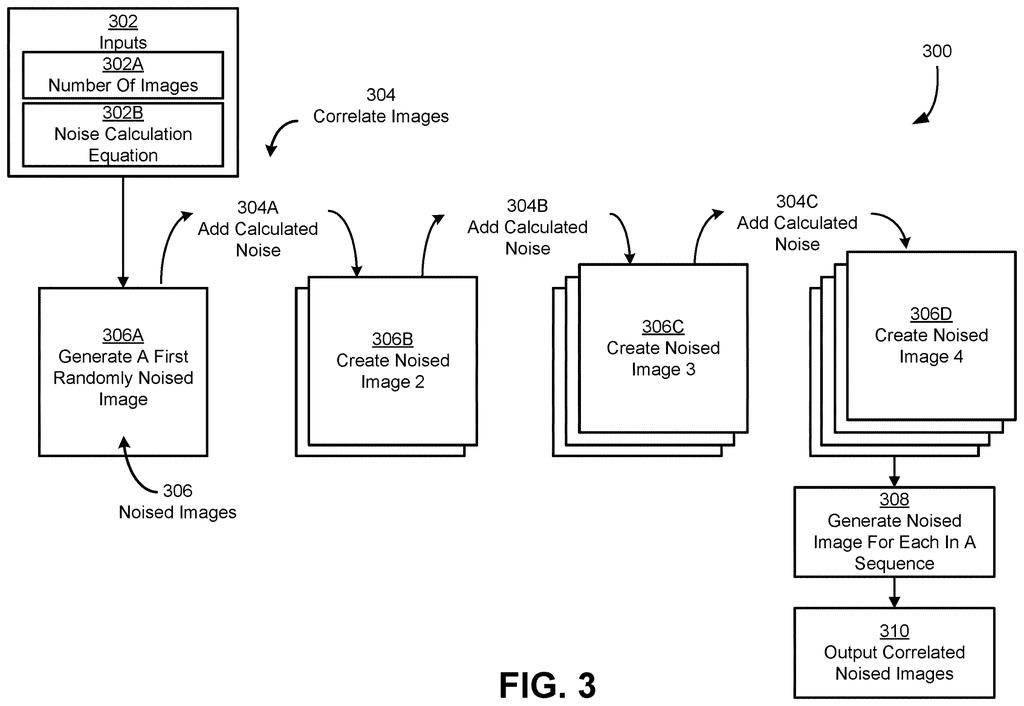
The twist is how the starting static is made. The processor generates a series of correlated noised images, meaning each one carries noise based on the noise in earlier images in the series. The dependent claims add variations:
- Copying the same noise from an earlier image into the next one, then adding extra noise on top.
- Adding that extra noise at random, following a probability distribution (a rule for how likely different values are).
- Building the noised series from images that had no noise to begin with.
The description gives a simple recipe: a factor times the earlier frame's noise, plus a factor times fresh noise. The model then denoises the whole series into video frames, following constraints from the text, such as which objects appear, where they sit and what style they have. The description also mentions lighting, speed and direction.
For training, the model first learns to make images from text, then is adapted using video and text pairs and the correlated noise. The filing says inputs can also include a first-frame image, a frame count or a video length.
Apparatuses, system, and techniques to process resources used to perform a neural network to generate one or more images.
Translation: This patent covers the hardware and methods needed to run AI models that produce pictures.
What shared static means for text-to-video tools
If you have tried text-to-video tools, you know the basic ask: type a sentence, get a clip. The filing points at a cost problem underneath. Video holds many near-duplicate frames, which take extra memory and computing power, and the patent uses that overlap by letting neighboring frames share their starting static.
The claims are written around a processor, which fits Nvidia's business of selling the chips these models run on. The description says the work can run on CPUs, GPUs and other processors, including in a data center. For you, any effect would show up behind the scenes, in how video generators are built and trained.
Nvidia's 47th filing we've tracked under our Enterprise AI coverage since May adds to a run that includes one cutting data shuffling and one building newsletters from social posts.
This idea needs almost no new equipment. The claims describe a change to how the starting static is made, which is a software step that runs on the same chips that already train and run image generators.
What has to exist first is the heavy part: a strong text-to-image model and a big collection of video and text pairs to adapt it. The filing says it begins with an ordinary image model, then adapts it. The shortest route to a product is an existing image generator, a new noise recipe and a round of video training.
That makes it a believable recipe, though the document gives no test results, so you cannot judge how good the clips look. It is also a continuation of a 2023 application, so the idea has been in the works for a while.
Get our take in your Top Stories
Liked this breakdown? Add Patentlyze as a preferred source on Google, and our plain-English take shows up more often in your Top Stories the next time Nvidia patent news breaks.
There are more where this came from
We read every patent application Big Tech publishes and send you the ones worth knowing. Plain English, free, every week.
The drawings
56 drawing sheets from US 2026/0350760 A1 · click any drawing to enlarge


Show the other 48 sheets


Want this weekly breakdown for a company we don't cover? Patentlyze Pro →
Be the first to weigh in