
IBM Patents a System That Decodes Horn Honks and Alerts Drivers Automatically
That honk you just heard — was it aimed at you, the car cutting in two lanes over, or the cyclist up ahead? IBM wants vehicles to figure that out automatically and just tell you.
What IBM's horn-intent detection actually does for drivers
Imagine you're driving and someone lays on their horn nearby. You don't know if they're honking at you, at another car, or just venting frustration at a red light. That split-second confusion is what IBM's new patent is trying to eliminate.
The system uses your car's sensors to pick up a signaling sound — a horn, a siren, an alert beep — and then tries to determine three things: where the sound came from, who it was aimed at, and why it happened. It also generates a bird's-eye aerial view of the nearby vehicles to give spatial context.
Once the system figures out the intent, it sends a plain-language message to whoever is inside your car — essentially translating road noise into useful information. Think of it like a real-time translator for the unspoken language of traffic.
How IBM's system maps sound source, target, and intent
The patent describes a computer-implemented method that runs on a vehicle's onboard system, pulling in data from a set of sensors to process nearby sounds in real time.
The core pipeline has a few distinct steps:
- Condition gathering: The system first builds a picture of the vehicle's surroundings — identifying nearby vehicles, their positions, and movement context.
- Sound identification: Sensors detect a signaling sound (the patent uses horn honking as the primary example) and isolate it from background noise.
- Intent prediction: This is the interesting part — the system attempts to infer why the sound was made (e.g., warning, aggression, acknowledgment) and who the intended target is.
- Aerial view generation: Based on the gathered conditions, the system renders an overhead spatial map showing the vehicle's position relative to others nearby.
- Passenger alert: A message is generated and delivered inside the vehicle communicating the predicted intent in understandable terms.
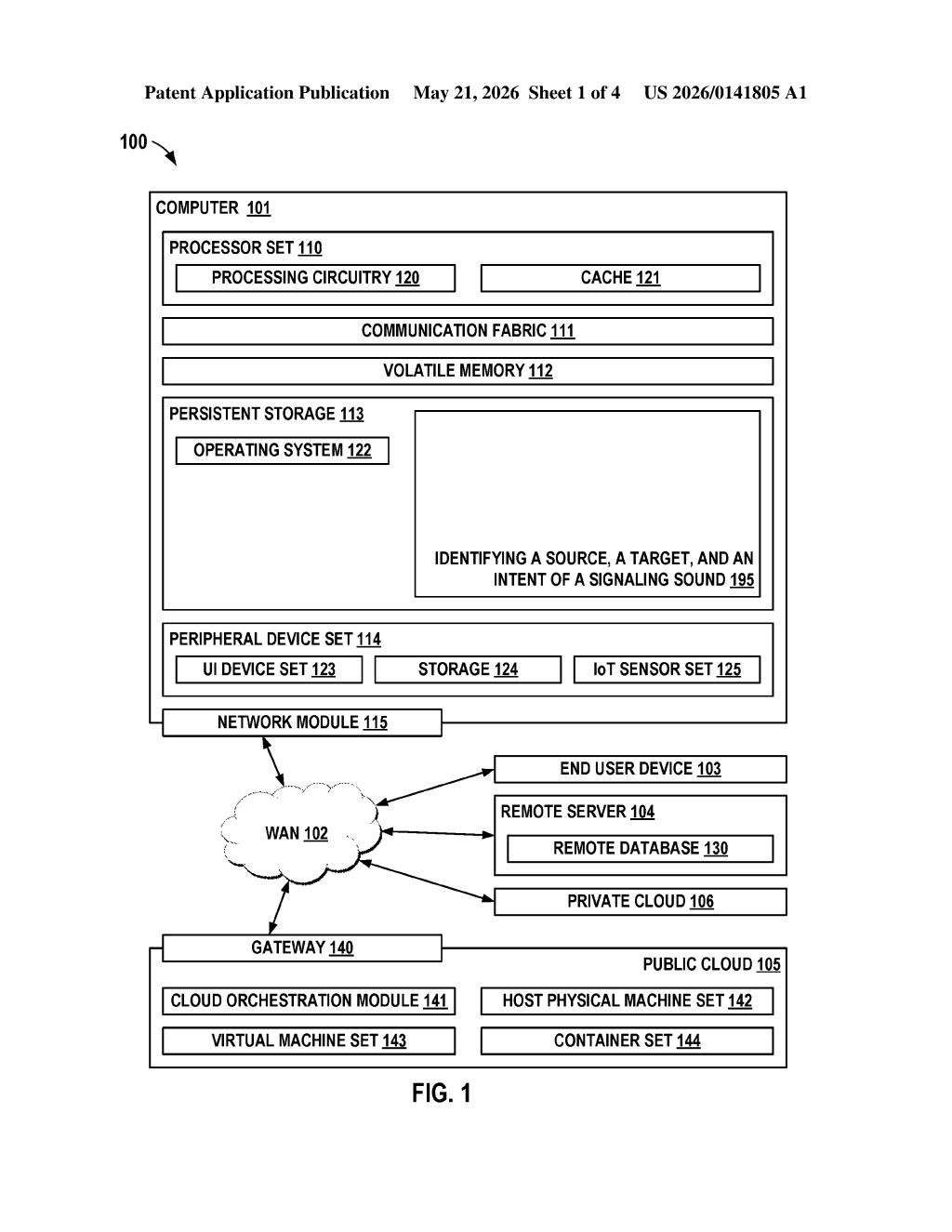
The patent doesn't deeply specify the underlying model architecture, but intent prediction from audio plus spatial context strongly implies a machine learning classifier trained on labeled sound-and-scenario data. The system integrates with cloud infrastructure (the abstract mentions private/public cloud and IoT sensor sets), suggesting it may offload heavy inference to remote servers.
What this means for accessibility and autonomous driving
The most obvious use case here is accessibility: deaf and hard-of-hearing drivers currently can't perceive auditory road cues at all, and a system that converts horn honks into on-screen alerts could meaningfully change that. That alone makes this worth taking seriously.
Beyond accessibility, this kind of sound-intent layer is genuinely useful for autonomous and semi-autonomous vehicles, which need to process the full sensory environment of a road — including the informal communication language of human drivers. A self-driving system that can't interpret a honk the way a human would has a real situational awareness gap. IBM's filing is positioning this as a solvable engineering problem.
This is one of those patents that sounds niche until you think about it for thirty seconds. Decoding the intent behind road sounds is a real gap in both accessibility tech and autonomous vehicle perception — IBM is filing into genuinely underserved territory. Whether the intent-prediction accuracy holds up in chaotic real-world traffic is the hard question, but the problem statement is solid.
Get our take in your Top Stories
Liked this breakdown? Add Patentlyze as a preferred source on Google, and our plain-English take shows up more often in your Top Stories the next time IBM patent news breaks.
There are more where this came from
We read every patent application Big Tech publishes and send you the ones worth knowing. Plain English, free, every week.
Want this weekly breakdown for a company we don't cover? Patentlyze Pro →