
Adobe Patent Reveals AI Music Generator That Critiques and Refines Its Own Output
Most AI music generators make one attempt and hand you the result. Adobe is patenting a system that checks its own output against a target, measures how far off it is, and tries again with a better starting point.
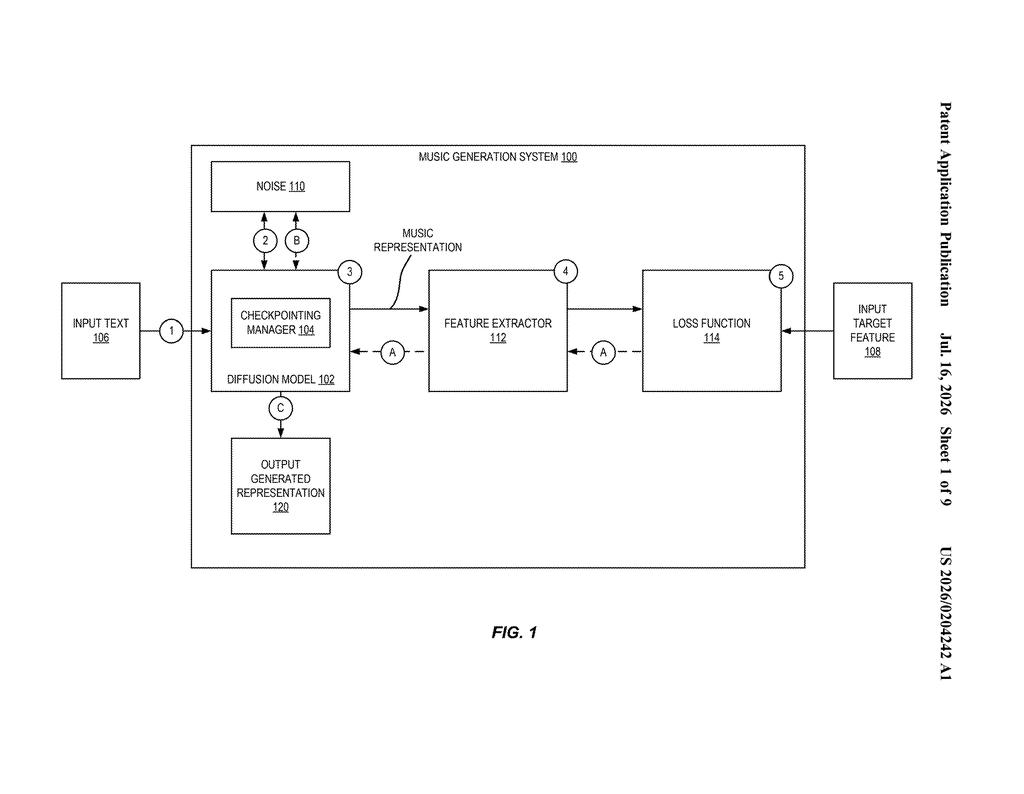
How Adobe's self-correcting music AI actually works
Imagine asking an AI to write a song and getting something close, but not quite right. Maybe the tempo is off, or the mood doesn't match. Adobe's patent describes a system that doesn't just generate music and stop. It checks what it made against what you actually wanted, measures the gap, and adjusts its approach before generating again.
The trick is in what the system starts with. AI music generators typically begin with a blob of random noise and sculpt it into audio using your text description as a guide. Adobe's system keeps that process, but adds a feedback loop: after the first draft, it grades its own work, then tweaks the starting noise to push the next attempt closer to the goal.
This kind of self-correction is common in image-generation research, but applying it to music is trickier because sound has its own structure. If Adobe brings this into a product like Adobe Audition or a future generative audio tool, it could mean fewer manual retries when AI-generated music doesn't quite fit your creative brief.
How the optimizer rewrites the noise seed mid-generation
The patent describes what researchers call inference-time optimization, which means the system improves its output during the generation process rather than requiring retraining. Here's the step-by-step flow:
- You type a text prompt describing the music you want.
- The system grabs a random noise latent (a blob of mathematical randomness that seeds the generation) and runs it through a neural network to produce a rough music spectrogram (a visual map of sound frequencies over time).
- It then extracts measurable features from that spectrogram, things like rhythm patterns, tonal qualities, or energy levels.
- Those features are compared to a target output, which could be a reference track, a style profile, or specific musical attributes you want to hit.
- The gap between what it made and what was wanted is calculated as a loss (a score of how wrong the output is).
- That loss is used to adjust the original noise latent, producing an optimized noise latent that should steer the next generation attempt closer to the target.
- The system generates a new spectrogram from this corrected starting point.
The process borrows from a well-established technique in image AI called diffusion model guidance, but applies it to audio spectrograms, which carry a different kind of structural complexity than images.
What this means for AI-generated music in creative tools
For anyone using AI tools to score video, create background music, or prototype audio ideas, the difference between one shot and done versus self-correcting generation is significant. Right now, most generative music tools give you a batch of random variations and let you pick the best one. A system that actively steers toward a target could reduce that trial-and-error loop considerably, especially when you have a specific reference or mood in mind.
For Adobe, this fits a broader push to make generative AI in its creative suite more controllable. Getting AI to not just generate, but generate to spec, is the harder and more commercially useful problem. This patent is a step toward that, even if the details of how well it works in practice remain to be seen.
This is a technically solid idea that addresses a real frustration with AI music tools: the lack of precision control. Whether Adobe ships it in a consumer product or keeps it in research is the real question, but the self-correction loop is genuinely useful engineering rather than a paper exercise.
There are more where this came from
We read every patent application Big Tech publishes and send you the ones worth knowing. Plain English, free, every week.
Want this weekly breakdown for a company we don't cover? Patentlyze Pro →
Be the first to weigh in