
Apple Patents a Method for Interleaving Chunked Entropy Data Streams
Apple has filed a patent describing a way to weave two separate data streams together at the chunk level — slotting pieces of one stream inside the other — and then cleanly pull them back apart at the other end.
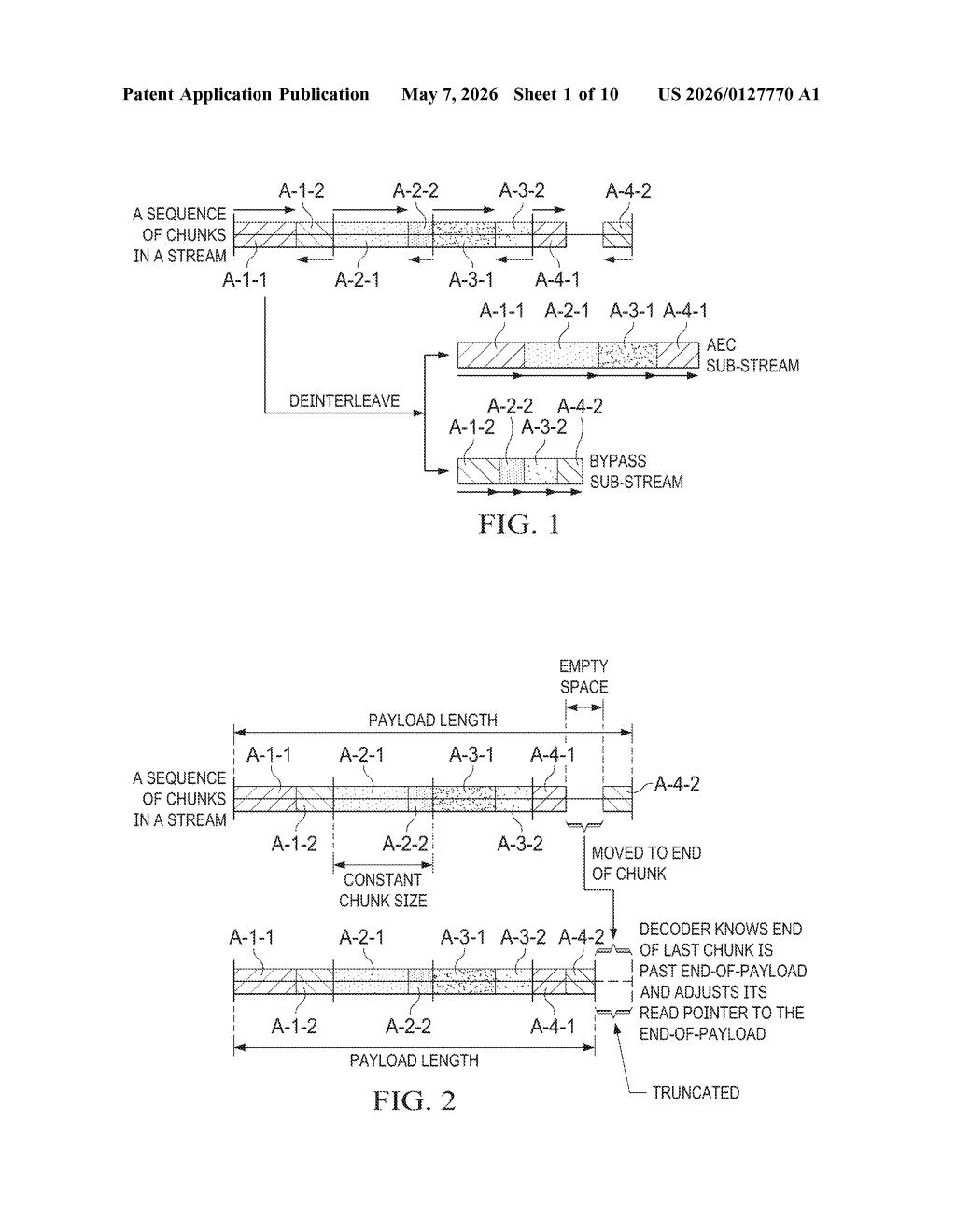
What Apple's interleaved chunk streaming actually does
Imagine you're packing two separate Lego sets into one box for shipping. Instead of dumping them together randomly, you use a system: you put a few pieces from Set A, then a few from Set B, then back to Set A — in a predictable pattern so whoever opens the box can sort them out instantly.
That's essentially what this Apple patent describes. You have two independent streams of compressed data, each broken into pieces called chunks. Rather than sending them one after the other, the method inserts pieces of one stream inside the chunks of the other, creating a single combined stream for storage or transmission.
On the receiving end, the process runs in reverse — the combined stream is decoded back into the original two independent streams. This kind of interleaving can improve how efficiently a decoder processes data, especially when each chunk has internal structure that benefits from being adjacent to related data.
How Apple splits and reassembles the interleaved streams
The patent describes a two-phase process: concatenation (combining) and extraction (separating).
In the combining phase, two independent data streams — each made up of one or more chunks — are merged into a single combined data stream. The key detail is how they're merged: rather than simple sequential appending, the system takes at least a portion of a chunk from the second data stream and inserts it between two sub-streams within a chunk from the first data stream. Each chunk is itself structured with a first sub-stream and a second sub-stream in sequence, and the interleaved material lands between those two.
In the extraction phase — described in the independent claim — a decoder takes the combined stream and recovers both original streams intact. This implies the combined stream carries enough structural metadata or framing to tell a decoder exactly where the boundaries are.
The term entropy stream in the title is key context: entropy coding (think Huffman coding or ANS/RANS — algorithms that compress data by encoding common values with fewer bits) is widely used in video, image, and general-purpose compression. Interleaving entropy-coded chunks can help decoders stay busy by reducing stall cycles while waiting for the next chunk to arrive.
What this means for Apple's compression pipeline
For most users, this patent would be invisible — it lives deep inside a compression or data-transport layer. But for Apple's platforms, efficient entropy coding matters everywhere: video encoding on iPhone and Mac, ProRes and HEVC pipelines, file system compression, and potentially on-device ML model weight storage.
The interleaving approach hints at a system optimized for parallel decoding or pipelined hardware — the kind of custom silicon work Apple does with its media engines on the A- and M-series chips. By structuring how two streams coexist in a single bitstream, Apple may be laying groundwork to keep its decoders fed more efficiently, reducing latency in real-time encoding or playback scenarios.
This is a focused, low-level compression engineering patent — not a headline feature, but exactly the kind of infrastructure work that makes Apple's media pipelines faster than competitors'. The single inventor and narrow claim scope suggest this is a genuine engineering contribution rather than a broad defensive filing. Worth a look if you work in codec or storage engineering.
Get our take in your Top Stories
Liked this breakdown? Add Patentlyze as a preferred source on Google, and our plain-English take shows up more often in your Top Stories the next time Apple patent news breaks.
There are more where this came from
We read every patent application Big Tech publishes and send you the ones worth knowing. Plain English, free, every week.
Want this weekly breakdown for a company we don't cover? Patentlyze Pro →