
Apple Patents Chips That Reroute Around Their Own Broken Test Circuits
Apple is patenting a way for chips to detect when part of their own built-in test wiring is broken — and automatically route around it. It's a small but telling sign of how seriously Apple takes chip manufacturing reliability at scale.
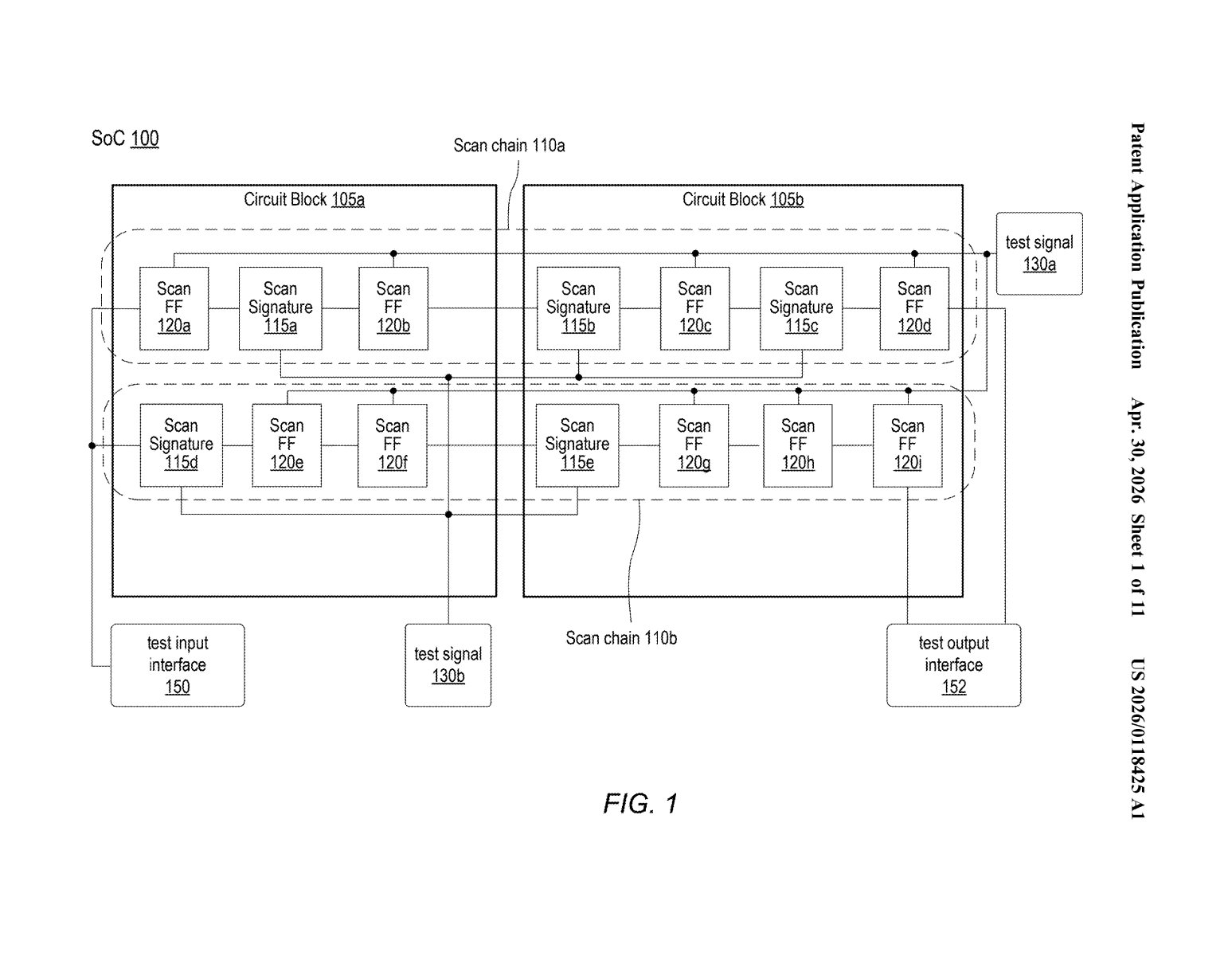
How Apple's chips test themselves — even when broken
Imagine a factory quality-control line where one inspection station breaks down. Normally, everything behind it piles up and you can't check any of it. Apple's patent describes a smarter version of that line — one that notices the broken station and redirects products to a working path.
Every modern chip has a hidden testing system baked right into it, called a scan chain. It's essentially a long daisy-chain of tiny memory cells that lets engineers push a test signal through the chip and catch defects. The problem: if even one link in that chain fails, the whole test can break down.
What Apple is patenting is a chip that can identify which specific link is broken and then enable an alternate route that skips it — so testing can continue and the chip can still be validated. Think of it like a GPS that reroutes you the moment a road closes, automatically and without you asking.
How the scan chain detects and bypasses a failing flip-flop
The patent describes a chip architecture built around three core components working together:
- Scan-enabled flip-flop circuits — tiny one-bit memory cells chained sequentially across multiple circuit blocks. Together they form a scan chain, a standard technique for manufacturing testing where a known pattern of 1s and 0s is shifted through the chain and read out the other end to detect faults.
- Scan signature circuits — helper circuits attached to specific flip-flops that can rapidly load a known test pattern directly into the chain at multiple points, rather than having to shift it all the way from one end. This speeds up diagnosis.
- A test circuit — the brain of the operation. It identifies which specific flip-flop in the chain is failing, then enables an alternate scan chain path that bypasses that broken cell entirely.
The key innovation is in that last piece. Traditional scan chains are brittle: a single failing flip-flop can make it impossible to test everything downstream of it. By adding alternate routing logic, Apple's design lets the chip remain testable even with a damaged internal test structure.
The scan signature circuits also allow concurrent loading of known patterns — meaning the chip doesn't have to shift data laboriously from one end; it can seed the chain at multiple points simultaneously, making fault isolation faster.
What self-healing test logic means for Apple Silicon yields
For Apple, which designs its own silicon at enormous scale — from the A-series in iPhones to the M-series in Macs — even small improvements in chip test coverage can translate into meaningful yield gains at the fab. If a chip can still be fully tested despite a defective scan cell, it might pass quality control rather than being discarded, which directly impacts cost and supply.
This also matters for chips where test infrastructure itself is safety-critical — think automotive or medical applications where Apple has been expanding. A chip that can route around its own broken diagnostics is a more resilient chip overall. For you as a consumer, the downstream effect is potentially better chip quality and fewer duds making it through to finished devices.
This is deep semiconductor plumbing — the kind of patent that never appears in a keynote but quietly represents real engineering discipline. It's not flashy, but it signals that Apple's silicon team is thinking carefully about what happens when manufacturing-scale reality meets chip design theory. Worth attention if you follow Apple Silicon or chip yield engineering.
There are more where this came from
We read every patent application Big Tech publishes and send you the ones worth knowing. Plain English, free, every week.
Want this weekly breakdown for a company we don't cover? Patentlyze Pro →