
Samsung Patents a Two-Adhesive Mount for Fingerprint Sensors Hidden Behind Screens
Keeping a fingerprint sensor perfectly still inside a phone display is harder than it sounds. Samsung's latest patent describes a two-adhesive approach designed to hold the sensor in place without the weaknesses that come with using just one type of glue.
What Samsung's dual-glue fingerprint fix actually does
Imagine a puzzle piece that has to sit perfectly flush inside a cutout, stay put through drops and temperature swings, and never shift even a fraction of a millimeter. That's essentially the job of the fingerprint sensor built into the bottom of your phone's screen.
Samsung's patent describes using two different adhesives instead of one to lock that sensor in place. The first glue is a heat-cured resin, which hardens slowly when exposed to heat and forms a strong, stable bond underneath the sensor. The second is a light-cured resin, which sets almost instantly when hit with UV light and wraps around the sides to stop the sensor from shifting.
The idea is that each adhesive does what the other can't. The heat-set glue provides a firm, long-lasting foundation. The light-set glue acts as a fast-setting clamp around the edges. Together, they're meant to keep the sensor locked in without adding bulk or complexity to the display stack.
How the two adhesives divide the mounting job
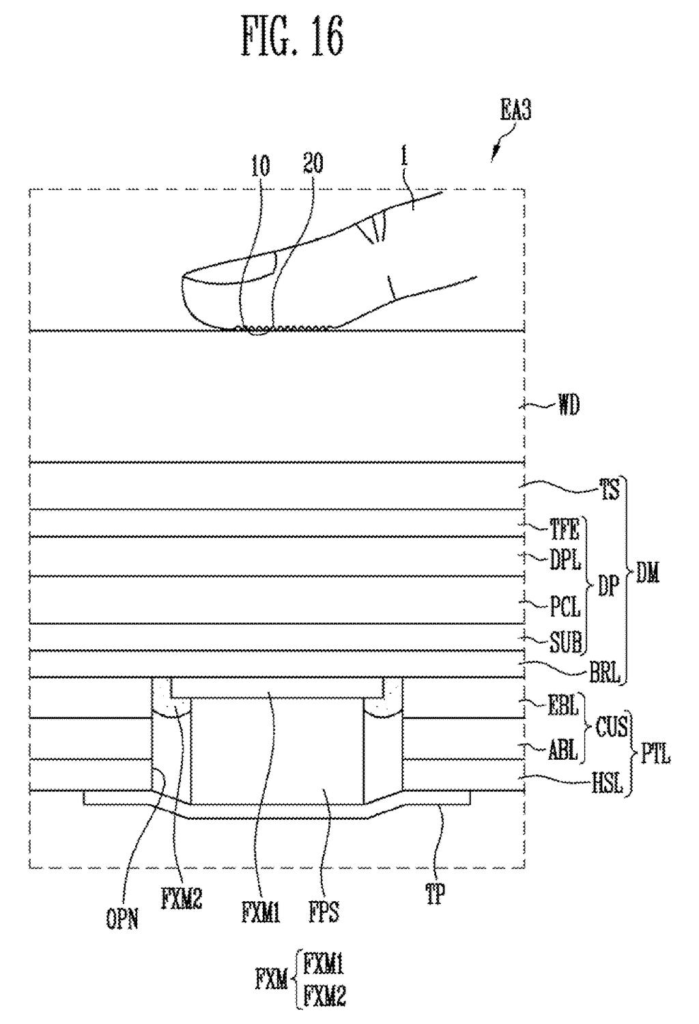
The patent describes a display assembly built in layers. From the front, you have the display panel itself, then a protective layer, then a back panel (called the cover panel) that has a cutout hole. The fingerprint sensor sits inside that cutout hole.
To hold the sensor steady, Samsung proposes two distinct fixing members:
- First fixing member (thermosetting resin): A heat-cured adhesive placed between the display panel and the top face of the fingerprint sensor. It hardens when heated, creating a durable bond that anchors the sensor vertically.
- First-second fixing member (photo-curable resin): A UV-light-cured adhesive that contacts both a portion of the first fixing member and the side of the fingerprint sensor. It cures almost instantly and prevents the sensor from moving laterally inside the opening.
The claim specifies that these two adhesives are made of different materials, which is the core of the invention. Using a single adhesive means accepting trade-offs in cure speed, bond strength, or flexibility. The two-adhesive approach lets Samsung optimize each axis of the mounting problem independently.
What this means for Galaxy display reliability
Under-display fingerprint sensors are now standard on mid-range and flagship Samsung Galaxy phones. Any shift in the sensor's position, even tiny, can degrade read accuracy or cause optical artifacts in the display. A more reliable mounting method directly affects how consistently the sensor works over the phone's lifetime.
For consumers, this is the kind of invisible engineering that determines whether your phone still reads your fingerprint reliably two years after you buy it. For Samsung, tighter sensor mounting also reduces warranty returns. It's not a flashy feature, but it's the sort of refinement that separates durable hardware from hardware that degrades.
This is routine manufacturing engineering, not a product breakthrough. The underlying idea, using two adhesives with complementary curing mechanisms to solve a positioning problem, is the kind of incremental fix that rarely makes headlines but genuinely matters for long-term device quality. Worth noting only if you follow display manufacturing closely.
There are more where this came from
We read every patent application Big Tech publishes and send you the ones worth knowing. Plain English, free, every week.
The drawings
23 drawing sheets from US 2026/0219750 A1 · click any drawing to enlarge


Want this weekly breakdown for a company we don't cover? Patentlyze Pro →
Be the first to weigh in