
Qualcomm Patents a System That Syncs Your Screen's Refresh Rate to What Apps Actually Draw
Your phone's screen often refreshes 120 times per second even when the app it's showing can only produce 30 frames per second — a wasteful mismatch Qualcomm now wants to fix automatically.
How Qualcomm's refresh-rate matching actually works
Imagine your phone's screen is a flipbook that turns pages 120 times every second, but the app you're using only draws 30 new pictures per second. The screen is doing a lot of extra work for no visible benefit — and burning battery the whole time.
Qualcomm's patent describes a system that watches how fast an app is actually producing new frames and then tells the display to refresh at roughly that same speed. If a game slows down under load, the screen slows down to match. If a video app is capped at 24 frames per second, the display doesn't need to spin at 120.
The system uses timing signals — called Vsync pulses — that already exist in every display as reference points, then feeds that data into a model that picks the best refresh rate for the moment. The goal is a screen that's always just fast enough, but never wastefully fast.
Inside the frame-rate adaptation model and Vsync timing
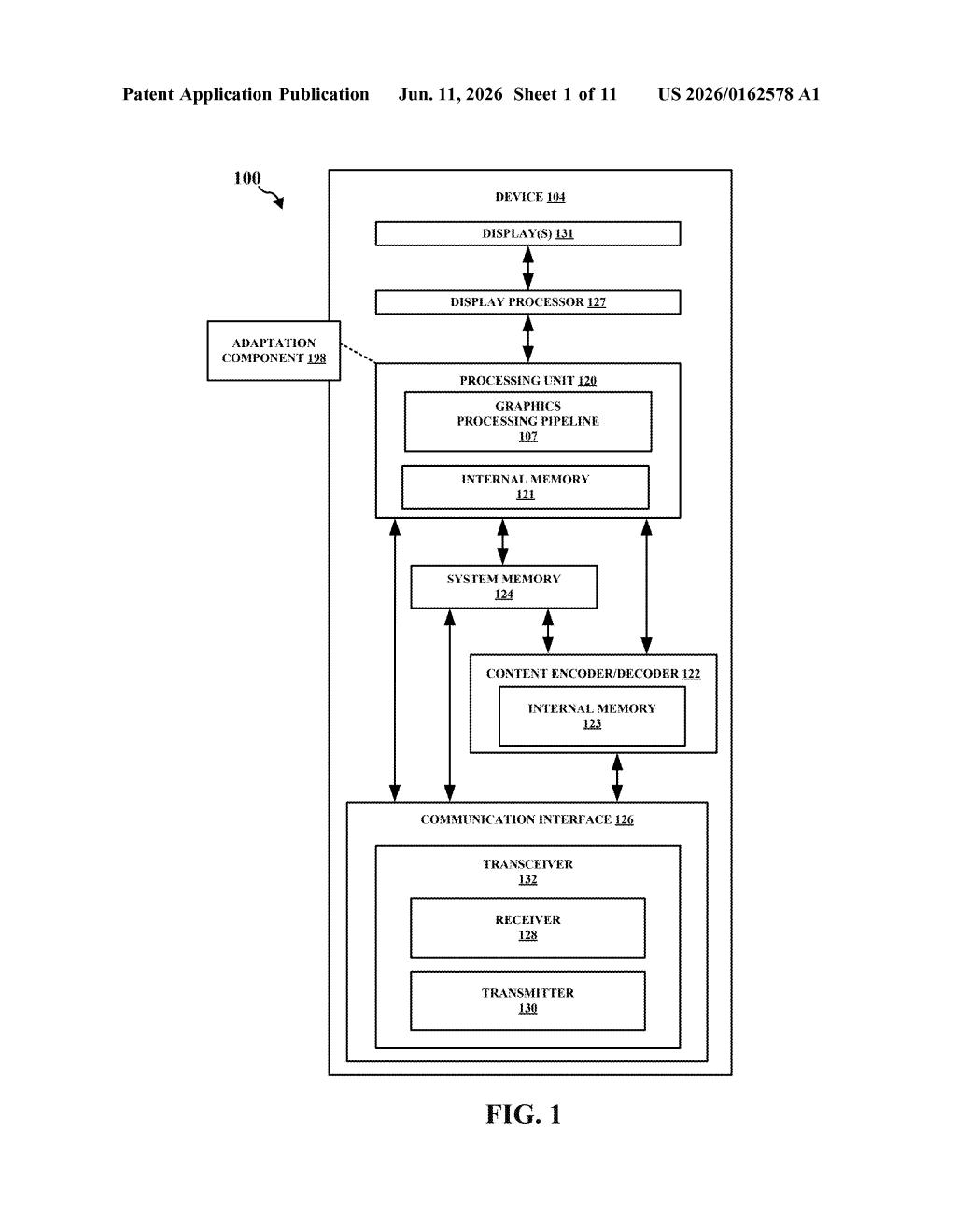
The patent describes a processor-level component that continuously monitors two things: the actual content render rate (how many frames per second an app is genuinely producing) and Vsync timestamps (the regular timing signals a display uses to synchronize when it draws each new image — think of them as a metronome beat the screen follows).
Using those inputs, it calculates an updated content render rate — a refined estimate of what the app will likely produce in the near future, not just what it did in the last instant. This matters because render rates fluctuate; a single measurement is noisy.
That refined rate then goes into a frame rate adaptation model, which is tuned per-application and per-context. The model compares the estimated render rate against the display's current refresh rate and decides whether a change is warranted — and if so, to what target frequency.
Finally, it outputs a command to update the display refresh rate. The whole loop runs on the CPU and is designed to react quickly to real workload changes, avoiding scenarios where the display runs significantly faster or slower than the content being fed to it.
What this means for battery life and display smoothness
For everyday users, the most direct payoff is battery life. High refresh rate displays — the 90 Hz, 120 Hz, and 144 Hz panels now common on Android phones and tablets — are power-hungry. Running them at full speed when an app only needs 30 or 60 frames per second wastes energy in exchange for nothing visible. A tightly matched refresh rate means the display chip does less unnecessary work.
For Qualcomm specifically, this fits squarely into its Snapdragon platform strategy: squeeze more efficiency out of the display pipeline without sacrificing the premium feel of high-refresh screens. If this lands in a shipping SoC, it would be one more lever Qualcomm can pull when competing on power efficiency benchmarks against rivals like MediaTek and Apple Silicon.
This is solid, unsexy engineering — the kind of work that doesn't make headlines but quietly extends screen-on time on the next generation of Snapdragon devices. It's not a new idea in principle (variable refresh rate has existed for years), but automating it at the application-render-rate level rather than relying on developers to set explicit targets is genuinely useful. Worth watching for Snapdragon 8-series integration.
There are more where this came from
We read every patent application Big Tech publishes and send you the ones worth knowing. Plain English, free, every week.
Want this weekly breakdown for a company we don't cover? Patentlyze Pro →