
Google Patents a System That Shifts Its Voice Assistant's Listening Power Based on Who's Talking
When an AI voice assistant is talking, it doesn't need to listen as carefully. Google has patented a system that takes advantage of exactly that insight, dialing the transcription engine up or down depending on whether the assistant's mouth is open or its ears are.
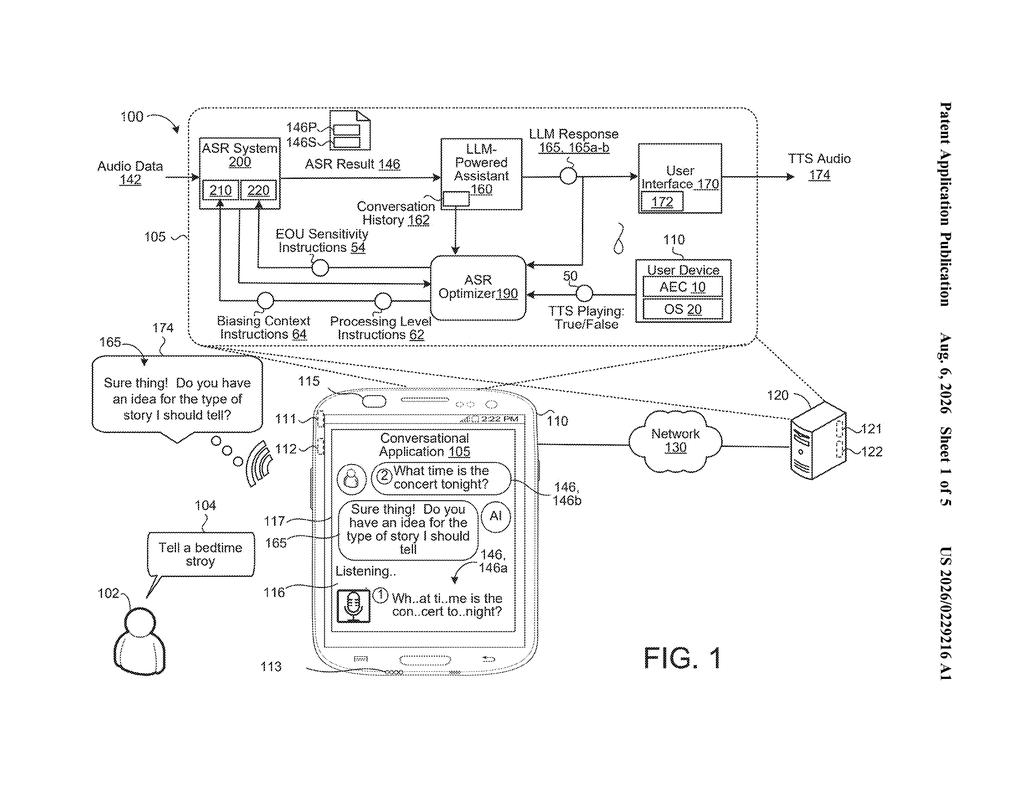
How Google's AI voice assistant manages listening vs. Speaking
Imagine you're having a back-and-forth conversation with a voice assistant like Google Assistant. When the assistant is speaking, you're (usually) not. And when you start talking, the assistant has stopped. These two moments don't need the same amount of computing muscle behind them.
Google's patent describes a system that tracks these conversational turns and automatically adjusts how much processing power the speech recognition engine uses. When the assistant finishes speaking and it's your turn, the system ramps up its listening effort to catch every word of your question accurately. Once you've spoken and the assistant is about to start reading back its answer, the system dials that effort back.
The result is a voice assistant that's not running at full throttle the whole time, reserving its sharpest attention for the moment it actually matters most: right when you start talking.
… instructing an automated speech recognition (ASR) system to use a first level of ASR processing for performing speech recognition on anticipated user speech …
Translation: The system tells its speech recognition tool to switch to a specific listening mode for expected user replies.
How TTS events trigger ASR processing level changes
The system works by watching for two specific signals, called TTS events (text-to-speech events), that mark the start and end of the assistant's spoken output.
- A TTS end event fires when the assistant finishes speaking. The system interprets this as: 'the user is about to talk.' It immediately instructs the ASR system (automated speech recognition, the engine that turns your voice into text) to switch to a higher, more accurate processing level.
- A TTS start event fires just before the assistant begins speaking again. The system interprets this as: 'the user is probably done talking.' It drops the ASR system to a lighter, lower-power processing level.
The ASR system is connected to an LLM-powered assistant (a large language model, the same kind of AI that powers tools like ChatGPT or Gemini). The transcribed text from your speech gets handed to the LLM, which generates a written response. That response then gets converted back into speech and played through your device.
The key idea is that the two processing levels are deliberately different. The patent doesn't lock the system into a fixed mode; it treats the conversation's rhythm as a real-time signal for how hard to work.
Based on receiving a TTS start event indicating that second TTS audio is about to be audibly output from the user device, the method includes instructing the ASR system to use a second level of ASR processing.
Translation: When the assistant is about to speak, it changes its speech recognition level to handle incoming sound differently.
What this means for always-on AI voice assistant design
Voice assistants built on large language models are increasingly expected to run in always-on or near-always-on modes, including on phones, smart speakers, and earbuds. Running the speech recognition engine at maximum accuracy around the clock burns battery and compute resources. A system that scales its effort intelligently based on conversational state could make these assistants faster, cheaper to run, and more efficient on low-power hardware.
For you as a user, this could translate to an assistant that responds more quickly when you speak (because the engine was already primed) while also lasting longer on a charge. It also hints at how Google is thinking about the infrastructure behind Gemini-powered voice features, where every millisecond of responsiveness and every watt of power consumption matters at scale.
This is less a flashy feature patent and more a quiet engineering bet that conversational AI will need to be resource-aware, not just capable. The insight is simple and correct: a voice assistant that treats every moment of a conversation the same way is wasting effort. Whether Google turns this into a measurable battery or latency improvement depends entirely on implementation, but the thinking here is sound and the approach is practical.
There are more where this came from
We read every patent application Big Tech publishes and send you the ones worth knowing. Plain English, free, every week.
The drawings
5 drawing sheets from US 2026/0229216 A1 · click any drawing to enlarge


Want this weekly breakdown for a company we don't cover? Patentlyze Pro →
Be the first to weigh in