
Google Patents a Dual-Pupil Prism System for AR Waveguide Displays
Getting bright, crisp images into a thin AR lens without bulky optics is one of the hardest unsolved problems in wearable tech. Google's new patent attacks it by splitting a single light beam into two before it ever enters the waveguide.
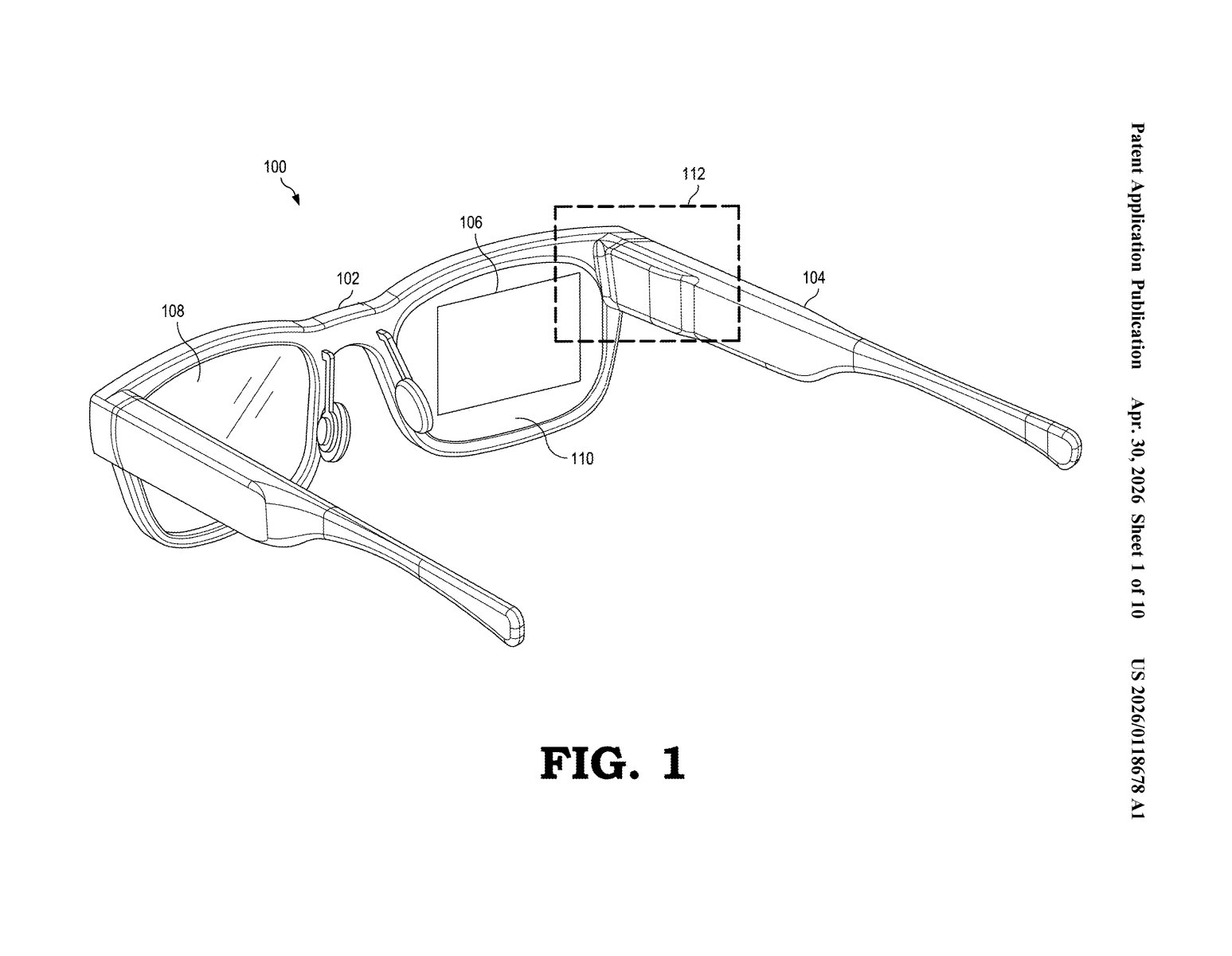
What Google's dual-pupil waveguide prism actually does
Imagine trying to funnel a garden hose's worth of light through a straw — that's roughly the challenge AR glasses face when projecting images into a thin lens you can actually wear. The light has to travel through a special slab of glass called a waveguide, bouncing around inside until it reaches your eye. Getting enough light in cleanly is notoriously difficult.
Google's patent describes a small glass prism — called an incoupler prism — glued to the back of the waveguide (the side away from your eye). Instead of sending one beam of light into the waveguide, this prism takes the single image coming from the display and splits it into two separate light beams, called "input image pupils," before they enter the glass.
The idea is that two entry points can fill the waveguide more evenly, potentially reducing the dark spots and brightness drop-offs that plague current AR displays. It's a clever optical sleight of hand tucked inside the lens itself.
How the incoupler prism splits and routes display light
The patent centers on a waveguide-based optical combiner — the core optical element in most modern AR glasses that overlays digital images onto your view of the real world. Light from a small light-emitting image source (think a micro-LED or LCOS projector) enters the waveguide through an incoupler, bounces down the length of the lens via total internal reflection (like light trapped inside a fiber-optic cable), and exits through an outcoupler toward your eye.
The key invention here is the geometry of the incoupler. Normally, the incoupler sits on the same side of the waveguide as the image source. Google's design flips this: the incoupler prism is attached to the opposite face of the waveguide from the image source. The display light passes through the waveguide first, hits the prism on the back face, and the prism then generates two input image pupils — two distinct copies of the image beam — that are coupled back into the waveguide for propagation.
Splitting into two pupils serves a practical purpose:
- It can expand the effective eye box (the zone where your eye can see the full image)
- It can distribute light more uniformly across the waveguide, reducing brightness falloff
- It potentially reduces the number of separate optical components needed at the lens edge
The prism-on-the-back-face geometry also keeps the light path compact, which matters enormously for keeping lenses thin and socially wearable.
What this means for next-gen AR glasses optics
The waveguide display is the dominant approach for see-through AR optics — it's what's inside Magic Leap, HoloLens, and reportedly Google's own upcoming glasses hardware. The perennial complaints about these displays are a narrow eye box, dim brightness, and visible artifacts. A dual-pupil incoupling scheme directly targets all three.
For you as a potential AR glasses wearer, this could mean fewer moments where the image disappears when your eye shifts slightly, and more consistent brightness across the field of view. It's also notable that Google is actively investing in fundamental waveguide optics patents again — a signal that their AR hardware ambitions are very much alive, even if no shipping product using this exact design has been announced.
This is genuinely interesting optics work, not a defensive filing or a vague software claim. Splitting the entrance pupil before incoupling is a real technique with real tradeoffs (alignment tolerances, prism fabrication), and the fact that four named inventors — including researchers with backgrounds in nanophotonics and diffractive optics — are on this suggests it's more than a paper exercise. Whether it makes it into a shipping Google product is another question, but it's the kind of foundational optics IP that matters if you're trying to build AR glasses that people actually want to wear.
There are more where this came from
We read every patent application Big Tech publishes and send you the ones worth knowing. Plain English, free, every week.
Want this weekly breakdown for a company we don't cover? Patentlyze Pro →