
Nvidia Files Patent to Catch Faulty Timing Before Sensor Readings Are Corrupted
When a chip's internal clock drifts, the data it produces can become unreliable without anything obviously breaking. Nvidia's patent describes a system that catches that drift automatically and tells downstream components to keep going anyway.
What Nvidia's clock-sync detection actually does
Imagine a factory assembly line where every station is supposed to work in perfect rhythm. If one station starts running at a slightly different pace, the parts it hands off may be misaligned, and the whole line could jam up or produce bad output without anyone realizing why.
Nvidia's patent tackles the same problem inside chips. Every circuit on a chip is supposed to tick along in sync with a shared clock signal. If one circuit falls out of step, the data it produces can be wrong or corrupted. The patent describes a way to detect that desync the moment it happens and flag it, so that whatever is receiving that data knows something is off.
Critically, the system doesn't just raise an alarm and stop. It also triggers a corrective operation so that downstream components can keep functioning despite the problem, rather than crashing or silently producing bad results.
Upon detecting a circuit operating asynchronously, a corrective operation may be performed such that a component that receives data generated using the at least one circuit continues operating in view of the indication.
Translation: When a timing glitch is found, the system applies a fix so downstream parts keep working without crashing.
How the system flags and corrects async circuit behavior
The patent centers on a monitoring system that watches whether a given circuit is staying in step with a reference clock (the master timing signal that keeps everything on a chip synchronized).
If a circuit is detected as running asynchronously (meaning out of sync with that reference), two things happen:
- An indication is generated and sent to any component that relies on data from the offending circuit, so that component knows the data may be unreliable.
- A corrective operation is triggered, giving downstream logic a way to keep operating rather than halting or silently trusting bad data.
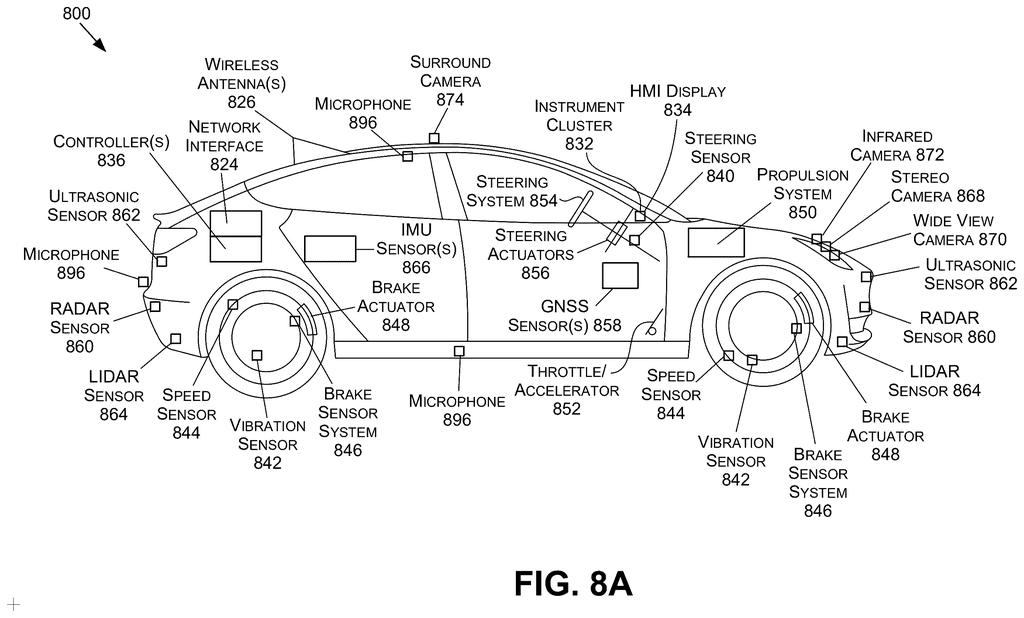
The patent title references "sensor processing," suggesting the primary concern is sensor data pipelines, where timing errors can cause subtle but consequential data corruption. In autonomous driving or robotics, for example, a sensor feeding stale or misaligned data into a perception system is a genuine safety risk.
The first independent claim was canceled in this publication, which limits what can be assessed about the precise legal scope, but the abstract and structure point to a fault-detection and fault-tolerance mechanism for time-sensitive data pipelines.
What this means for Nvidia's sensor and safety work
For Nvidia, which is deeply invested in autonomous vehicles, robotics, and high-performance computing, sensor data reliability is not an abstract engineering concern. A self-driving system that continues operating on corrupted sensor input because no one told it the source was out of sync is a genuine safety problem. This patent describes a layer of defense against exactly that.
The broader principle, detecting and communicating timing faults rather than just crashing, is also relevant to data center hardware, where a failing clock domain can produce silent errors that are notoriously hard to diagnose. If Nvidia bakes this kind of monitoring into its chips, it could make those systems easier to debug and more resilient under real-world operating conditions.
This is a fairly narrow, infrastructure-level patent about timing fault detection. It's not the kind of thing that headlines a product launch, but in safety-critical compute, the difference between 'system crashes when a clock drifts' and 'system detects the drift and keeps going gracefully' is genuinely important. Worth a note if you follow Nvidia's autonomous systems or data center hardware work.
There are more where this came from
We read every patent application Big Tech publishes and send you the ones worth knowing. Plain English, free, every week.
The drawings
12 drawing sheets from US 2026/0227821 A1 · click any drawing to enlarge


Want this weekly breakdown for a company we don't cover? Patentlyze Pro →
Be the first to weigh in