
Samsung Files Patent for Fixing Your Fridge Without Leaving a Virtual World
Your fridge is frosting up while you're deep in a virtual world. Samsung's filing turns that fridge into a shivering character you can fix by draping a cloth over it.
What Samsung's metaverse fridge avatar does
Right now, if your fridge starts frosting up while you're wearing a VR headset, the only fix is to quit your session, walk over, and deal with it. The same goes for an air conditioner that shuts off with an error code, or a robot vacuum that starts up in the middle of your meeting.
Samsung's patent application describes a way to skip that exit. While you're in the virtual world, the system keeps an eye on your real appliances. When one needs you, a character version of it shows up next to you. A frosting fridge, for example, shivers.
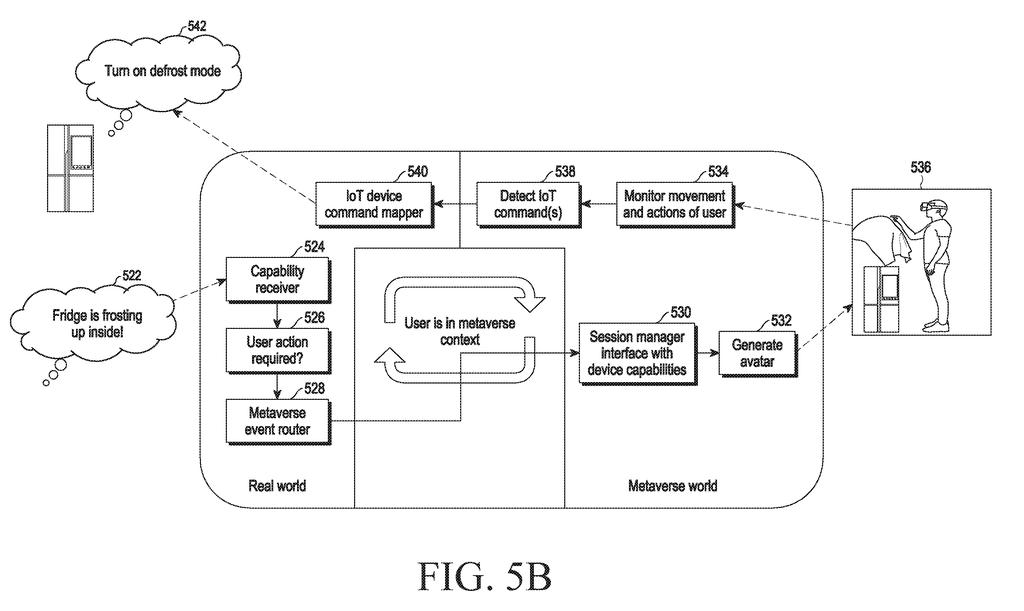
Then you act on the character. Drape a virtual cloth over the shivering fridge, and the real fridge switches on its defrost mode. Make a stop gesture at the robot vacuum, and it stops cleaning. The system also weighs how urgent the appliance is against how important your current task is, so a quick chore doesn't barge into a big meeting.
… determining an IoT device to generate an interactable avatar of the IoT device in the metaverse environment in which a user is engaged, based on the monitored at least one operating state of the at least one IoT device; …
Translation: The system decides when a virtual 3D version of a real appliance should appear inside your virtual world.
How a shivering fridge avatar becomes a command
The claims cover a method run by an electronic device (the filing mentions a smartphone, laptop, smartwatch, cloud server or home hub). It watches the operating state of IoT devices, meaning internet-connected appliances like a fridge, air conditioner or robot vacuum. An operating state is simply what the device is doing: on, off, standby, sleep, maintenance mode and so on.
The core claim has three steps: monitor the appliances, decide which one should get an avatar in the virtual world where you are, and generate that avatar so it reflects the appliance's state. Dependent claims add a compatibility score (a number rating how urgent the appliance's need is compared with what you're doing in the virtual world). An avatar appears only when the score clears a threshold. The system also sorts your current task into critical (a meeting, a call, a focused session) or non-critical.
The avatar is built by an AI model from the appliance's readings (temperature, speed and so on), the action it needs, a library of 3D models, and a library of gestures. A frosting fridge shivers. In one example, an air conditioner that needs cleaning appears as a person feeling cold.
To act on an avatar:
- The system tracks the avatar's movements and your movements, including combined voice and gesture input.
- A gesture-recognition AI model matches them up to work out your intent.
- That gesture is looked up in a library of IoT commands.
- The command is sent to the real appliance, which changes its state.
In the filing's examples, covering the fridge with a cloth starts defrosting, and wiping the air conditioner avatar's face starts its auto-clean mode.
… generating, within the metaverse environment, an interactable avatar of the determined at least one IoT device requiring user’s attention, wherein the interactable avatar is a representative of an operating state of the at least one IoT device.
Translation: It creates a virtual helper object in your headset that mirrors whatever problem is happening with your real appliance.
Why your headset could become a home remote
If you spend long stretches in a headset for games, work meetings or shopping, the practical payoff is simple: household chores stop yanking you out of the experience. Instead of a phone alert that forces you to quit, the chore comes to you inside the virtual space, and you handle it with a gesture.
The filing's own examples are a fridge, an air conditioner and a robot vacuum, all home appliances. It describes no product, and the examiner's first review rejected the claims as filed, which is routine at this stage and usually followed by amendments. Treat it as a look at how Samsung thinks about connecting the virtual and physical worlds, not a sign of a launch.
Samsung's 14th filing we've tracked since July on AI agents acting for you, after routing screenshots to apps and deciding which actions need approval, adds another piece to how the phone handles tasks on your behalf.
The core idea here needs no new hardware to exist. If your headset already knows you're wearing it, and your appliances already report their status to your phone, software alone could connect the two and nudge you when something needs attention.
The harder part is making that nudge feel like more than a pop-up. The patent describes a cartoon version of your fridge or washing machine appearing in your virtual space and acting out its problem, which means someone has to design a believable animated character for every appliance you own and teach the system to tell a deliberate tap from an accidental one.
That design work is the real distance between this patent and something you could actually buy. The basic alert could ship in an update. The animated appliance that shivers to tell you the freezer is open is years of careful design work away from feeling finished.
Get our take in your Top Stories
Liked this breakdown? Add Patentlyze as a preferred source on Google, and our plain-English take shows up more often in your Top Stories the next time Samsung patent news breaks.
There are more where this came from
We read every patent application Big Tech publishes and send you the ones worth knowing. Plain English, free, every week.
The drawings
9 drawing sheets from US 2026/0319572 A1 · click any drawing to enlarge


Show the other 1 sheets

Want this weekly breakdown for a company we don't cover? Patentlyze Pro →
Be the first to weigh in