
Sony Patents a System That Splits Game Graphics Work Between Your Console and the Cloud
Every frame in a video game is the result of hundreds of tiny graphics tasks. Sony has patented a way to split those tasks on the fly between a local console and a remote server, shifting the load depending on how fast your internet is at that exact moment.
What Sony's split rendering system actually does for gamers
Every time a game renders a new frame on your screen, it's doing dozens of separate jobs: calculating lighting, drawing shadows, handling geometry, and more. Right now, a console either does all of that work itself or ships the whole job to a cloud server. There's no middle ground.
Sony's patent describes a system that can split those individual jobs across both places at once. The console handles some tasks locally, while a remote server handles others. The trick is that the system watches your available processing power and your internet connection speed at the same time, then decides in real time which tasks go where.
The result is that your console doesn't need to be as powerful on its own, and a slow internet connection doesn't necessarily kill the experience either. The system simply adjusts what it offloads based on what the network can actually handle right now.
… an output image processor configured to generate the one or more images for display at least in part based on data generated by performing the first rendering task and data generated by performing the second rendering task …
Translation: It combines local and cloud graphics to build the final picture on your screen.
How the allocation processor divides graphics tasks in real time
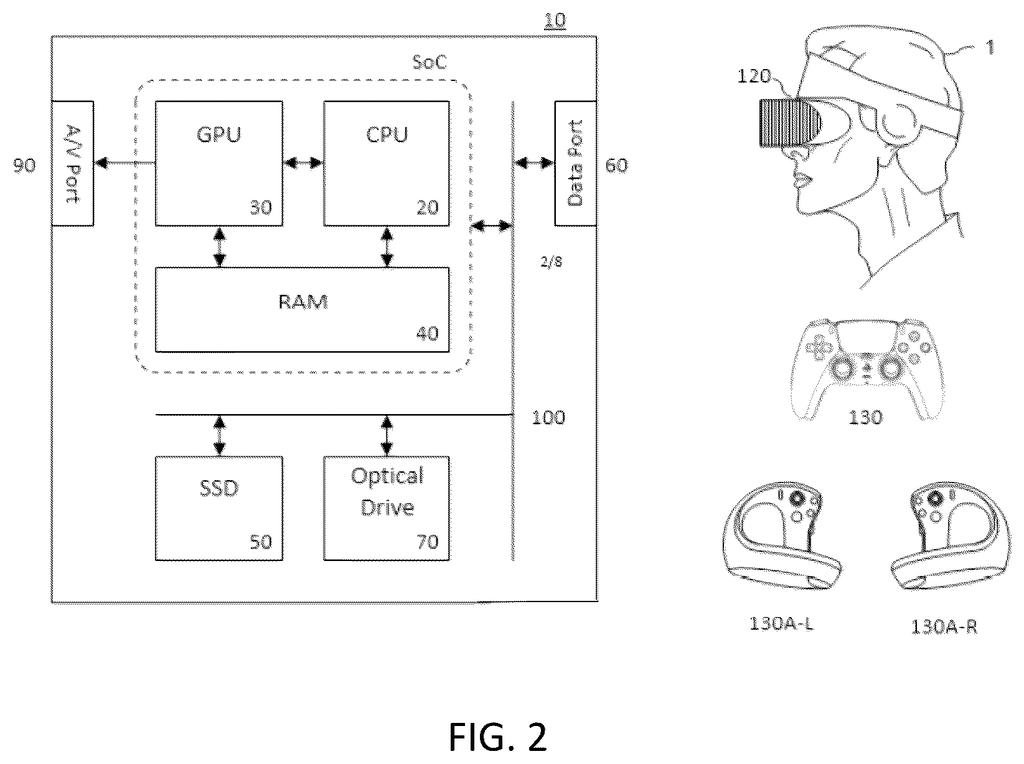
The patent describes four main components working together inside a data processing device (think a game console or similar hardware).
- Rendering processor: handles the graphics tasks assigned to the local device.
- Communication processor: sends requests to a remote server and collects the results of the graphics tasks that run there.
- Output image processor: takes results from both the local rendering and the remote server and combines them into the final image you see on screen.
- Allocation processor: the brain of the system. It monitors how much local processing headroom is available and how much bandwidth the connection to the server can support, then assigns each rendering task to either the local device or the remote server accordingly.
The key word in the claim is dynamic allocation: the system doesn't lock in a fixed split at startup. It continuously watches two variables, local resources and network bandwidth, and redistributes tasks as conditions change. If your connection slows down, more work shifts to the console. If the console is under strain, more work offloads to the server.
The claim doesn't specify what types of rendering tasks are eligible for splitting, which means the scope is deliberately broad. Shadow rendering, geometry processing, post-processing effects, or anything else involved in producing a frame could theoretically be managed this way.
… allocate a task as the first rendering task or the second rendering task based on available processing resources of the data processing apparatus and an available communication bandwidth between the communication processor and the remote computing device …
Translation: The system decides what the console does versus the cloud based on your current hardware load and internet speed.
What this means for PlayStation streaming and cloud gaming
For players, this could mean that a mid-range console paired with a decent internet connection delivers graphics that neither could produce alone. It also suggests Sony is thinking about a future where the line between local hardware and cloud servers is something the system manages invisibly rather than something you choose manually in a settings menu.
For the broader industry, Sony's interest in cloud-assisted rendering is worth reading carefully. The independent claim here is written broadly enough that, if granted, it could cover any system that dynamically splits rendering tasks between a local device and a remote server based on those two variables. That's a wide net, and it would cover a lot of architectures competitors are already building toward.
Sony's 12th filing we've tracked since July in our GPU rendering race watchlist adds to a pattern that includes splitting graphics between device and cloud and one skipping unchanged 3D scan data.
Claim 1 covers any device that splits graphics work between itself and a remote computer, making that split decision based on two conditions together: how much local processing power is free, and how much the connection can carry. The claim names no specific device type, no particular wireless standard, and no category of visual task, which means the coverage is wide by design.
In practice, that scope reaches phones, headsets, consoles, and laptops alike, as long as the device is running that two-part calculation to decide where the heavy visual lifting happens.
If granted in this form, the claim would give Sony a strong position over a broad range of products offloading graphics to remote servers, and any manufacturer building that kind of shared-rendering logic into a consumer device would have to work around it.
There are more where this came from
We read every patent application Big Tech publishes and send you the ones worth knowing. Plain English, free, every week.
The drawings
6 drawing sheets from US 2026/0278908 A1 · click any drawing to enlarge


Want this weekly breakdown for a company we don't cover? Patentlyze Pro →