
Samsung Patents a Way for Robots to Update Their Maps Using Plain-Language Descriptions
Telling a robot 'the couch moved to the left side of the room' sounds simple, but today's robots can't really act on that kind of instruction. Samsung's new patent describes a system that bridges that gap, letting plain-language updates rewrite a robot's internal map of its environment.
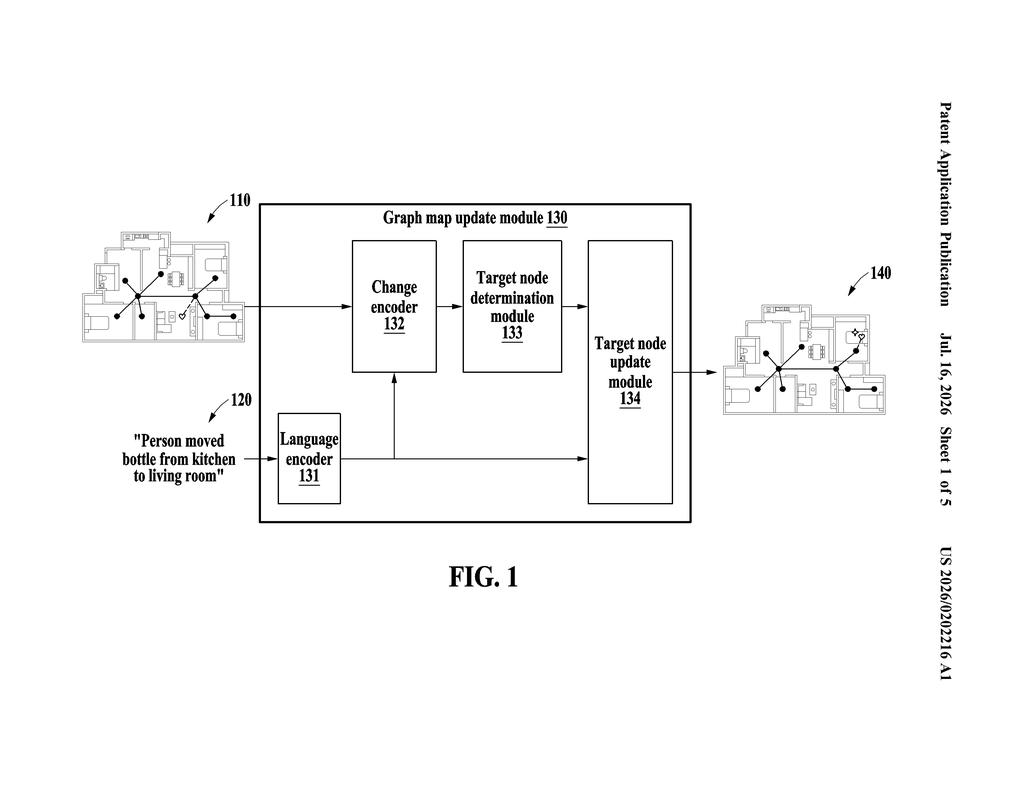
How Samsung wants robots to learn about room changes
Imagine you own a robot vacuum or a home-assistant robot. It has a detailed map of your house that it built over time. Now you rearrange the living room, and suddenly the robot is confused, bumping into the new sofa or taking weird routes around furniture that no longer exists where it thinks it does.
Samsung's patent describes a fix for exactly this situation. Instead of the robot having to re-scan the entire room from scratch, you could simply tell it what changed. Say something like "the bookshelf moved to the hallway" and the robot's internal map updates to reflect that.
The key idea is that the robot's map is built as a graph, a connected web of nodes representing locations and objects, and the system figures out how to apply your words directly to that map. It's a small but genuinely useful idea for anyone who lives in a home that changes.
How natural language rewrites the robot's graph map
The patent describes a system centered on a graph map, a data structure that represents a physical area as a network of connected nodes and edges. Each node might represent a room, a piece of furniture, or a specific location, and the edges describe the relationships between them ("the chair is next to the table," "the hallway connects the bedroom to the kitchen").
When a change happens in the real world, the user provides a natural language input, a plain-English (or any language) description of what changed. The system then interprets that description and applies the corresponding update to the graph map. So adding a node, removing one, or changing how nodes relate to each other can be triggered by a sentence rather than a manual reconfiguration or a full re-scan.
The patent is light on specifics about how the language is interpreted, but the architecture strongly implies a language model or natural language processing component sits between the user's words and the map update logic.
- Generates a graph map of a target area (a home, warehouse, or similar space)
- Accepts plain-language descriptions of changes in that area
- Translates those descriptions into map updates automatically
What this means for home robots and autonomous navigation
For home robots and autonomous devices, keeping maps accurate is one of the hardest day-to-day problems. Re-scanning an environment takes time and compute, and most consumers won't bother with a manual update process. A natural language interface for map corrections is a genuinely practical step toward robots that stay useful in real homes, where things move around constantly.
Samsung makes a wide range of devices that navigate physical spaces, including robot vacuums under the Jet Bot brand and broader home-automation hardware. A patent like this fits neatly into that product direction, making autonomous devices easier to correct and maintain without any technical know-how from you, the user.
This is a focused, practical idea rather than a sweeping AI play. The core insight, that graph maps are a natural fit for language-driven updates, is clean and useful. Whether Samsung can make the language interpretation reliable enough for real-world messiness ("the big couch, not the small one") is the real engineering challenge, and the patent doesn't address that. Worth watching as Samsung's home robot ambitions grow.
There are more where this came from
We read every patent application Big Tech publishes and send you the ones worth knowing. Plain English, free, every week.
Want this weekly breakdown for a company we don't cover? Patentlyze Pro →