
Samsung Patents a Way to Cut the Memory AI Models Need to Think
Every time a large language model generates text, it builds up a growing pile of temporary data called a KV cache. Samsung's new patent describes a way to keep that pile small without losing much quality.
What Samsung's AI memory compression actually does
Imagine you're having a long conversation with an AI assistant. Behind the scenes, the AI is keeping notes on everything said so far so it can stay consistent. The longer the conversation, the more notes it stores, and those notes eat up memory fast. On a phone or a small device, that memory is limited.
Samsung's patent describes a method for deciding which of those notes are truly important and which can be safely compressed or dropped. It ranks the stored information in two ways: first by which parts of the conversation matter most, then by which internal details within each part are the most useful. The less important data gets trimmed down.
The result is that the AI can hold a longer conversation, or run on a device with less memory, without a major drop in quality. Think of it like a smart note-taker who summarizes the boring parts but writes the key moments out in full.
… determining token importance for each of the tokens based on the query tensor and the key tensor; clustering the key tensor and the value tensor into a plurality of clusters based on the determined token importance; …
Translation: It figures out which parts of the data matter most and groups them together accordingly.
How the patent scores and prunes cached AI data
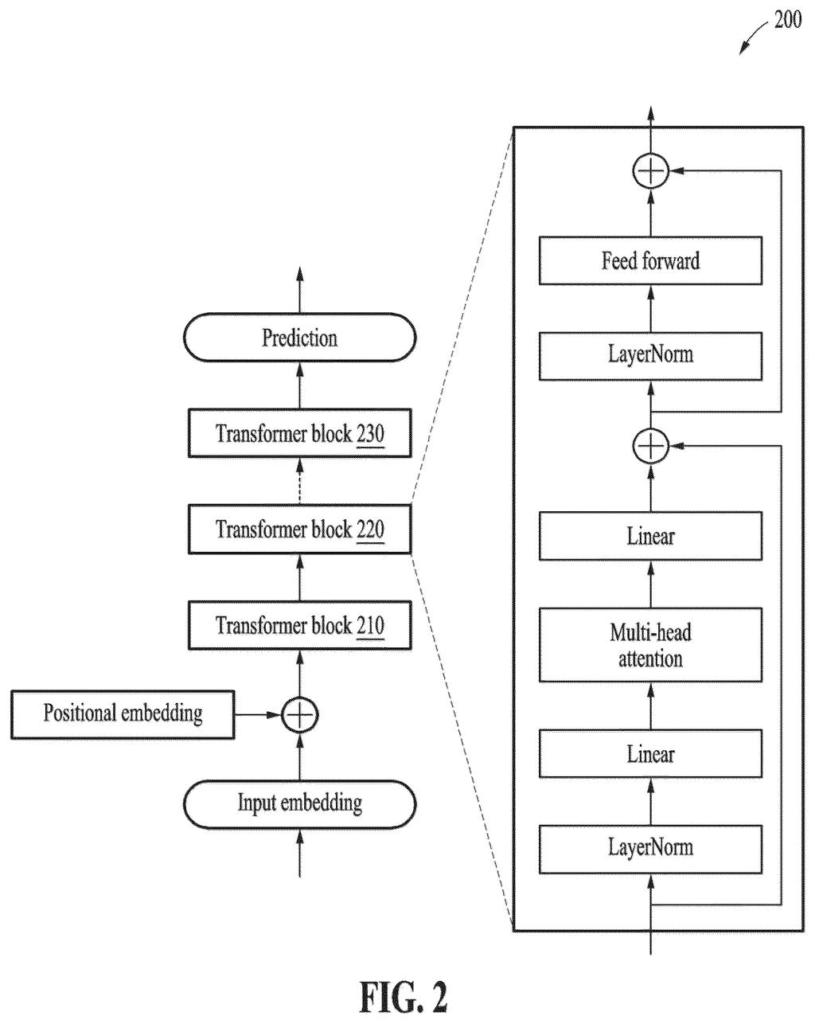
Transformer-based AI models (the architecture behind ChatGPT, Gemini, and most modern language models) rely on something called a KV cache (key-value cache). This is a block of memory that stores processed information about earlier parts of a conversation or document, so the model doesn't have to recompute everything from scratch with each new word it generates.
The problem is that the KV cache grows linearly with context length. On memory-constrained hardware like a smartphone chip, this becomes a bottleneck quickly.
Samsung's method compresses the KV cache in two layered steps:
- Token importance scoring: The system compares the query tensor (what the model is currently asking about) against the key tensors (index pointers to stored information) to decide which stored tokens, meaning which chunks of earlier context, are most relevant right now.
- Clustering: Tokens are grouped into clusters based on their importance scores, keeping similar-priority data together.
- Channel pruning: Within each cluster, the system then scores individual channels (the internal data dimensions inside each tensor) and removes the least informative ones.
The outcome is compressed key-value data that takes up significantly less memory but retains the parts of the context the model is most likely to need.
… generating compressed key-value data by pruning at least one of the channels of the key tensor and the value tensor based on the determined channel importance, and storing the compressed key-value data as key-value cache data …
Translation: It shrinks the memory footprint by throwing away less important details before saving it.
What this means for AI running on phones and chips
Running large AI models on phones and edge devices is one of the central engineering problems in the industry right now. The KV cache is one of the biggest obstacles: longer conversations and documents demand more memory than most mobile chips can comfortably provide. A method that intelligently compresses that cache without destroying output quality directly affects how capable on-device AI assistants can be.
Samsung makes both the chips (Exynos) and the consumer devices (Galaxy phones, tablets) that would benefit from this. A patent like this fits squarely into the company's push to run more AI processing locally rather than relying on cloud servers, which also has privacy and latency benefits for you as the end user.
This is genuinely useful engineering work, not a vanity filing. KV cache bloat is a real and well-documented bottleneck for on-device AI, and a two-stage importance-scoring approach (token-level then channel-level) is a reasonable and non-obvious solution. Whether Samsung's specific implementation outperforms existing compression techniques is the real question, but the problem being solved is worth solving.
There are more where this came from
We read every patent application Big Tech publishes and send you the ones worth knowing. Plain English, free, every week.
The drawings
7 drawing sheets from US 2026/0228532 A1 · click any drawing to enlarge


Want this weekly breakdown for a company we don't cover? Patentlyze Pro →