
Microsoft Patents a System That Maps Blueprint Labels Onto Real-World Photos
Imagine pointing a camera at a server rack or a factory machine and seeing every part automatically labeled — pulled directly from the official schematic diagram. That's exactly what Microsoft has patented.
What Microsoft's schematic-to-camera overlay actually does
Picture a technician standing in front of a complicated piece of industrial equipment. They have the official blueprint on their tablet, but figuring out which physical part matches which labeled box on the diagram takes real mental effort — and mistakes happen.
Microsoft's patent describes a system that bridges that gap automatically. You feed it the schematic diagram and a live camera image of the actual equipment, and it figures out how to line them up. The result is a segmented view — a version of the camera image where each physical component is highlighted and labeled, using the text straight from the original diagram.
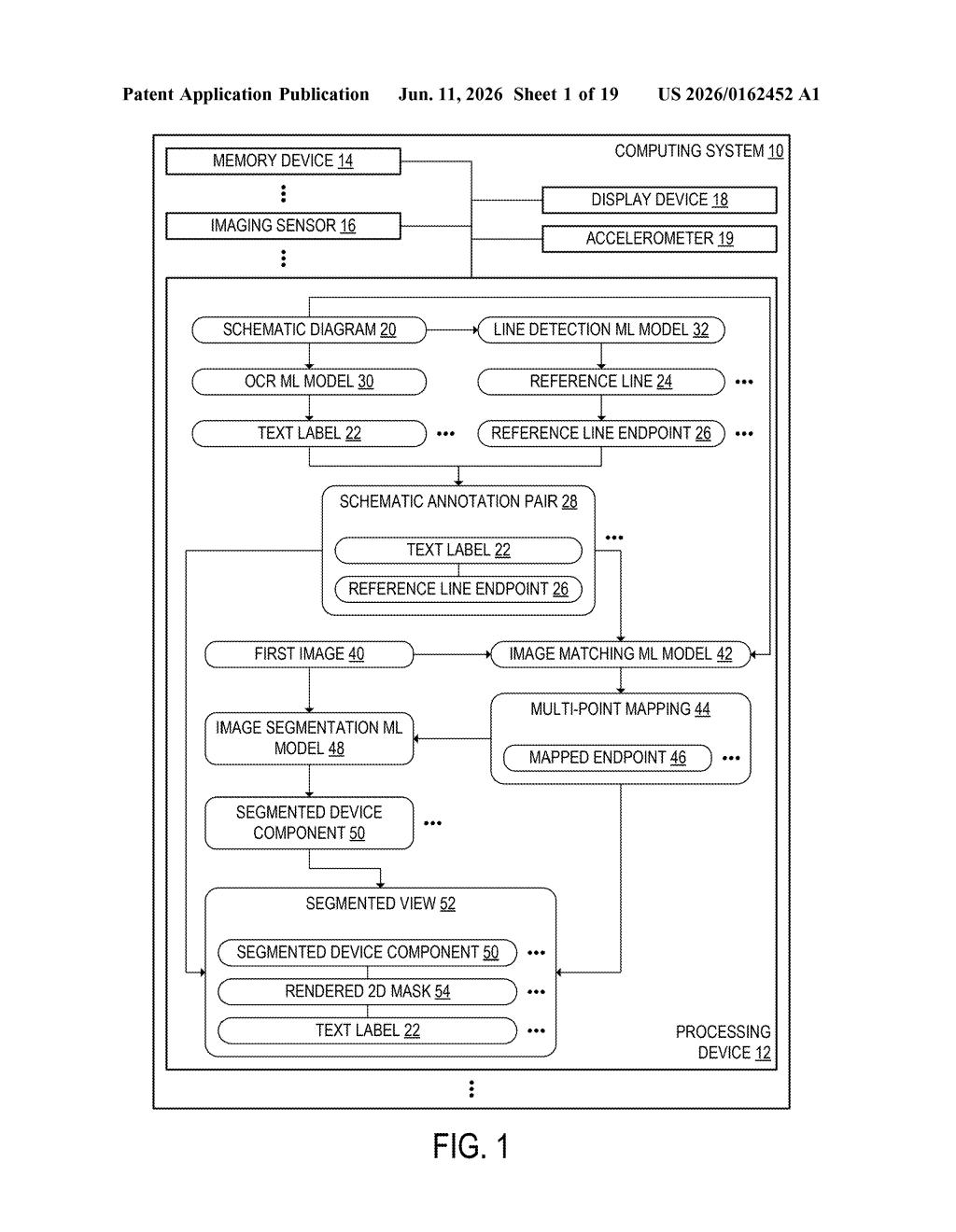
The system uses several AI layers working in sequence: one reads the text labels from the schematic, another traces the pointer lines, a third matches those reference points to the real image, and a fourth draws clean boundaries around the actual physical parts. The technician ends up with a camera view that automatically annotates what they're looking at.
How the system reads diagrams and matches them to real images
The system chains four machine-learning models together to go from a raw schematic to an annotated real-world image.
- OCR model — reads the text labels printed on the schematic diagram (things like 'power supply' or 'relay switch').
- Line detection model — traces the leader lines (the pointer arrows or callout lines that connect a label to the part it describes) and records the tip of each line — the exact point on the diagram where the line meets the component.
- Image matching model — takes those tip coordinates and finds the corresponding spots in a real camera photograph of the equipment, computing a multi-point mapping (think of it as pinning multiple landmarks on both the diagram and the photo so the two images warp into alignment).
- Image segmentation model — uses those matched anchor points to draw boundaries around each physical component in the camera image, isolating it from its surroundings.
The output is a segmented view — the camera image with each component visually highlighted and labeled. The patent specifies that the imaging sensor and display device are part of the same computing system, suggesting a tablet, AR headset, or handheld device as the intended form factor.
What this means for workers using technical diagrams on the job
Field technicians, maintenance engineers, and factory workers spend significant time cross-referencing printed or digital schematics with actual equipment. Getting that lookup wrong can mean misidentifying a component under repair. A system that does the matching automatically — and overlays the result on a live camera view — removes a whole category of human error from that process.
Microsoft already sells productivity and industrial tools through products like Teams, HoloLens (now discontinued as a standalone product, but the IP lives on), and its Dynamics 365 Field Service platform. A schematic-overlay capability would fit naturally into any of those contexts. For you as an end user, this is the kind of feature that could eventually show up in a work-oriented tablet app or a next-generation mixed-reality headset.
This is a genuinely useful industrial-assistance patent, not a vanity filing. The specific pipeline — OCR to line detection to image matching to segmentation — is well-scoped and solves a real problem that field workers deal with every day. Whether it ships as a standalone feature or gets absorbed into a broader mixed-reality or field-service product, it has a clear path to practical use.
There are more where this came from
We read every patent application Big Tech publishes and send you the ones worth knowing. Plain English, free, every week.
Want this weekly breakdown for a company we don't cover? Patentlyze Pro →