
Google Patents a Backward-Compatible Audio Codec That Upgrades Quality On-the-Fly
Google is working on a way to send higher-quality audio to capable devices while keeping older hardware perfectly happy — all inside the same audio stream.
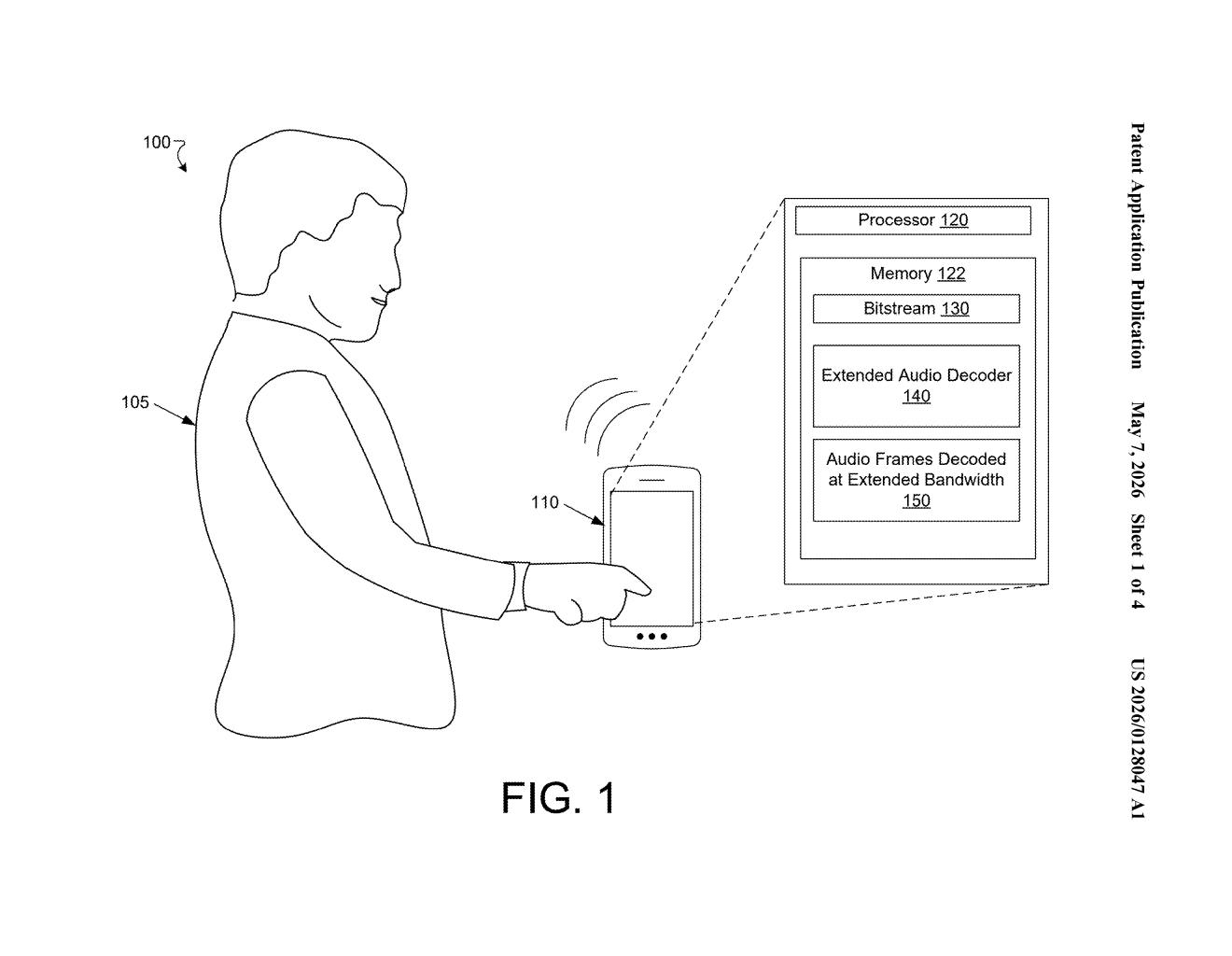
What Google's scalable audio extension actually does
Imagine you're streaming music and your phone gets a better version of the audio than your old Bluetooth speaker, even though both are receiving the same signal. That's essentially what this patent is going for.
Google has filed a patent for an audio codec — a system that compresses and decompresses sound — that can deliver higher audio quality to devices that support it, while older or simpler decoders just ignore the bonus data and play the standard version. No separate streams, no broken playback.
The system works with Opus, a popular open audio format used in calls, streaming, and gaming. A newer decoder sees a set of extension bits tacked onto the normal audio data and uses them to reconstruct richer, more detailed sound. An older decoder simply skips those bits and plays the audio as usual. You get better quality if your device can handle it — and nothing breaks if it can't.
How the extended codebook unlocks higher resolution audio
The patent describes an audio codec that splits its output into two layers: a base bitstream containing a standard compressed audio frame, and an extension bitstream containing additional data that allows a capable decoder to reconstruct the audio at higher fidelity.
The core technical mechanism revolves around a vector quantizer (VQ) — a component that maps audio data to entries in a lookup table called a codebook. Normally, the codebook has a fixed number of entries, which caps how precisely audio can be represented. This patent extends that codebook dynamically: the extension bits tell the decoder to expand its codebook from a first number of entries to a larger second number, enabling finer-grained reconstruction.
Two specific quantizer types are called out:
- Pyramid VQ (PVQ) — a well-known audio quantization technique used in Opus that maps audio vectors onto a geometric shape to save bits efficiently
- Cubic Quantizer — a complementary approach for mapping audio onto a cubic grid at higher resolutions
The extension can increase both bandwidth (the frequency range of audio reproduced, e.g., going beyond standard voice or music cutoffs) and bit depth (the precision of each audio sample, roughly analogous to resolution in images). A header in the Opus format signals to the decoder which extensions are present, so non-upgraded decoders can safely skip everything they don't understand.
What this means for Opus and next-gen audio streaming
Opus is everywhere — it's the codec behind Google Meet, Discord, YouTube, and WebRTC broadly. A backward-compatible upgrade path means Google could push higher-quality audio to modern clients without fragmenting the ecosystem or forcing infrastructure changes. That's a genuinely hard engineering problem, and a clean solution here would make Opus more competitive with newer codecs like Apple's AAC-ELD or Dolby's AC-4 for high-fidelity use cases.
For you as a listener, this could eventually translate to noticeably cleaner voice calls or higher-resolution music streaming — without your app needing a separate "HD mode" toggle. The upgrade just happens if your device supports it.
This is solidly interesting infrastructure work. Jean-Marc Valin is one of the original creators of Opus and Speex, so this isn't a speculative patent from a random team — it's a core codec engineer extending the format he built. The backward-compatibility angle is the real story: getting higher quality without splitting the ecosystem is a real and underappreciated engineering challenge, and this approach is elegant.
There are more where this came from
We read every patent application Big Tech publishes and send you the ones worth knowing. Plain English, free, every week.
Want this weekly breakdown for a company we don't cover? Patentlyze Pro →