
Google Patents a System That Explains What You Just Did by Accident
You tap something on your phone, the screen changes, and you have no idea what just happened. Google has filed a patent for a system that answers the question: 'What did I do there?'
What Google's 'What Did I Do?' feature actually does
Imagine you're scrolling on your phone, your palm grazes the screen, and suddenly something changes — a setting gets toggled, a file moves, a tab closes. You're left staring at the screen wondering what on earth just happened.
Google's patent describes a system designed to answer exactly that question. When you ask the device what just happened — either by voice, a button, or some other prompt — it looks back at the most recent action and generates a plain-language summary describing what it was. Think of it like an undo button that explains itself before you decide whether to reverse anything.
The core idea is simple: the system ties your request for an explanation directly to whatever happened closest in time to when you asked. No digging through history logs or settings menus — just ask, and your device tells you what it did.
How Google identifies and summarizes a recent accidental action
The patent describes a method running on a user device that listens for a summary request — essentially a signal from the user asking 'what just happened?' When that request comes in, the system identifies the most recently performed action on the device by looking at temporal proximity (how close in time an action was to when you asked).
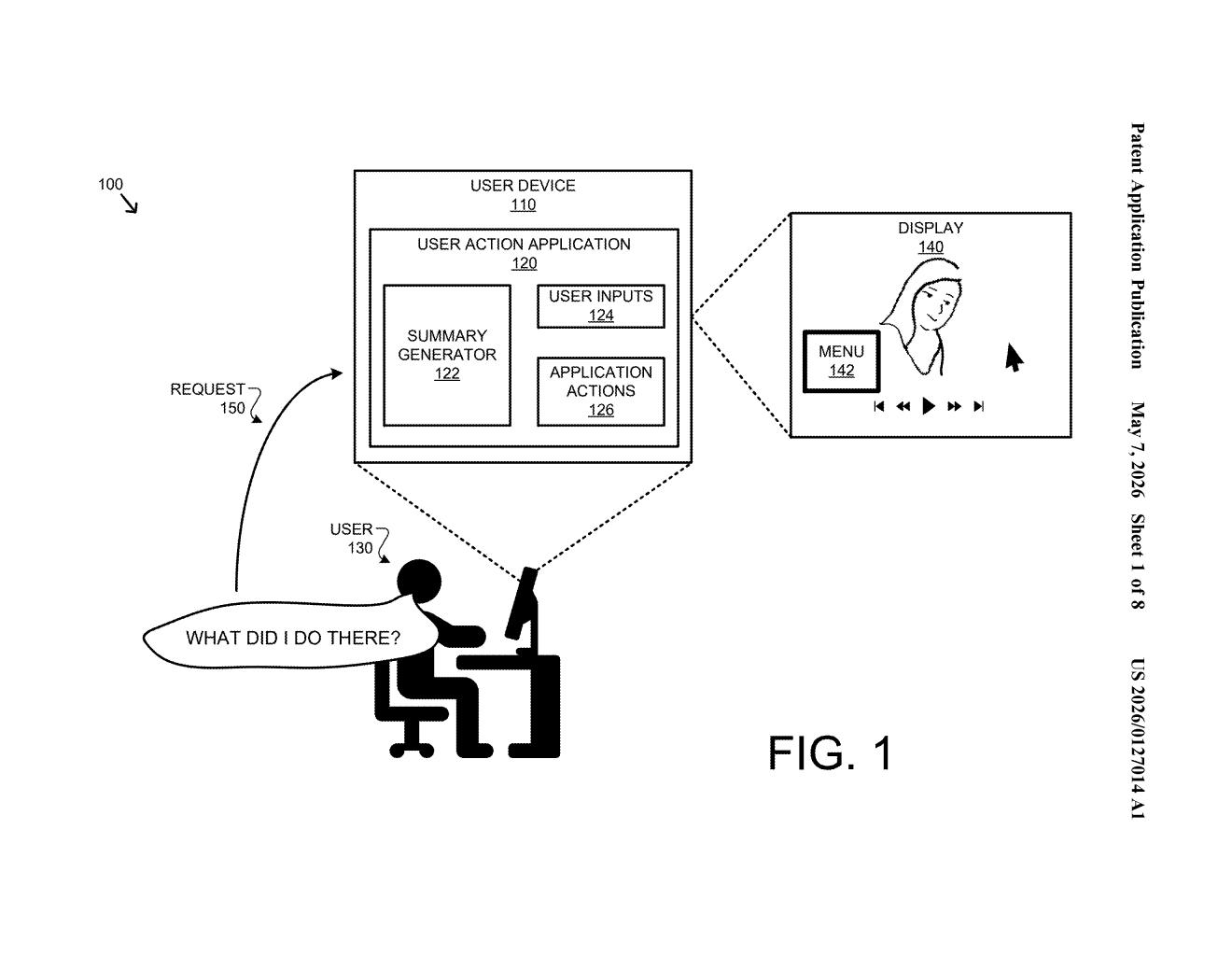
Once the action is identified, a Summary Generator component (shown explicitly in the patent's architecture diagram) produces a human-readable descriptor for that action. This descriptor is then returned as a direct response to the user's query.
The patent's diagram labels key components as:
- User Inputs — the raw input events captured from the user
- Application Actions — the resulting state changes those inputs caused
- Summary Generator — the module that translates actions into explanations
The example query shown in the patent diagram is literally: 'What did I do there?' — which gives you a strong sense of the conversational, low-friction UX Google is aiming for. The claim language is intentionally broad, covering any type of input and any type of action, which means this could apply across touch, mouse, keyboard, stylus, or even voice-driven interactions.
Why accidental inputs are a bigger problem than you'd think
Accidental inputs are a real usability problem, especially on touchscreens where fat-finger errors are constant. Today, your options are usually: hit undo and hope for the best, dig through a history panel if one exists, or just live with the confusion. A system that explains what happened before you decide to reverse it is a genuinely useful addition to any OS-level toolkit.
For Google, this fits naturally into Android or ChromeOS as an accessibility and general UX feature. It's particularly relevant for users with motor control differences who may trigger unintentional inputs more frequently — giving the device the ability to narrate its own recent actions could meaningfully reduce frustration across a wide range of users.
This is a small, practical patent that solves a real and underappreciated problem. It's not flashy AI infrastructure work — it's the kind of thoughtful UX plumbing that makes devices less maddening to use every day. The broad claim language means Google could slot this into Android's accessibility stack, a Gemini assistant feature, or even Chrome, and it would fit naturally in any of those contexts.
There are more where this came from
We read every patent application Big Tech publishes and send you the ones worth knowing. Plain English, free, every week.
Want this weekly breakdown for a company we don't cover? Patentlyze Pro →