
Apple Patents Eye-Gaze Detection That Triggers Hot Corner Actions
Apple is patenting a way to trigger hot corner shortcuts just by looking at the corner of a screen — no mouse, no trackpad, no touch required. Your eyes do the clicking.
What Apple's gaze-triggered hot corners actually do
If you use a Mac, you probably know about hot corners — those invisible trigger zones in the corners of your screen that launch Mission Control, start a screensaver, or lock your display when you move your cursor there. Right now, triggering them requires deliberately flicking your mouse to a corner. Apple wants to make that happen with just your eyes.
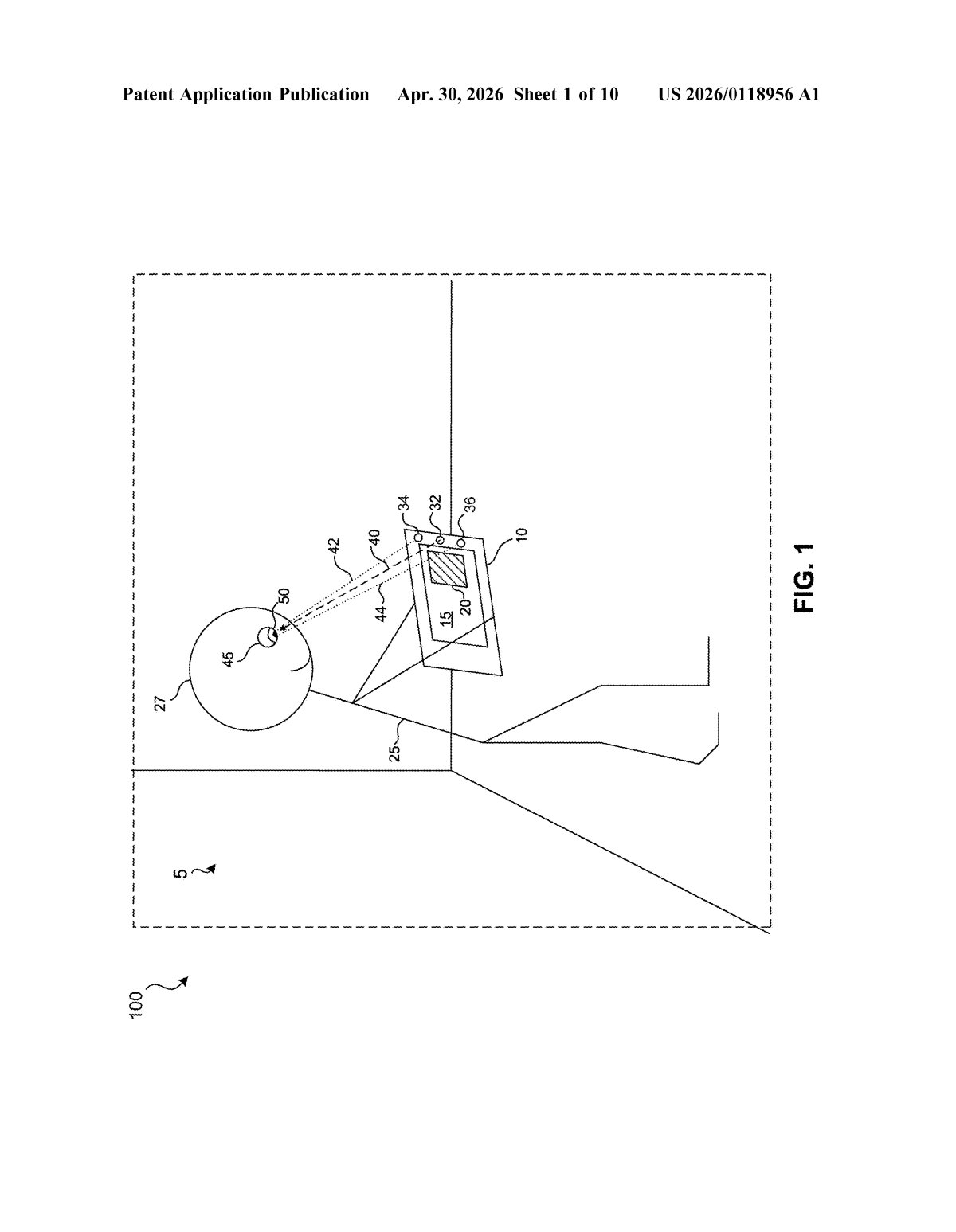
The patent describes a system where a small illuminator (think: an infrared LED) shines light at your eye, and a sensor reads back the reflection. Because the sensor is physically aligned with the direction from your eye to a specific corner of the screen, the quality and pattern of that reflection changes depending on whether you're looking at that corner or not. No complex camera-based face tracking needed — it's more like a targeted optical tripwire.
When the system detects your gaze has landed on a hot corner zone, it fires off whatever action you've assigned to it — just like moving a cursor there would. It's a surprisingly elegant, low-overhead approach to hands-free UI control.
How Apple's illuminator detects your gaze direction
The core trick here is using reflective properties of the eye — specifically how light bounces back differently depending on gaze angle — rather than building a full 3D eye-tracking model.
Here's the flow Apple lays out:
- An illuminator (likely infrared) shines light toward the user's eye.
- A sensor (likely a small IR camera or photodetector) is positioned so its optical axis roughly aligns with the line between the eye and a specific hot corner zone on the display.
- The system measures a reflective property of the returned light — such as a spectral property, meaning the color or intensity distribution of the reflection.
- When that reflective property matches the signature of the eye looking directly toward the hot corner zone, the system triggers the associated UI action.
This is notably different from full gaze-tracking systems (like the ones in Apple Vision Pro) that reconstruct exactly where you're looking in 3D space. Instead, Apple is using a binary alignment check — is the eye approximately pointed at this corner, or not? That's computationally lighter and potentially more reliable in low-power or always-on contexts.
The patent covers a generic "electronic device with a processor and a display," which is intentionally broad — this could apply to Macs, iPhones, iPads, or wearables.
What this means for hands-free Mac and Vision Pro control
Hot corners are a power-user staple on macOS, but they've always been a mouse-dependent feature. A gaze-based trigger could make them genuinely useful on devices where you're not using a cursor — think iPad, a future Mac with a built-in eye-tracking sensor, or even a heads-up display context. For users with motor disabilities, this could be a meaningful accessibility upgrade: a reliable, low-friction way to activate system shortcuts without any physical input.
The optical alignment approach is also interesting from an engineering standpoint. Rather than running a power-hungry neural network to track gaze continuously, Apple's method could be implemented with minimal hardware — a few strategically placed IR emitters and sensors. That fits well with always-on or low-power use cases, and it sidesteps a lot of the privacy concerns that come with persistent camera-based eye tracking.
This is a genuinely clever bit of engineering — using physical sensor alignment as a shortcut to avoid full gaze-tracking complexity. It's not the most glamorous patent Apple has ever filed, but it solves a real problem (cursor-free UI shortcuts) in a lean, practical way. If this ships in a future MacBook or iPad with embedded IR sensors, it could quietly become one of those features power users immediately love.
There are more where this came from
We read every patent application Big Tech publishes and send you the ones worth knowing. Plain English, free, every week.
Want this weekly breakdown for a company we don't cover? Patentlyze Pro →