
Nvidia Patents a Way to Stream Full-Resolution Video at a Quarter of the Data
Nvidia is patenting a technique that compresses a video frame down to one-quarter its original size before sending it over a network, then uses AI on the receiving end to rebuild the full picture. The goal is better video quality at lower bandwidth costs.
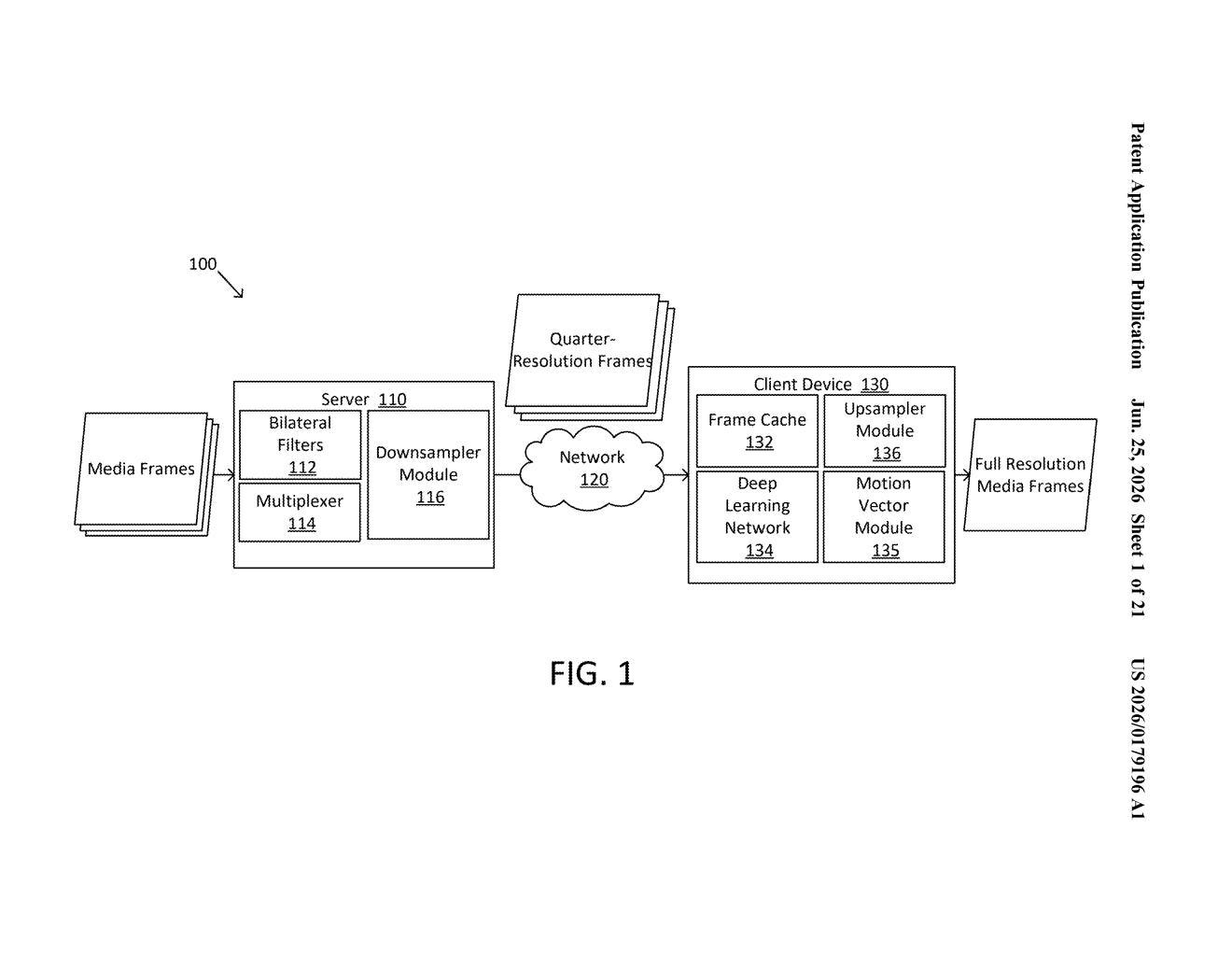
How Nvidia shrinks and rebuilds streamed video frames
Imagine you're streaming a game or movie over the internet. The server has to send a lot of image data very quickly, and if your connection isn't perfect, you get blur, stuttering, or dropped quality. Nvidia's patent describes a way to dramatically reduce how much data needs to travel across that connection in the first place.
Instead of sending a full image, the server selects just one pixel out of every four, in a rotating pattern across the frame, and sends only those. That's one-quarter of the original data. Before doing this, it also applies special filters to parts of the image that are moving, to avoid ugly motion artifacts. The result is a much smaller file to transmit.
On your end, the device receives these stripped-down frames and uses an AI model to intelligently fill in the missing three-quarters of the picture, reconstructing something that looks like the full-resolution original. It's a compression trick where the heavy lifting shifts from the network to an on-device AI.
Inside Nvidia's cyclic pixel selection and AI reconstruction
The system works in two distinct phases: a server-side encoding step and a client-side reconstruction step.
On the server, the pipeline has three main jobs:
- Motion-aware filtering: Before any compression happens, the system applies multiple filters to the video frame. Pixels that belong to fast-moving objects get a blur treatment to reduce the visual noise that would otherwise appear after compression. Pixels in still areas are left sharper.
- Multiplexing: The filtered outputs are merged into a single combined frame via a multiplexer (essentially a combining switch that merges multiple signals into one stream).
- Cyclic downsampling: The combined frame is divided into a grid of 2x2 pixel blocks. From each block, the system picks just one pixel in a rotating (cyclic) pattern. The result is a quarter-resolution frame, roughly 75% smaller than the original.
The quarter-resolution frames are transmitted to the client. On the receiving end, a deep learning reconstruction model (a trained neural network) takes the sparse pixel data and infers what the missing pixels should look like, producing a full-resolution output. The patent does not specify a particular neural architecture, leaving that open.
What this means for cloud gaming and video streaming
Bandwidth is the persistent bottleneck in cloud gaming and remote desktop services. Services like Nvidia's own GeForce NOW have to balance image quality against the amount of data they push per second. A technique that cuts the raw data payload to one-quarter before it even hits the network encoder could meaningfully reduce costs and improve quality on constrained connections.
The AI reconstruction piece is what separates this from older downsampling tricks. Traditional approaches (like simple bilinear scaling) smear and blur when upscaling aggressively. A trained model can use learned patterns about what video frames typically look like to make much better guesses about the missing pixels. For Nvidia, which already ships AI upscaling in its DLSS technology for local gaming, applying similar logic to the streaming pipeline is a natural extension.
This is a real engineering bet, not a speculative moonshot. Nvidia already has production AI upscaling (DLSS) and a cloud gaming service (GeForce NOW), so the pieces to actually ship this exist. The cyclic downsampling approach is clever because it preserves spatial coverage across the frame rather than just scaling the whole image down, which gives the reconstruction model more to work with. Whether it outperforms existing video codecs in practice is the question, but the underlying idea is sound and commercially motivated.
There are more where this came from
We read every patent application Big Tech publishes and send you the ones worth knowing. Plain English, free, every week.
Want this weekly breakdown for a company we don't cover? Patentlyze Pro →