
Nvidia Patents Reusable Shortcuts That Speed Up How 3D Scenes Are Lit
Building a 3D scene in real time is expensive work, and a big chunk of that cost comes from organizing geometry before a single pixel is drawn. Nvidia's new patent proposes a way to skip much of that prep by reusing pre-baked shortcuts tied to common triangle patterns.
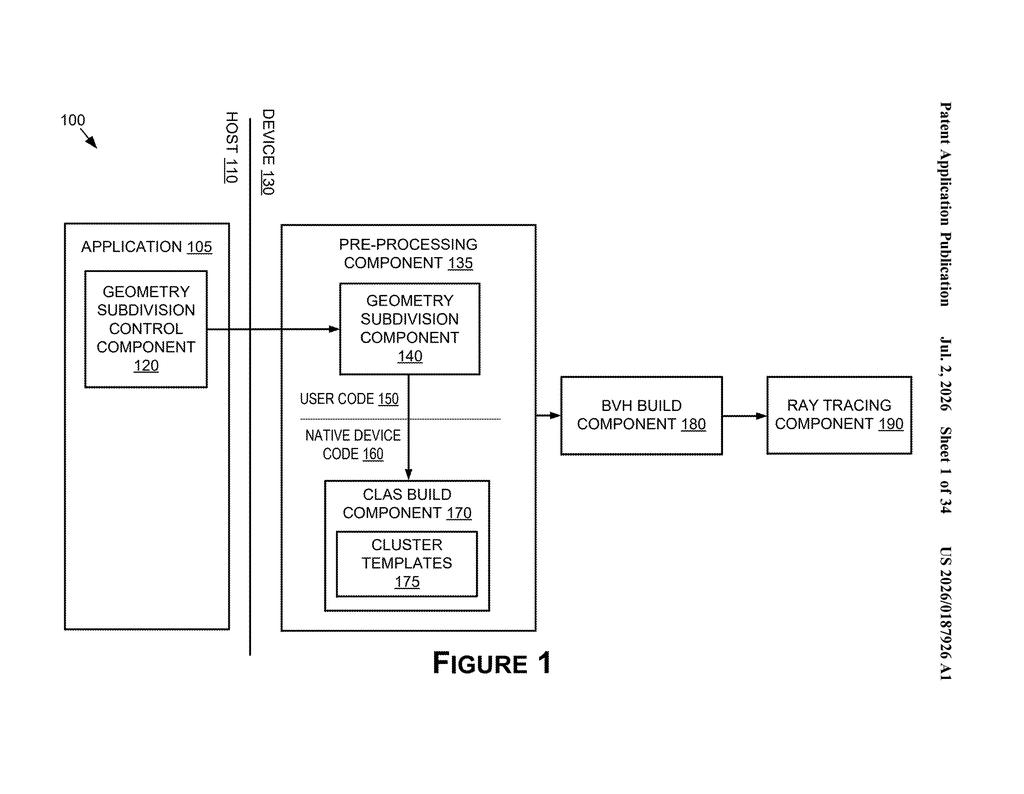
How Nvidia's triangle-cluster shortcut speeds up 3D scenes
Imagine a video game engine that has to figure out, sixty times a second, exactly where every triangle in a scene sits so it can calculate which ones a ray of light will hit. Right now, the GPU rebuilds much of that spatial map from scratch every frame, which takes time and power.
Nvidia's patent describes a system where common triangle arrangements, think curved surfaces or repeated geometry like tiles or leaves, are recognized in advance and given a pre-built "shortcut" structure. When the GPU encounters that pattern during rendering, it grabs the ready-made shortcut instead of computing one on the fly.
The application running on your CPU asks the GPU driver: "do you support this triangle pattern?" The driver hands back an identifier and a memory size. The CPU allocates the memory, points the GPU at the actual vertex positions, and the GPU snaps the precomputed template into place. Less work per frame, same visual result.
How the GPU builds BVH subtrees from cluster templates
The patent centers on bounding volume hierarchy (BVH) trees, the spatial index structures that ray-tracing hardware uses to quickly figure out which triangles a light ray might intersect. Building those trees is a significant per-frame cost, especially for dynamic or tessellated geometry (surfaces the GPU subdivides into finer triangles at render time).
Nvidia's approach introduces cluster templates: precomputed BVH subtrees tied to a recognized pattern of triangles. The workflow is driven through an API (the programming interface between application code and the GPU driver):
- The application issues a first API call naming a triangle pattern it wants to use.
- The driver returns a template identifier and the memory footprint needed.
- The application allocates that memory and issues a second API call with the actual vertex positions and the template ID.
- The GPU fills in the template with the real coordinates and slots the resulting BVH subtree into the larger scene hierarchy.
This matters most for tessellated clusters, where a patch of geometry is split into many small triangles by a fixed, predictable pattern. Because the connectivity is known ahead of time, the BVH topology can be precomputed once and reused, with only the vertex positions changing each frame.
What this means for real-time ray tracing and game graphics
Ray tracing is the rendering technique behind the photorealistic lighting in modern games and film previsualization tools, but it is computationally heavy. A significant bottleneck is the time the GPU spends (re)building its spatial index every frame when geometry moves or is subdivided. This patent targets exactly that bottleneck.
For game developers, a driver-level system like this could mean more complex tessellated scenes without sacrificing frame rate. For Nvidia, it deepens the tight coupling between its hardware and software stack, the kind of capability that could ship as part of a future RTX or GeForce feature set and require developers to opt in through an updated API.
This is practical GPU engineering, not a flashy concept. BVH build time is a real and well-documented bottleneck in ray-traced games, and a template-based approach is a sensible way to attack it. The API design described here also suggests Nvidia is thinking about this as a developer-facing feature, not just a driver-internal optimization, which makes it more likely to actually ship in some form.
Get our take in your Top Stories
Liked this breakdown? Add Patentlyze as a preferred source on Google, and our plain-English take shows up more often in your Top Stories the next time Nvidia patent news breaks.
There are more where this came from
We read every patent application Big Tech publishes and send you the ones worth knowing. Plain English, free, every week.
Want this weekly breakdown for a company we don't cover? Patentlyze Pro →