
Meta Patents a Method for Sealing Flexible Circuits Through Smart Glasses Hinges
Every time you fold your smart glasses, the wiring inside bends with them. Meta's latest patent tackles exactly what happens to that wiring at the hinges, where repeated flexing is most likely to cause it to fail.
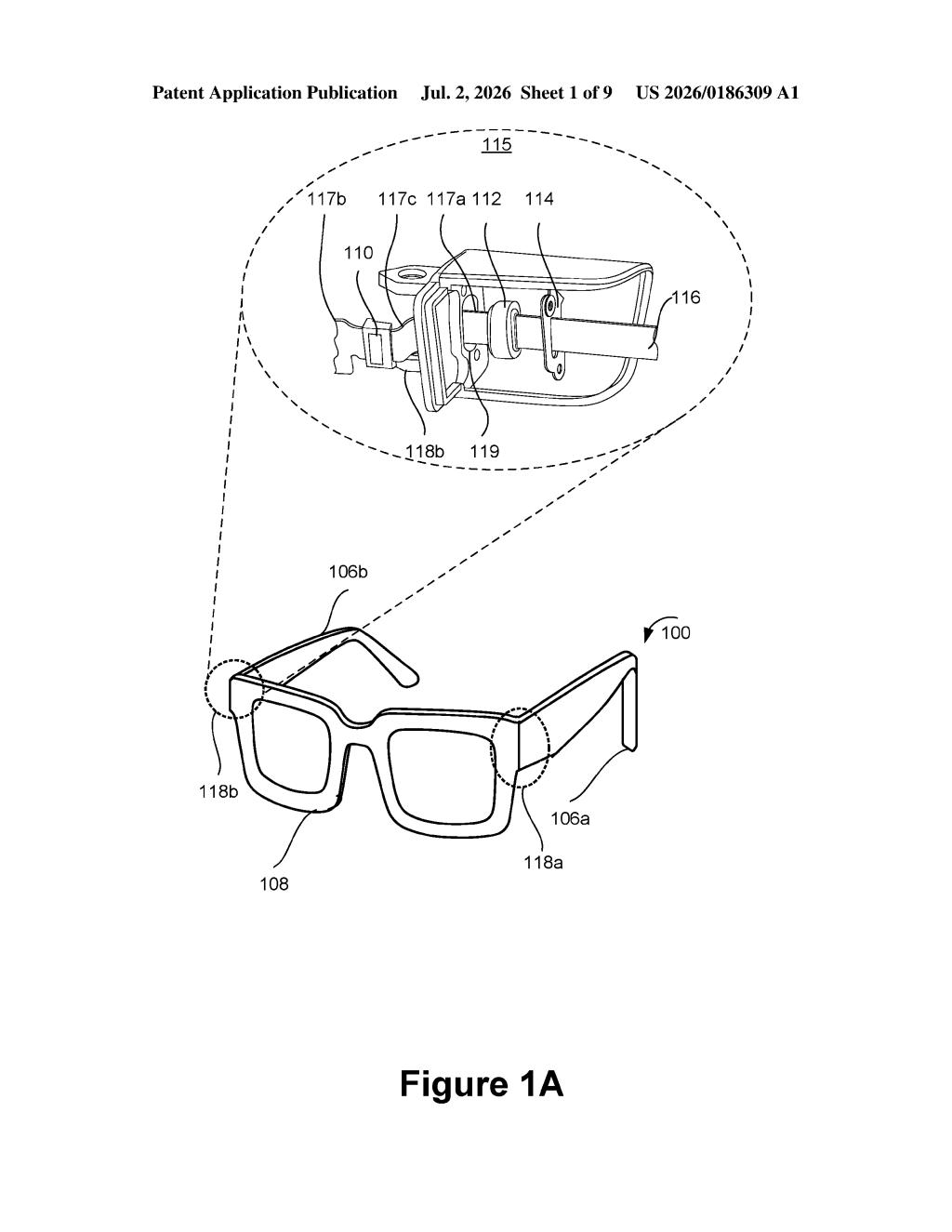
What Meta's overmolded circuit protection actually does
Imagine folding a pair of glasses thousands of times over a few years. The arms fold in, the camera and speakers still need power and instructions, and somewhere inside the frame a thin ribbon of wiring has to survive all of that bending without cracking or losing its connection.
That ribbon of wiring is called a flexible printed circuit, and it runs from the main frame all the way through both temple arms (the parts that rest on your ears) to reach the camera and speakers. The problem is that where the arms connect to the frame at the hinges, the wiring is under repeated stress every single time you open or close the glasses.
Meta's solution is to encase the wiring in a protective plastic shell at three key spots: once in the main frame, and once in each arm. Those encased sections keep the circuit from shifting, kinking, or pulling loose at the points where it crosses the hinge. It's a bit like adding strain-relief boots to a charging cable where it meets the plug.
How the overmolded FPC seals across three separate frame sections
The patent describes a flexible printed circuit (FPC), essentially a thin, bendable ribbon that carries electrical signals, running continuously from the front frame of the glasses through both hinges and into each temple arm to connect a camera and two speakers.
The core invention is the use of overmolded portions, sections where a rigid or semi-rigid plastic material is molded directly around the FPC at specific locations. Three of these molded anchors are specified:
- One inside the main front frame
- One inside the left temple arm
- One inside the right temple arm
Overmolding means the plastic is formed around the circuit after the circuit is already in place, locking it into position. This prevents the ribbon from sliding, bunching up, or pulling tight when the hinge opens and closes. Without it, repeated folding could stress the same spot on the circuit every time, eventually cracking the conductive traces inside.
The design lets a single continuous FPC carry signals to all three components (camera plus two speakers) rather than requiring separate wiring runs or connectors at each hinge, which would add bulk and potential failure points.
What this means for the longevity of Ray-Ban Meta glasses
Smart glasses have a durability problem that most people only discover after a year or two of daily use: the electronics inside are fragile, and hinges are the most mechanically stressed part of any glasses frame. A circuit that fails at a hinge means a camera that stops working or speakers that cut out, and that kind of failure is expensive to repair in a sealed consumer device.
For Meta, which already sells the Ray-Ban Meta smart glasses with a camera and open-ear audio, this kind of manufacturing detail is directly relevant to the product's real-world lifespan. A more durable internal wiring design could reduce warranty claims and make future versions more reliable without necessarily making them thicker or heavier.
This is unsexy but genuinely useful engineering. Hinge durability is one of the most common failure modes in wearables with moving parts, and solving it at the circuit level rather than just making the hinge itself sturdier is the right approach. It won't make headlines on launch day, but it's exactly the kind of detail that determines whether smart glasses last two years or five.
Get our take in your Top Stories
Liked this breakdown? Add Patentlyze as a preferred source on Google, and our plain-English take shows up more often in your Top Stories the next time Meta patent news breaks.
There are more where this came from
We read every patent application Big Tech publishes and send you the ones worth knowing. Plain English, free, every week.
Want this weekly breakdown for a company we don't cover? Patentlyze Pro →