
Adobe Patents a System That Catches When Co-Editors Fall Out of Sync
When two designers edit the same file at the same time, how does anyone know they're actually looking at the same thing? Adobe has a patent for a way to answer that question automatically.
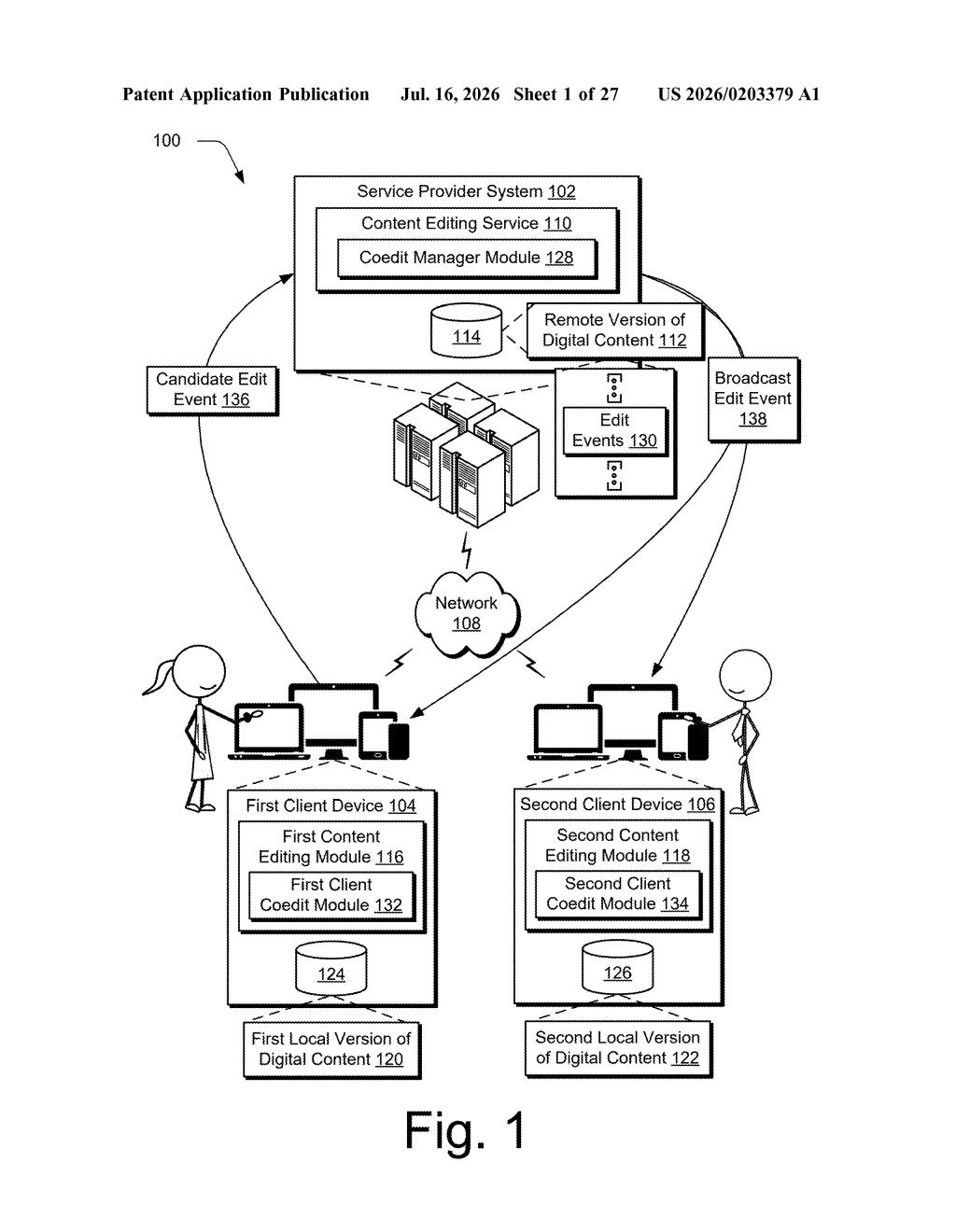
What Adobe's co-editing sync check actually does
Imagine you and a colleague are both editing the same Adobe document at the same time. You make a change, your colleague makes a change, and everything looks fine on both screens. But behind the scenes, a network hiccup or a timing glitch could mean the two versions have drifted apart without either of you noticing.
Adobe's patent describes a system that creates a short, unique "fingerprint" every time someone makes a change to a shared document. That fingerprint is sent to all the other devices in the session. Each device can check its own copy of the document against the fingerprint to confirm it matches. If it doesn't, the system knows something is out of sync and can fix it.
Think of it like a checksum on a downloaded file. You don't read the whole file to confirm it arrived correctly. You just compare a short code. Adobe is applying the same idea to live, multi-person document editing inside tools like Photoshop or Illustrator.
How Adobe generates and broadcasts the fingerprint
The system watches a shared document for any change, which Adobe calls a "change in state." When a change is detected, it identifies exactly which parts (elements) of the document were affected.
It then runs those elements through two steps:
- Serialization (converting the affected elements into a standardized text or data string, so the content can be compared apples-to-apples regardless of which device is doing the comparing)
- Hashing (running that string through a mathematical function that produces a short, fixed-length code, the "fingerprint," that uniquely represents the content at that moment)
The fingerprint is then broadcast to every client device in the co-editing session. Each device compares the received fingerprint against a fingerprint it generates from its own local copy of the same elements. If the two codes match, the device knows it is in sync. If they don't match, the device knows its local version differs and can request a correction.
The key technical advantage here is efficiency: instead of sending entire sections of a large design file across the network for comparison, the system sends only a small fingerprint code. The heavy lifting (hashing and comparison) happens locally on each device.
What this means for real-time creative collaboration
Real-time collaboration tools live or die on trust. If you and a colleague are editing the same Photoshop or Illustrator file and your screens show different things without warning, the consequences range from annoying (wasted work) to serious (publishing the wrong version of an asset). This patent targets exactly that failure mode, giving the software a way to prove consistency rather than just assume it.
For Adobe, this kind of infrastructure work supports its push to make Creative Cloud products viable for teams working simultaneously on the same files, a capability Google Docs users take for granted but that is much harder to pull off with complex, layered design files. A reliable sync-check layer is the kind of unglamorous plumbing that makes that experience feel solid.
This is infrastructure work, not a flashy feature, but it is the right kind of infrastructure work. Real-time co-editing in professional design tools is one of the places where Adobe still lags behind browser-native tools, and a robust consistency-check mechanism is a real prerequisite for closing that gap. It won't ship as a bullet point on a feature list, but users will notice when it's working because nothing will break.
There are more where this came from
We read every patent application Big Tech publishes and send you the ones worth knowing. Plain English, free, every week.
Want this weekly breakdown for a company we don't cover? Patentlyze Pro →
Be the first to weigh in