
Microsoft Patent Enables Interactive 3D Objects to Be Embedded Inside Ordinary Videos
Imagine watching a product video and being able to spin the item around yourself, without leaving the video player. Microsoft's new patent describes exactly that kind of experience, baked directly into a video file.
What Microsoft's interactive video format actually does
Right now, video is a one-way street. You watch, you can't touch. If a company posts a video showing off a new gadget, you see whatever angle the camera person chose, and that's it. Microsoft's patent describes a new kind of video format where a 3D object can be dropped right into a video, and viewers can rotate, zoom, or otherwise interact with it while the rest of the video plays normally behind it.
The person making the video gets a settings panel where they decide exactly what viewers are allowed to do with that embedded object. The viewer then sees those controls and can adjust the 3D element to their liking.
One genuinely useful detail: the 3D content can be stored as a reference link rather than hard-coded into the file. That means if the product changes, the price updates, or a mistake was made, the creator can fix the information without having to re-upload an entirely new video. The original video file stays the same; only the linked content gets refreshed.
How the 3D object and video data are stored together
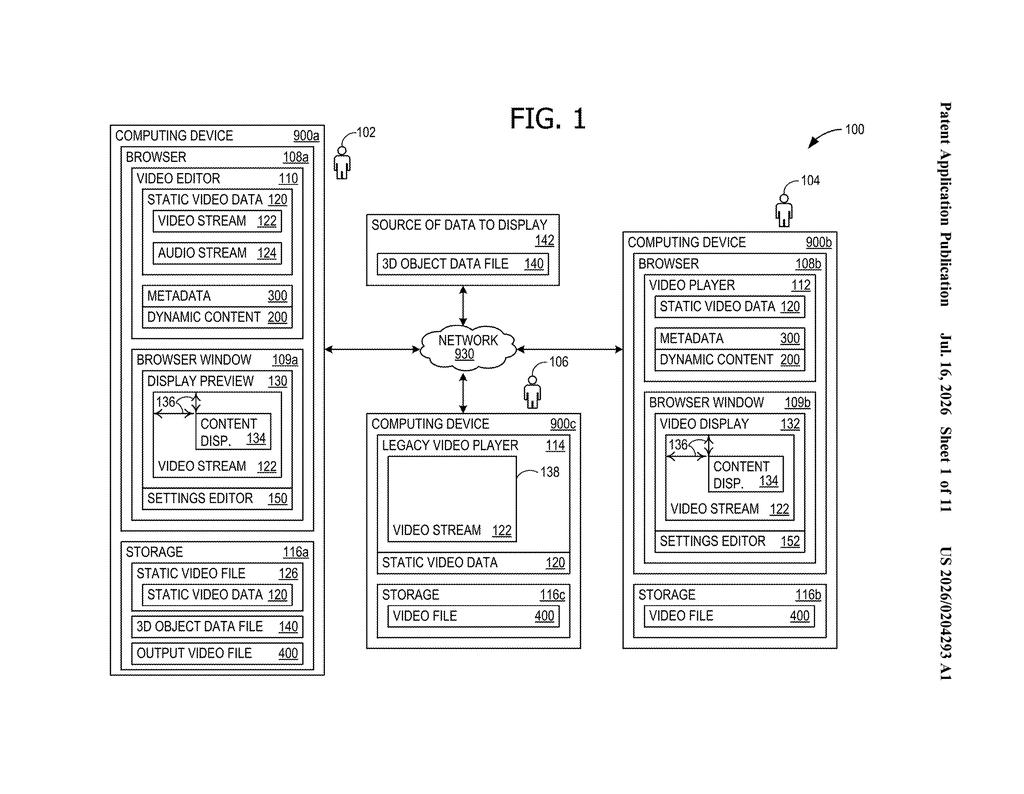
The patent describes a video editing and playback system with two main pieces: an editor and a viewer.
On the editor side, a creator builds a video timeline the usual way, then adds what the patent calls dynamic content, specifically a 3D object, alongside the regular (static) video footage. A settings editor lets the creator configure how the 3D object behaves, including whether viewers can interact with it (rotate it, zoom in, change its appearance) or whether it simply plays as a fixed overlay.
On the viewer side, the video player reads the stored metadata and renders both the background video and the interactive 3D layer. Viewers see controls tied to whatever permissions the creator set. The patent is explicit that this interactivity is configurable, so creators could allow full manipulation or lock it to a single perspective.
- The output video file packages static footage, timeline metadata, the 3D object itself, and the display/interaction settings all together.
- The 3D content can be stored as a URL reference rather than embedded directly, allowing updates to the object without replacing the video file.
- Errors introduced during production (wrong specs, outdated info) can be corrected after the fact by updating the referenced content.
What this means for product videos and online publishing
For anyone selling or explaining physical products online, this kind of format closes a real gap. A furniture retailer, a car manufacturer, or a hardware company could release a single video that lets viewers inspect an object from any angle, something that currently requires either a separate 3D viewer tool or multiple camera cuts. The interactivity lives inside the video rather than requiring a separate app or web experience.
The live-update angle is practical for publishers and marketers. Product specs change, prices shift, and mistakes happen. Today, fixing a detail in a published video means re-editing and re-distributing the whole file. With this system, the linked 3D content can be corrected server-side, and every existing share of the video automatically shows the updated version. That's a meaningful change for anyone managing video at scale.
This is a genuinely interesting format idea, particularly the live-update-via-reference approach, which solves a real and annoying problem for video publishers. The interactive 3D piece is flashier but depends entirely on whether Microsoft can get this format adopted in actual video players, which is the hard part that no patent can guarantee.
There are more where this came from
We read every patent application Big Tech publishes and send you the ones worth knowing. Plain English, free, every week.
Want this weekly breakdown for a company we don't cover? Patentlyze Pro →
Be the first to weigh in