
Samsung Patents a Dual-Camera Eye System That Moves Like Human Eyes for Robots
Human eyes do three things simultaneously: they pan left and right, tilt up and down, and converge toward objects at different distances. Samsung's new patent tries to give robots exactly that, all driven by a single mechanical shaft.
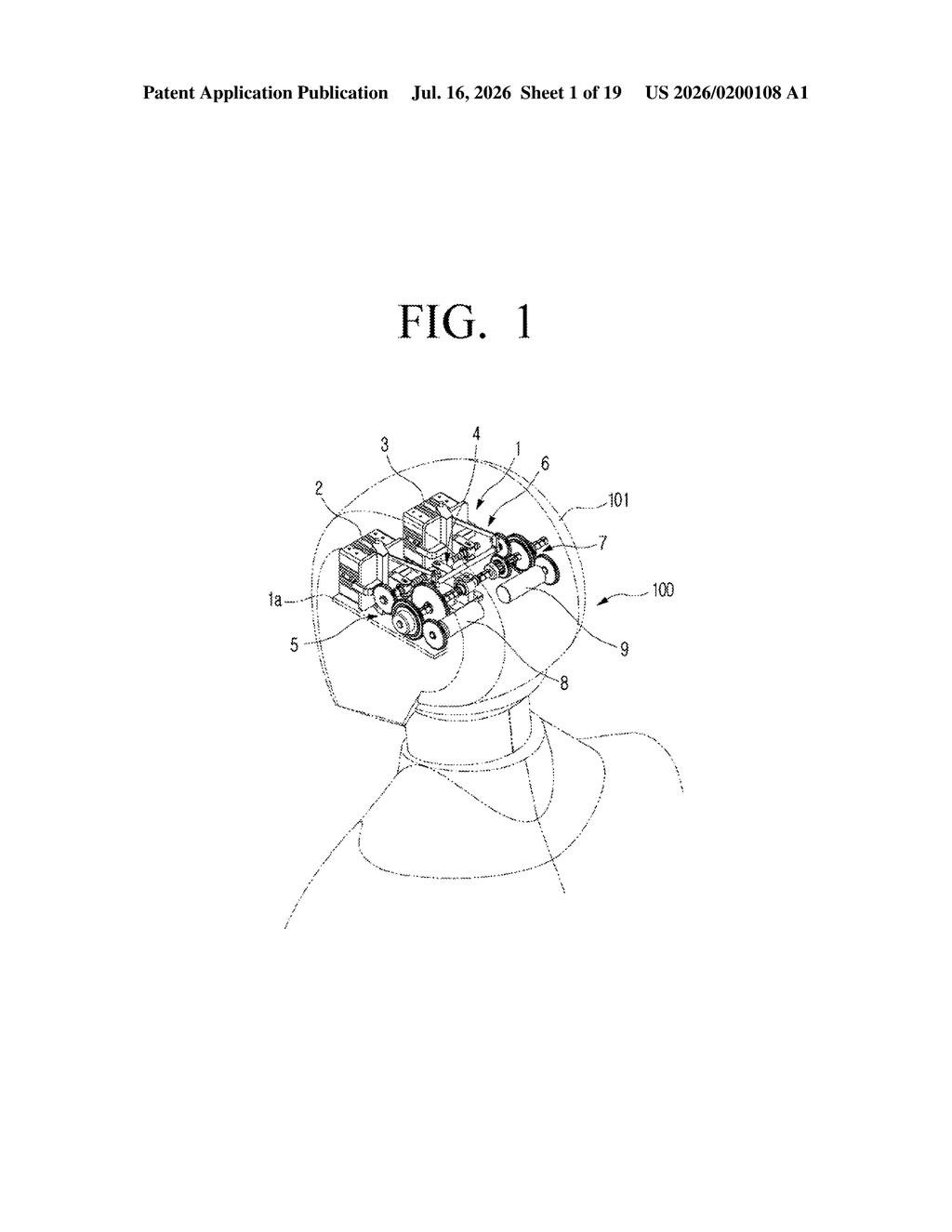
What Samsung's robotic eye mechanism actually does
Imagine watching someone's eyes as they follow a ball across a room. Both eyes move together, swiveling side to side, tilting up or down, and pointing slightly inward to focus on close objects. That coordinated motion is something our brains handle effortlessly, but building it into a robot is a serious mechanical puzzle.
Samsung's patent describes a two-camera system, essentially a pair of robot eyes, where both cameras move in sync via a single central shaft. That one shaft can slide forward and back, spin in place, or do a corkscrew motion, and each type of movement controls a different kind of eye motion. Sliding tilts the eyes left or right. The corkscrew tilts them up or down. Spinning adjusts how much the two eyes angle toward each other, which is how depth focus works.
The result is a compact unit, driven by just two motors, that can replicate the full range of coordinated human-like eye movement. For a robot trying to track a person's face or navigate a cluttered room, that kind of visual flexibility could matter a lot.
How one shared shaft controls three types of eye movement
The core of Samsung's design is a motion generating device built around a single main shaft. That shaft is the mechanical heart of the system: depending on how the two motors drive it, the shaft can perform three distinct motions, each triggering a different eye behavior.
- Linear movement (the shaft slides parallel to the base): this activates the left-and-right tilting mechanism, panning both cameras together horizontally, the way you turn your head to look sideways.
- Helical movement (a combined rotation and linear push, like a corkscrew): this drives the up-and-down tilting mechanism, angling both cameras upward or downward relative to the base.
- Pure rotation (the shaft spins in place): this controls the focus adjusting mechanism, changing the angle between the two cameras so they converge on near or far objects, mimicking how human eyes cross slightly when looking at something close.
All three behaviors are coordinated through just two motors and one shaft, which keeps the mechanical complexity low while achieving a wide range of motion. The left and right cameras are mounted on the upper side of a shared base, so both always move together as a unit rather than independently.
What this means for Samsung's humanoid robot ambitions
For robots meant to interact with people, realistic and functional eye movement is not a cosmetic feature. Eyes that track a person naturally, that converge when focusing on a nearby object, make interactions feel far less unsettling. More practically, depth perception in robots depends on both cameras pointing at the same object, and keeping that focal angle correct as the robot moves is exactly what this mechanism is designed to do.
Samsung has been building out its humanoid and service robot efforts, and a compact eye mechanism that mimics human gaze with minimal motor count is the kind of foundational engineering those platforms need. If this shows up in a Samsung robot, it would likely sit behind a face-like exterior, doing the mechanical work that makes the robot feel like it's actually looking at you.
This is not a flashy AI patent, it is a mechanical engineering solution to a real and underappreciated problem in robotics. Getting two cameras to move in coordinated, human-like ways without a tangle of motors and linkages is genuinely hard, and Samsung's single-shaft approach is a clean piece of design. Worth watching as humanoid robots move from lab demos to actual products.
There are more where this came from
We read every patent application Big Tech publishes and send you the ones worth knowing. Plain English, free, every week.
Want this weekly breakdown for a company we don't cover? Patentlyze Pro →