
Qualcomm Patents a Way to Stream Only the Avatar Parts an AR Call Actually Needs
Sending a full 3D avatar over a live call is expensive on bandwidth. Qualcomm's new patent describes a system that figures out which pieces of your avatar are actually needed in a given moment and requests only those.
What Qualcomm's partial avatar streaming actually does
Imagine joining a video call where, instead of your face on camera, you show up as a 3D animated character. That character might have a detailed outfit, accessories, facial expressions, and more. Sending all of that data every time someone joins a call would be slow and wasteful, especially on a phone.
Qualcomm's patent describes a smarter approach: your avatar is broken into individual pieces (called assets), and the system only fetches the specific pieces that are relevant for a given session. It uses a kind of digital permission slip (an "access token") to request just those parts from a central library of avatar components.
The end result is that your animated character still shows up correctly in the augmented reality call, but your device isn't hauling around data it doesn't need. Think of it like streaming only the chapters of a book you're actually reading, rather than downloading the whole thing upfront.
How the ARF manifest and access token system works
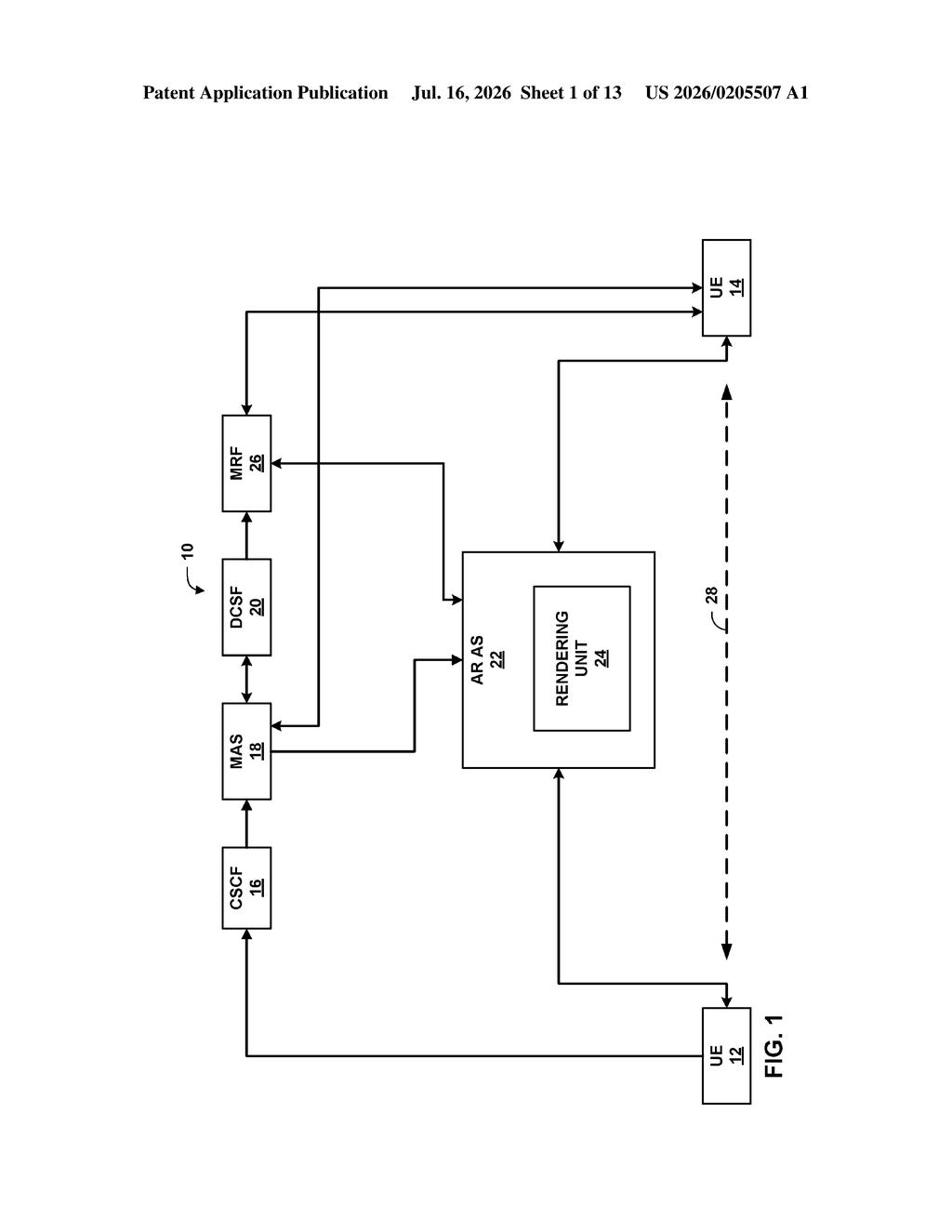
The patent describes a device that participates in an augmented reality (AR) communication session using animated avatars. Instead of transferring a complete avatar package, the system uses a structured file format called an Avatar Representation Format (ARF) manifest, which acts like a table of contents listing all available avatar components.
Along with that manifest comes an access token, a kind of digital key that proves the device is authorized to retrieve avatar assets from a central container. The device then receives information about which specific assets (clothing, accessories, facial features, etc.) are selected for the current session, and sends a targeted request for only those pieces, attaching the access token.
Once the selected assets arrive, the system also receives a live animation stream (data describing how the avatar should move and react in real time) and uses it to animate the avatar during the call.
- ARF manifest: the catalog of all possible avatar parts
- Access token: the authorization key tied to the full asset library
- Selected assets: only the subset needed for this session
- Animation stream: real-time movement and expression data applied on top
What this means for AR video calls and bandwidth
AR video calls with photorealistic or stylized avatars require transmitting a lot of 3D data. On mobile networks, sending an entire avatar library for every session is impractical. By requesting only the assets a session actually uses, this approach reduces the data load without sacrificing the visual result on the other end. For Qualcomm, whose chips power the majority of Android phones and many AR headsets, building this kind of efficient streaming into the hardware and software stack is a natural fit.
If AR communication becomes a mainstream alternative to traditional video calls (think Apple Vision Pro-style calls or Meta's avatar chat features), the underlying plumbing for how avatar data moves around matters a lot. A patent like this one is Qualcomm staking out intellectual territory in that infrastructure layer early.
This is infrastructure-level patent work, not a flashy consumer feature. But it's the kind of thing that becomes genuinely important if AR calls go mainstream. Qualcomm is methodically claiming the low-level data-delivery mechanisms that any platform doing live 3D avatars would eventually need. Worth watching as a signal of where the company thinks AR communication is headed.
There are more where this came from
We read every patent application Big Tech publishes and send you the ones worth knowing. Plain English, free, every week.
Want this weekly breakdown for a company we don't cover? Patentlyze Pro →
Be the first to weigh in