
Google Patents a System That Keeps Headset Cameras Accurately Pointed at Your Eyes
Before a pair of AR glasses can track your eyes, every camera inside has to know exactly where it sits relative to every other camera. Google's new patent describes the factory process for getting that right.
What Google's headset camera calibration actually does
Imagine putting on a pair of AR glasses and the eye-tracking feels slightly off -- like the cursor on a screen that's a little too high. That mismatch usually comes from tiny manufacturing errors in where the cameras end up sitting inside the headset, even a fraction of a millimeter off from where the software thinks they are.
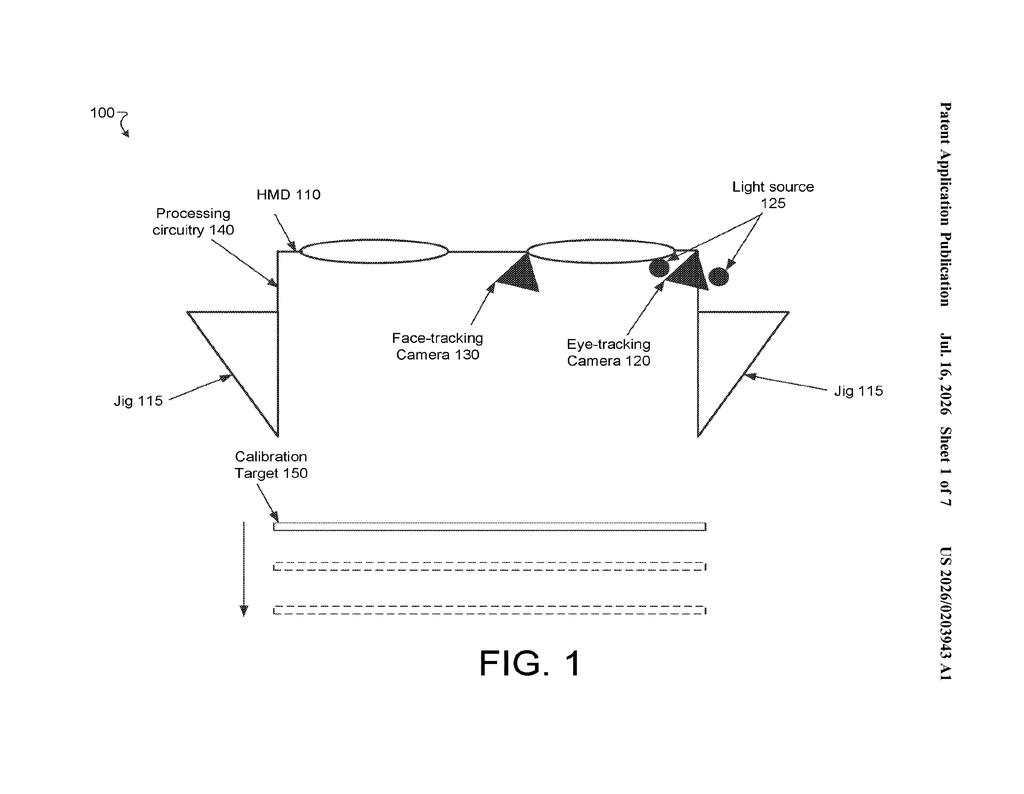
Google's patent describes a factory calibration rig designed to fix this before the headset ever ships. The headset is placed in a custom holder facing a panel of LEDs that can slide along a rail. By photographing that panel from multiple distances, the system figures out each camera's precise physical characteristics (how wide its field of view is, how much it distorts the image) and exactly where it sits in 3D space relative to the others.
Both the eye-tracking camera and the face-tracking camera are calibrated at the same time, in a single step. Then the small LEDs that shine infrared light into your eye -- the ones that help the camera know where you're looking -- get their own separate calibration pass. The result is a headset that knows, with high precision, where each sensor actually is.
How the LED panel and rail system calibrate the cameras
The patent covers a factory calibration method for head-mounted displays (HMDs) that have both an eye-tracking (ET) camera and a face-tracking (FT) camera pointing inward toward the wearer's face.
The calibration rig consists of two main parts: an LED panel mounted on a linear rail (so it can slide to different known distances) and a jig that holds the headset in a fixed orientation facing the panel. The cameras photograph the LED panel at multiple positions along the rail.
From those images, the system calculates two classes of measurements simultaneously:
- Camera intrinsics -- the internal optical properties of each camera, such as focal length and lens distortion (how much the image bends near the edges).
- Camera extrinsics -- the position and orientation of each camera relative to a shared reference point (the LED panel at its base position), which tells the software how all the cameras relate to each other in 3D space.
In a separate second step, the small infrared LEDs that ring the eye-tracking camera -- the ones that illuminate the eye so the camera can detect gaze direction -- are calibrated individually. The system determines where each LED sits relative to the ET camera itself, which is essential for accurate gaze estimation.
What this means for AR headset accuracy and comfort
Eye tracking in AR headsets is only as good as its calibration. If the software assumes a camera is 2mm to the left of where it actually ended up after assembly, gaze detection drifts, text feels hard to select, and foveated rendering (where the headset renders highest detail only where you're looking, to save processing power) falls apart. Precise factory calibration is what keeps those errors from compounding.
Google has been working on its own AR headset hardware, and a well-documented calibration pipeline is the kind of unglamorous infrastructure work that separates a polished shipping product from a research prototype. If this process ends up in a consumer device, you probably won't notice it -- which is exactly the point.
This is factory-floor engineering, not a flashy consumer feature, but it's the kind of careful groundwork that determines whether an AR headset's eye tracking feels precise or frustrating. The fact that Google is patenting a specific rig design suggests this calibration process is part of an active hardware development program, not just a research exercise.
There are more where this came from
We read every patent application Big Tech publishes and send you the ones worth knowing. Plain English, free, every week.
Want this weekly breakdown for a company we don't cover? Patentlyze Pro →
Be the first to weigh in