
AI Patent Teaches Robots to Learn Smoother, More Natural Movement
Imagine a theme park robot that can smoothly shift from waving at a child to dodging a stroller, all without pre-programmed instructions for every scenario. That's essentially what Disney is patenting here.
What Disney's multi-goal robot motion system actually does
Picture an animatronic character at a Disney park. Today, most of those characters follow carefully scripted routines. If something unexpected happens nearby, the robot can't adapt on the fly without a human operator stepping in.
Disney's new patent describes an AI system that controls how a jointed object (think: a robot arm, a character figure, or any mechanical creature with moving parts) decides what to do next. Instead of following a fixed script, the AI weighs a set of competing priorities and chooses a movement that satisfies as many of them as possible at once. Those priorities can even change from moment to moment, so the character can shift goals mid-motion.
The practical upshot: a robot that can be told "be expressive, but also stay safe, but also track that guest" and actually figure out how to do all three at once, rather than requiring engineers to hard-code every possible combination in advance.
How the model weighs rewards to pick each movement
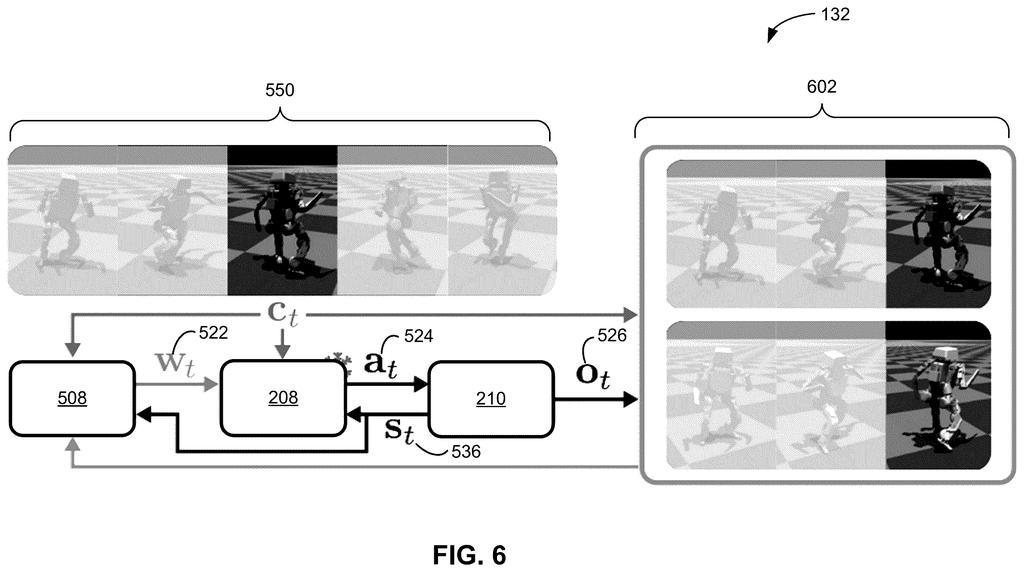
The patent describes a multi-objective reinforcement learning approach (a type of AI training where the system learns by trial and error, optimizing for several goals simultaneously rather than just one) for controlling an articulated object, meaning anything with joints and moving parts.
At each moment in time, the AI model takes in two things:
- The current physical state of the object (where every joint is, how it's moving)
- A set of weighted priorities (called reward weights) that tell the model how much to care about each goal right now
The model then outputs an action, a concrete instruction for how the object should move next. Crucially, those reward weights can change between time steps, so the AI isn't locked into a single objective. It can prioritize smooth motion one second and collision avoidance the next, adapting in real time.
This sidesteps a classic robotics problem: building separate controllers for every possible situation and then stitching them together. Instead, one model handles the full range of behaviors, with the weight values acting as a dial that shapes how it behaves at any given moment.
What this means for Disney's next-gen park characters
Disney operates some of the most complex animatronic characters in the world, and making them feel alive rather than mechanical is the whole point. A system that lets a single AI model adapt its behavior dynamically, without needing a new training run for every new situation, would cut development time and make characters far more responsive to real-world conditions.
Beyond theme parks, this approach applies to any jointed robot that needs to juggle competing demands, including warehouse arms, assistive devices, or entertainment robots in other contexts. For Disney specifically, the patent signals a push toward characters that feel genuinely interactive rather than just well-timed.
This is a genuinely interesting patent from an unexpected corner of the robotics world. Disney's R&D arm has published serious academic work on animatronic control for years, and this filing looks like a direct extension of that research pipeline into protected intellectual property. Whether it ships as a next-generation park character or becomes internal tooling, the underlying approach is solid and the application is obvious.
There are more where this came from
We read every patent application Big Tech publishes and send you the ones worth knowing. Plain English, free, every week.
The drawings
7 drawing sheets from US 2026/0212199 A1 · click any drawing to enlarge


Want this weekly breakdown for a company we don't cover? Patentlyze Pro →